Fontgombault (in operation), Bénavent, Saint-Gaultier, Ruffec – the number of micro-power projects on the Creuse River continues to grow

At the end of October, the investigating commissioner issued a favorable opinion on the project to authorize the Moulin de Bénavent hydroelectric power station, brushing aside the five opinions of environmental protection associations, experts in the field of water and rivers. They had demonstrated that the project did not meet the challenges of restoring ecological continuity and migratory fish on a river classified as a priority axis and biological reservoir by the SDAGE and the national biodiversity strategy. Despite all the existing literature on the impact of weirs and received ideas, we can still read in the conclusions of the report that the structure “will protect the homes of towns and villages located downstream from the mill”!

Read the report of Bénavent public enquiry (french)

Read our views on the projects Bénavent, Saint- Gaultier (french)

New cycle of Tuesday Webinars: REGISTRATION OPEN

Public debate – also via videoconferencing and webinars

Register and take part in our next webinars. Already 3 new dates.

Programme details and registration here (in french only)

  • 26 novembre 2024 de 16h à 18h : « Saumon Loire Allier : où en est-on ?

  • 3 décembre 2024 : Les aménagements urbains de protection contre les inondations de Brives-Charensac à l’épreuve!

  • 21 janvier 2025 : La pollution microplastique sur le bassin de la Loire.

ERN +180 ORGANISATIONS CALL THE EU COMMISSION TO PROVIDE GUARANTEES ON CLIMATE, NATURE AND PUBLIC HEALTH, ENSURING THE PROTECTION OF PEOPLE

Keep the Green Deal solid! Europe must not destroy its crowning achievement. It’s future-proofing jobs, prosperity and nature.

The Commission must keep up the momentum and implement smarter, not less. More than 180 NGOs agree!

There is no turning back. Society needs certainty and nature can’t wait!

#WeHadADeal

Brussels, 4 November 2024

The political direction set by President von der Leyen and the early parliamentary debates reveal a concerning shift: tackling the climate, biodiversity, and pollution crises is being deprioritised in favour of industry demands. With the Commissioners’ hearings approaching, the coming weeks will be critical for restoring the balance between the public good and corporate influence.

According to the new mission letters, all Commissioners must meet arbitrary ‘burden reduction’ targets and simplify legislation, posing the risk of delayed or weakened environmental action. It is not enough for this Commission to vaguely claim it will not deregulate environmental, public health and social standards. We demand clarity from President von der Leyen and her Commission on key issues:

  • No rollback of environmental, public health and social laws: President von der Leyen must make an unequivocal public commitment to uphold all existing environmental and climate EU laws and objectives, including those on sustainable finance and corporate accountability. We deplore the recent proposal by President von der Leyen to delay the application of the EU Deforestation Regulation and call on the European Parliament and all EU governments to reject the European Commission’s proposal.
  • Acknowledge the triple planetary crisis: Nature conservation and pollution reduction are quietly being sidelined in favour of a narrow focus on decarbonisation that fails to grasp the interconnectedness of the crisis. The urgent need to tackle pollution is now framed under a chemicals industry package aiming at simplifying the law, instead of better protecting citizens from harmful chemicals. All Commissioners must recognize that restoring and protecting nature, as well as reducing pollution, are integral parts of the solution to combat climate change. Addressing these challenges requires immediate, sustained action. Now is the time to accelerate, not retreat.
  • Support for Green Deal implementation: Businesses and stakeholders need legal certainty underpinned by a clear long term vision and effective regulations. The Commission must pledge to swiftly publish essential guidance documents for implementing newly adopted laws, and making digital safety information, permitting and digital reporting the norm – allowing tracking of progress and benchmarking of industry performance. Furthermore, the Commission should prioritise effective enforcement of environmental laws to ensure a level playing field, supported by necessary financial investments to bolster administrative capacities at all levels.
  • Balanced public participation: All public consultations must be carried in a way that ensures inclusivity of diverse views and avoids dominance by private influence over public interest [1]. In order to do so, particular attention must be paid to the voices of civil society organisations and their input must be routinely incorporated in upcoming dialogues and decision-making processes. Newly proposed mechanisms like ‘reality checks’ and ‘competitiveness checks’ should not be manipulated as tools for corporate lobbyists to hinder EU actions. The Commission must also resist using political ‘urgency’ as an excuse to bypass proper public scrutiny and adhere to its own Better Regulations guidelines to uphold transparency, consultations, and evidence-based decisions.
  • Collaboration across key policy areas: The Executive Vice-Presidents for Cohesion and Reforms, and for Clean, Just, and Competitive Transition, should be given clear guidance to collaborate effectively across key sectors—such as agriculture, transport, and fisheries—to ensure full alignment with green transition goals.
  • Firewalls between national interests and EU policy: Commissioners with previous ties to governments or political parties that opposed environmental regulations must be held accountable and rejected by the Parliament in case they are unable to dissociate themselves from earlier positions. Strong safeguards must be put in place to prevent conflicts of interest, for example in the application of forest and nature restoration rules.
  • Public money for proven climate solutions: The Commission must commit to allocate public funds solely to proven, cost-effective climate solutions. Unproven or expensive technologies should not receive the same level of financial and administrative support as established methods like nature-positive deployment of renewable energy, energy efficiency and nature-based solutions for climate adaptation. Economic activities that allow the EU’s zero-pollution and biodiversity objectives to materialise should be prioritised through public funding.

Despite carefully crafted mission letters, President von der Leyen has openly admitted that the focus has shifted away from climate action and the European Green Deal. In the EU Parliament, her own political group is pushing to weaken democratically adopted regulations on critical issues such as forest protection, greenhouse gas emissions from vehicles, and corporate accountability for human rights and environmental violations.

We call on President von der Leyen to address these critical gaps before the new European Commission assumes office, and we urge the European Parliament to raise these concerns during the upcoming Commissioner confirmation hearings.

Notes
[1] Recent reports show that fossil fuel lobbyists continue to benefit from an alarming level of access to the European Commission.


Download the list of signatories

Flood of 17 October 2024 in up part of the Loire

We were all impressed by this latest episode of flooding on the upstream Loire, which brought back a few memories.

Fortunately, once again, the arrangements at Brives-Charensac and the warning systems for major floods worked well.

The SOS Loire Vivante – ERN association is delighted to be behind this 4th solution.

In December, we will be organising a webinar on the subject of flood defences at Brives-Charensac, including an assessment. This will be an opportunity to find out more about the project.

In the meantime, for more information, you can read the brochure published in 2019 by the Ministry on the role of ecosystems in preventing natural hazards and page 11 dedicated to Brives-Charensac.

You can also read the article in L’Eveil about the flood of 17 October 2024.

The EEA report on the state of water bodies in Europe has just been published : Pollution, over-use and climate change threaten water resilience in Europe

Member States must urgently accelerate the implementation of the Water Framework Directive to improve the state of our waters.

Bruxelles, Belgique, 15 october 202, press release from Living Rivers Europe

A new report from the European Environment Agency (EEA) reveals that Europe’s water resources are under serious pressure, with no significant progress made since 2009*.

The report Europe’s state of water 2024: the need for improved water resilience underscores the urgent need for stricter implementation of the Water Framework Directive (WFD), significant changes to agricultural production, pollution reduction, and urgent ecosystem restoration.

Its main findings include:

  • Less than 40% of surface waters, such as rivers and lakes, are currently healthy.
  • Nearly 25% of groundwater bodies are not in good chemical status, even though they provide almost two-thirds of our drinking water.
  • The chemical status of rivers, lakes, and coastal waters has further deteriorated, with less than 30% meeting the pollution standards set by the WFD.
  • Harmful agricultural practices, particularly the intensive use of nutrients and pesticides, continue to be the most significant pressure on water. Diffuse pollution pressures from agriculture affect 32% of groundwaters and 29% of surface waters.
  • Chemical pollution from coal-fired plants, along with alterations to rivers due to dam construction and straightening, also exerts considerable pressure on surface waters.

Claire Baffert, Senior EU Policy Officer, Water & Climate Change Adaptation at WWF European Policy Office, said: “The persistently lousy state of Europe’s waters shows that Member States are failing to address the water crisis, year after year. The Water Framework Directive has been in place for over two decades, but its goals remain largely unmet because national governments do not take its requirements seriously. Unfortunately, as reflected in the Draghi report*, there are strong calls to weaken the directive’s standards to facilitate harmful projects, when what we truly need is to prioritise the protection of our water resources.”

Sara Johansson, Senior Policy Officer for Water Pollution Prevention at EEB, said “The EEA data shows that less than 30% of surface waters are in good chemical status. While these stats are alarming, they’re not even giving the full picture as it’s only assessed against a limited and outdated list of pollutants. New quality standards for water must be adopted with urgency so that monitoring and planning of measures can be included in the next River Basin Management Plans.”

Mark Owen, Director of the European Anglers Alliance, said: “This report not only highlights the crisis that we face with the state of EU waters but also the significant cost that citizens will face by continued inaction by member states. The report showcases the way forward with the example in Estonia restoring 3,300 KM of rivers by removing dams and river restoration, increasing biodiversity with improvements to 32 species. Similar actions are now required across the EU.”

Irene Duque, Freshwater Policy Officer at Wetlands International Europe, said: “Thank you, EEA! We have heard the message loud and clear: our water resilience is at risk. The path forward to meet EU targets and improve the health of European waters is equally clear: wetland restoration over maladaptation. Building dams and relying on more grey infrastructure continues to prove counterproductive, often worsening the problems it aims to solve. Wetland restoration remains a low priority on the EU’s agenda, but for those concerned about devastating floods, droughts, the decline of freshwater fish, or access to water as a human right, this is truly a no-brainer.”

Andras Krolopp, Head of Biodiversity Policy at The Nature Conservancy Europe, said: “The state of Europe’s waters is a wake up call for urgent action. As the EEA report shows, this is not only a European issue, but a global crisis. Restoring at least 25,000 km of rivers to their free-flowing state is not just an environmental necessity: it’s a commitment to biodiversity and our future. Europe has a global commitment under the Convention on Biological Diversity and the Nature Restoration Law to achieve this goal. We need to accelerate the implementation of the Water Framework Directive and prioritise water and ecosystem protection across all policies. The time to act is now, and delay is not an option.”

Europeans are increasingly paying the price for their government’s inaction on the water crisis. According to the latest Eurobarometer survey, 78% of Europeans want the EU to do more to address water pollution.

The Living Rivers Europe NGO coalition* urges Member States to accelerate the implementation of the WFD to improve Europe’s waters and integrate water and ecosystem protection across all policies.

Notes to editors:

*The deteriorating trend in the chemical status of surface waters and the overall lack of progress are partially linked to the fact that Member States are improving their monitoring practices, thereby identifying more pollutants than before.

*In its previous assessment from 2018, the EEA reported that “It can be expected that, by the time the third River Basin Management Plans are drafted (2019-2021), some of the several thousand individual measures undertaken in the first and second RBMPs should have had a positive effect in terms of achieving good status.” This has not been the case, showing that many Member States have failed to implement the planned measures.

*The Draghi report notes that the EU should consider other targeted updates to relevant EU Environmental legislation (i.e. the Environmental Impact Assessment Directive, the Birds, Habitats, Water Framework and potentially the SEA Directive) for renewable energy installations and grids. It considers including limited (in time and perimeter) exemptions in EU environmental directives (e.g.  the Habitats Directive and the Birds Directive) until climate neutrality is achieved. Exemption requirements need to be met under certain conditions (e g  installations do not endanger the population and mitigation measures).

*An illustration of insufficient WFD implementation can be found in the resurrection of infrastructure projects that damage biodiverse rivers, such as the Răstolița Hydropower Project in Romania, or the TURNU MĂGURELE –NIKOPOL hydraulic structure project on the Danube.

*Living Rivers Europe is a coalition of organisations advocating for the defence, maintenance and implementation of the WFD in its current form. The coalition includes the European Anglers Alliance, the European Environmental Bureau, the European Rivers Network, The Nature Conservancy, Wetlands International, and WWF, representing a movement of over 40 million European citizens. See the Living Rivers Europe’s handbook for the 2024-2029 mandate.
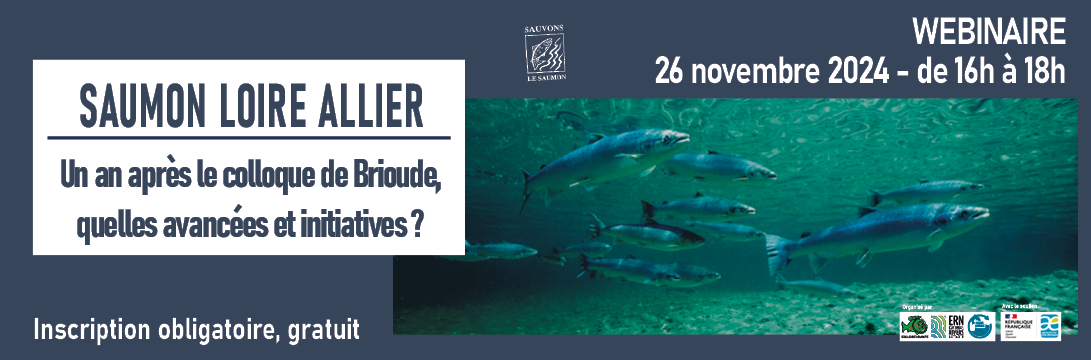
SAVE THE DATE : 26 November 2024: ‘SALMON LOIRE ALLIER’ webinar, one year after the Brioude symposium, what progress has been made and what initiatives ?

SOS Loire Vivante-ERN is organising a webinar on 26 November from 16.00 to 18.00 on the follow-up to the Brioude salmon conference (October 2023).

At the conference, a number of announcements were made by the stakeholders, in particular the development of a shared roadmap.

1 year on, where are we? Has a roadmap been drawn up? What progress has been made and what are the key decisions?

On 26 November, we are inviting some of the actors who took part in the Round Table to the conference to answer these questions. Full programme to follow

Free of charge but registration required (in French)

Opening of the Poutès dam on Monday 7 October

As has been the case every year for the past 3 years, the large gates of the ‘New Poutès’ were opened in automn to allow the highly migratory fish free passage and a free access to the best spawning grounds.

This year, 67 salmon from the Loire-Allier axis passed through the fish pass on the right bank of the Vichy dam bridge, but it is estimated that around a hundred fish must have passed through.

After interrupting their migration to spend the summer between Vichy and Langeac in the Allier or its tributaries, the survivors have restarted their migration towards the Dore, Sioule or Alagnon, and of course the Allier, with the arrival of more favourable temperatures. Over the next few days, they will pass through the Brioude, Vielle Brioude and Langeac dams before reaching the new Poutès dam, where the sluice gates were lowered on Monday in anticipation of their arrival.

Last year, spawning grounds were observed upstream of the Poutès, indicating that more than a dozen fish had returned to the Upper Allier. It is not yet possible to count fish at Poutès when the gates are open, but observing the spawning grounds upstream is still a good indicator. About ten spawners are expected to pass this year.

The gates will remain open for 2 months before closing again to enable hydroelectric production to resume.


Watch our two 2-minute videos


and the webpage : ‘New Poutes dam‘

Living Rivers Europe publishes a water manual for the 2024-2029 mandate

Our society relies on clean and abundant water for drinking and sanitation, crop production, 
cooling down power plants, and manufacturing goods. However, mismanagement and accelerating climate change are making Europeans increasingly vulnerable to water pollution, water scarcity, and floodings. The EU has a role to play in ensuring Europeans are protected from these risks, that farmers are adequately supported in the transition to climate-resilient agricultural models, and that Europe remains an attractive place for businesses.

In this handbook, the Living Rivers Europe coalition offers key recommendations for decision-makers to mainstream the protection of water and freshwater ecosystems across the policy spectrum in the upcoming mandate and protect Europeans from the risks of pollution, drought, flooding and biodiversity loss.

24 October : Expert Masterclass on Dam Removal : Register

As we approach the opening of the ORP call for proposals on October 29, WFMF, WWF, and ERN will host a 1 hour expert masterclass on dam removal with French expert Stéphane Weil from CATER Calvados Orne Manche, France .

He will present on the topic “: Restoring river continuity at a river or catchment scale. How to proceed ? Examples of approaches, technical and communication tools proposed by CATER COM in France”

This event aims to increase the visibility of ORP call and encourage a greater number of submissions.

Join us on October 24th, 2024, from 10:00 to 11:00 (CEST) via Zoom

Registration