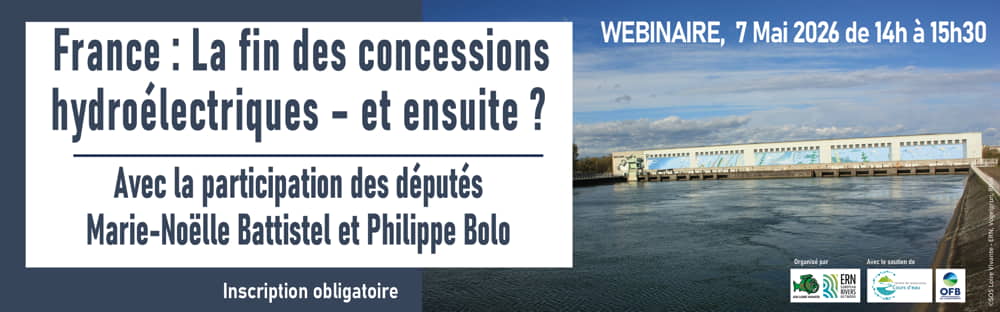
webinaire Open Rivers Programme , le 5 mai de 16h à 17h

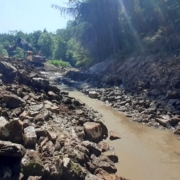
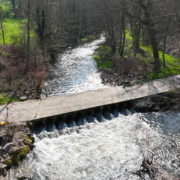
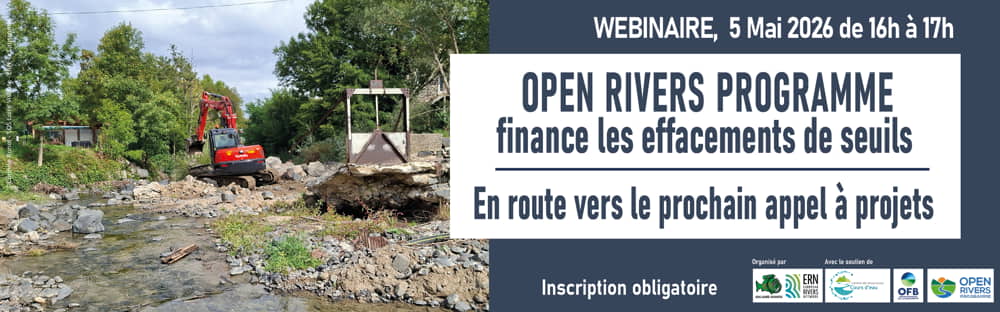
Venez y découvrir les appels à projet de Open Rivers Programme. Celui-ci finance des effacements d’obstacles transversaux en rivière partout en Europe.

 Collectivités, Syndicats de rivières, associations sont éligibles. Prochain dépôt de candidatures possible du 1er au 26 juin 2026.

Webinaire organisé par ERN avec le soutien de l’OFB et de Open Rivers Programme

Pendant 1 h : Présentation du Programme, retour d’expérience, conseils pour bien préparer sa candidatures, Q&R, animé par Corinne Ronot, ERN

Inscription obligatoire 

Civil society and water suppliers urge the European Commission not to weaken or remove fundamental water protection rules

On February 18, a group of associations representing the three pillars of the European Water Resilience Strategy published an open letter opposing the revision of the Water Framework Directive (WFD) announced by the European Commission for the second quarter of 2026.

The signatories, including environmental NGOs and stakeholders in the water sector, warn of the risk of weakening the text, even though its implementation remains incomplete in many Member States. “Rather than revising the WFD, its implementation must be accelerated,” they argue, emphasizing its crucial role in protecting ecosystems, food security, and adaptation to climate change.

The letter warns against premature revision, which could be motivated by industrial pressure, particularly to facilitate the extraction of raw materials. The associations call on the Commission to maintain a stable legal framework and to prioritize the application of existing rules.

European laws that protect our environment are under threat. Sign the petition

Our nature and our health are under attack. European laws that guaranteed clean water, pure air and diverse ecosystems, including the Water Framework Directive, are being quietly dismantled under the pretext of ‘simplification’ and ‘reducing red tape’.

More infos about the petition launched by the European NGO coalition #HandsOffNature, which requires our national and European leaders to uphold laws that protect people and nature.

  Together, let’s protect the EU law on Water! 

 Petition :


Europe’s last wild rivers in the Balkans are in decline

The Balkans, the last refuge for Europe’s wild rivers, are losing a little more of their natural heritage every year.

A recent hydromorphological assessment reveals that nearly 2,500 km of pristine rivers in the Balkans have disappeared since 2012, causing the proportion of near-natural rivers to fall from 30% to 23%. Albania, which is leading this decline, is suffering the consequences of the expansion of hydroelectric dams and river development.

Despite the protection of 900 km of rivers, efforts remain insufficient. Experts and associations involved in the “Save the Blue Heart of Europe” campaign are calling for stronger measures at national and European level to save these unique ecosystems before it is too late.

Check out the interactive map to learn more about the state of Balkan rivers.

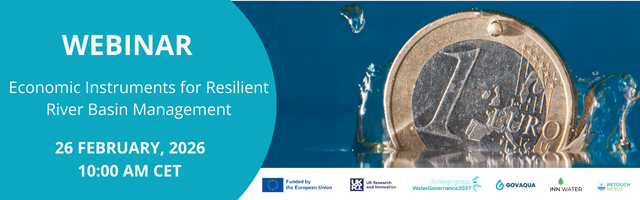
Webinar: Economic Instruments for Resilient River Basin Management

26 February 2026 | 10:00 am CET | in English

Meeting banner

Join three European research projects for a one-hour webinar on how water pricing and other economic instruments can help river basins become more resilient. Discover concrete examples from across Europe that illustrate how to integrate environmental externalities and support integrated and adapted water management in the context of climate change

Registration

Register “Barrier Removal for Flood Prevention and Safety” webinar

WWF Netherlands and ERN – on behalf of DRE – in collaboration with McMillen are organizing this Barrier Removal for Flood Prevention and Safety webinar.

programme & registration

𝐂𝐞𝐥𝐞𝐛𝐫𝐚𝐭𝐢𝐧𝐠 25 𝐲𝐞𝐚𝐫𝐬 𝐨𝐟 𝐭𝐡𝐞 𝐖𝐚𝐭𝐞𝐫 𝐅𝐫𝐚𝐦𝐞𝐰𝐨𝐫𝐤 𝐃𝐢𝐫𝐞𝐜𝐭𝐢𝐯𝐞 💧🎉

For a quarter of a century, the Water Framework Directive (WFD) has been the cornerstone of #EU water management. It protects rivers, lakes, groundwater, coastal waters and establishes the principle that clean water is a shared public good.
📝 To celebrate this milestone, Friedrich Barth, former team leader for the European Commission, takes us back to the day it was adopted.

𝐘𝐞𝐭 𝐭𝐨𝐝𝐚𝐲, 𝐭𝐡𝐞𝐫𝐞 𝐢𝐬 𝐫𝐞𝐚𝐬𝐨𝐧 𝐟𝐨𝐫 𝐜𝐨𝐧𝐜𝐞𝐫𝐧.
The European Commission has taken a dangerous step back and promised to reopen the #WFD, which would undermine decades of effort and put Europe’s ability to address pollution, biodiversity loss, and climate impacts on #water at risk.
The Living Rivers Europe coalition is worried.
⚠️𝐑𝐞𝐨𝐩𝐞𝐧𝐢𝐧𝐠 𝐭𝐡𝐞 𝐖𝐚𝐭𝐞𝐫 𝐅𝐫𝐚𝐦𝐞𝐰𝐨𝐫𝐤 𝐃𝐢𝐫𝐞𝐜𝐭𝐢𝐯𝐞 𝐭𝐡𝐫𝐞𝐚𝐭𝐞𝐧𝐬 𝐰𝐡𝐚𝐭 #𝐄𝐮𝐫𝐨𝐩𝐞 𝐡𝐚𝐬 𝐰𝐨𝐫𝐤𝐞𝐝 25 𝐲𝐞𝐚𝐫𝐬 𝐭𝐨 𝐬𝐚𝐟𝐞𝐠𝐮𝐚𝐫𝐝 𝐚𝐧𝐝 𝐫𝐞𝐬𝐭𝐨𝐫𝐞!⚠️

Mor info see the news from 4 december

Interview with Friedrich Barth by Wetlands International

Vjosa : Albania fails to comply with Energy Community Law

Extract from Press release in common from Euronatur/ Ecoalbanian / Riverwatch

++ NGOs file complaint against Albania ++ Hydropower projects on Vjosa river clearly breach Energy Community rules ++

Tirana, Radolfzell, Vienna, February 26th, 2019.

Today, the Energy Community Secretariat received a complaint against the Albanian Government (find attached). EcoAlbania, Riverwatch and EuroNatur – the three organisations behind the campaign for the protection of the Vjosa River in Albania – have raised concerns about the procedures for the Kalivaç and Poçem hydropower projects (HPP) not being in line with Energy Community rules.

This is the first time a complaint has been filed with the Energy Community regarding hydropower developments in Albania… Read more


European Commission’s reckless move risks derailing water protections

PRESS RELEASE – Brussels, 4th December 2025.

In a shocking turn for Europe’s environment, the European Commission has committed to reviewing and revising the Water Framework Directive by the second quarter of 2026 under the RESourceEU Action Plan, in order to promote “access to critical raw materials in the EU”. This is an extremely worrying move, as such revision threatens to bring down European water standards.

Commenting on the Commission’s decision, the Living Rivers Europe coalition, said: “This is a very reckless decision: it will open the floodgates to further contamination of our waters and accelerate the destruction of our rivers, wetlands and wildlife. The Water Framework Directive is not just any law, it is Europe’s frontline defence for clean, safe, and resilient water for millions of people. Dismantling its safeguards guts this protection, reducing it to a set of vague promises – leaving the future of our waters and wetland ecosystems at the mercy of powerful mining industry.”

The European Commission’s (EC) decision to revise the Water Framework Directive (WFD) is a concession to the metal and mining sectors. The Commission’s RESource EU Action Plan states that the WFD revision will help “promote access to critical raw materials in the EU”. The timing is striking: it comes just a week after EuroMines (EU’s biggest lobby for mining and metal industries) called on the EC to expand the use of derogations under the WFD and postpone deadlines.

Mining activities are no light touch on the local populations and nature. Beyond the human rights implications, mining leads to severe contamination of water with heavy metals from discharged mine effluent (liquid waste), which can severely harm wildlife and drinking water quality. Precious aquatic ecosystems should not suffer the consequences of industries’ endless drive for profit. Weakening the WFD safeguards to facilitate mining will reverse hard-won gains in water quality across the continent.

This move sets yet another dangerous precedent, allowing for hasty legislative changes without proper scrutiny. The fact that the Commission is already committed to revising the WFD without proper evaluation and better regulation steps is simply unacceptable. This strikes at the heart of the European project and undermines the trust of Europeans in the Commission’s commitment to protecting their future.

The European Commission seems determined to find any possible way to derail environmental laws, almost as if on a mission. It beggars belief that the von der Leyen II Commission is deciding to do, without proper evidence, what the von der Leyen I Commission ruled out after thorough evaluation,” added the coalition.

Civil society organisations are urging the European Commission to properly evaluate whether the WFD needs revising, based on science and proper evidence and not on anecdotal evidence of a few polluting industries.


Notes to editors:

  • Adopted 25 years ago, the WFD became the cornerstone of EU water protection. It sets legally binding standards to safeguard rivers, lakes, groundwater, and coastal waters.
  • In 2019, the Commission concluded after a nearly two-year fitness check evaluation that the WFD was a modern and much needed law fit for our times and that it was required to be effectively implemented and enforced. Only two months ago, co-legislators already agreed on an update to the list of surface water pollutants under the WFD and introduced two new exemptions to the Directive to accommodate the requests of some industries.
  • Living Rivers Europe, Industry’s role in water resilience: how some lead – and others wreck. Read here
  • Living Rivers Europe, The EU Water Framework Directive: A modern and powerful tool to provide clean, healthy, flowing waters. Read here
  • Living Rivers Europe, 13 myths about the Water Framework Directive. Read here

Are there still rivers for migratory fish?

Registration is now open (in French only)

  • 16 December from 4pm to 6pm: Axe Vienne Creuse Gartempe – Hydroelectricity or Refuge for Migratory Fish ?

Registration (in French only)

The Creuse has been identified as a key area for migratory fish in the context of climate change. Restoring watercourses and water quality, removing pressures, reconnecting rivers and providing access to refuge areas will facilitate the resilience of watercourses and the return of migratory fish to our rivers.
However, due to the energy transition in particular, there has been an increase in projects to equip weirs with micro-hydroelectric power stations, perpetuating the fragmentation of waterways on strategic routes.
Can these rivers be both sources of hydroelectric power and refuges for biodiversity and endangered migratory fish?
Should we sacrifice biodiversity and water quality in the name of renewable energy, or demand radical solutions to restore the free movement of species and the health of our rivers?


Programme : 1h de présentations, 1h round table , Q&A 

by ERN-SOS Loire Vivante (Roberto Epple, Président, Corinne Ronot, Co-directrice)

Speakers

  • Bruno Bordeau, Président LOGRAMI : L’axe Vienne-Creuse-Gartempe, un refuge pour les poissons migrateurs ?
  • André Berne, Avocat du barreau de Paris : Le droit français au secours de la biodiversité ou de la production d’énergie renouvelable ?

Table ronde / Questions – réponses 

  • Gilles Deguet, représentant FNE au comité de bassin Loire Bretagne
  • Bruno Barbey, Directeur FDAAPPMA 36
  • Joël Herbach, Président Allier Sauvage
  • Lionel Martin, Président de la Fédération de Pêche de la Haute Loire
  • un représentant du secteur de la production hydroélectrique (sous réserve)