Hommage à Edith Wenger, grande dame des fleuves vivants


Hommage à Edith Wenger, grande dame des fleuves vivants.
Date : 16 mars 2020      NOT TRANSLATED YET

Il y a quelques semaines a disparu Edith Wenger, une des pionnières de l’écologie des fleuves
en Europe et dans notre pays. Edith Wenger a longtemps travaillé au WWF Allemagne, au sein de l’équipe scientifique de l’Institut des Plaines Alluviales, basé à Rastatt. Avec l’Institut, elle avait entre autres rédigé dans les années 80 divers livrets sur l’écologie et la gestion des fleuves, dont, pour le compte du Conseil de l’Europe un texte sur la Loire et l’Allier. L’ouvrage a permis à plus d’un citoyen de comprendre que notre rapport aux écosystèmes fluviaux devait évoluer, après des siècles d’endiguements, de rectifications, de constructions de grands ouvrages. Et donc de montrer que les projets d’aménagement de la Loire prévus à l’époque par un syndicat d’élus, l’Epala, Etablissement Public d’Aménagement de la Loire et de ses Affluents, devaient être abandonnés. Dans les années 80, dans un pays comme la France, plutôt raide sur les questions écologiques, un tel positionnement était iconoclaste. Et courageux.
Il est important de revenir sur cette histoire. Important de rendre hommage au travail de cette
grande dame de la protection et de la restauration des fleuves. Sans elle, sans les citoyens,
scientifiques, entrepreneurs, fonctionnaires, chercheurs et rares élus qui ont pris avec elle, grâce à elle le risque de critiquer une culture dominante de l’artificialisation de la nature, notre regard collectif sur la nécessité de restaurer et protéger les fleuves n’aurait peut-être pas changé. Et sans elle, le mouvement Loire Vivante n’aurait pas réussi à inverser le cours de l’histoire de l’aménagement de la Loire, histoire qui conduisait inexorablement au bétonnage du « dernier fleuve sauvage d’Europe ».

Edith Wenger a contribué à créer en ce temps-là, avec le soutien de divers scientifiques, pêcheurs, naturalistes regroupés dans diverses ONG, le WWF, FNE, Amis de la Terre, Robin des Bois une opposition crédible au programme de grands barrages qui menaçait la Loire.

Edith et l’Institut des Plaines Alluviales ont apporté, avec d’autres scientifiques, les premiers
éléments qui ont permis de comprendre que continuer à construire ces grands ouvrages était plus porteur de périls que de promesses. Barrer la Loire irait à contre-courant de décennies de recherches montrant que la simplification des fleuves, leur régularisation, leur artificialisation entrainait, outre l’illusion dangereuse de maîtriser la nature, une série de conséquences négatives, coûteuses pour nos sociétés.

Edith Wenger a contribué à faire comprendre qu’aménager les cours d’eau avec la seule règle de l’ingénieur et l’illusion de maîtrise pouvait aggraver le risque naturel d’inondations, altérer la qualité de l’eau en plus d’appauvrir fortement la biodiversité, avec par exemple le risque de disparition du saumon et des poissons migrateurs, incapables de franchir des murailles de béton.

Sur la Loire, Edith Wenger s’était particulièrement investie dans le secteur du Bec d’Allier, vers Nevers aidée localement par une autre grande dame, Mme Voiret afin de s’opposer à la création d’un grand barrage écréteur, celui du Veurdre. Elle avait organisé au Bec d’Allier, en 1988, la visite du Prince Philip, président du WWF International qui a lancé le cri de ralliement de Loire Vivante « Vive la Loire sauvage ». Edith a aussi travaillé avec l’AuenInstitut sur le Mississipi, le Pantanal, le Danube afin de porter inlassablement cette parole si neuve et dérangeante à l’époque de l’intérêt de changer de regards sur les fleuves, formidables hydro-systèmes pour qui sait voir.

Pour les fleuves, des personnes comme Edith Wenger ont permis de tracer le chemin pour la transition en cours . Il ne faut pas l’oublier. Et lui exprimer notre gratitude, nos remerciements.

Loire Vivante, SOS Loire Vivante, ERN
24 oct. 2020 : New date for the world fish migration day

In light of the difficult situation facing us all at the moment, the #WorldFishMigrationDay Team has decided to postpone the big official celebration from May 16th to October 24th 2020.

We see this as is our chance to #gowiththeflow and an opportunity to get creative! In consideration of the uncertainty of this situation, we encourage our community to either plan digital or physical events to celebrate together on October 24th. We hope you all can join!

For more information visit our FAQ page or contact us directly!
www.worldfishmigrationday.com/faq

14 March – The International Day of Action for Rivers

The International Day of Action for Rivers

is a day dedicated to solidarity – when diverse communities around the world come together with one voice to say that our rivers matter. That communities having access to clean and flowing water matters. That everyone should have a say in decisions that affect their water and their lives. That it’s our time to stand up for these rights, now more than ever.

This year’s Day of Action for Rivers theme focuses on Women, Water, and Climate Change. Last year, 100 women from 32 countries who are leading efforts to protect and defend rivers gathered at the first Women and Rivers Congress .

More information on all events. Some has bee canceled (Coronoa)

> https://www.internationalrivers.org/dayofactionforrivers

Environment council meeting in Brussels : 9 Member States on the way towards a non-revision of the WFD

During the last Environment council meeting March the 5th, 4 Member states (AU, DK, FR, and GR) clearly asked for no revision to the directive  and 5 Member states (DE, ES, FI, IT, CY) made supportive statements to the fitness check conclusions & expressed the need for better implementation. This is good news for rivers, and these 9 supportive Member states represent 64,75% of the EU population.

Thank you to these ministers for their commitment. For France, we would particularly like to congratulate the French Minister for the Environment Elisabeth Borne for having positioned herself to maintain the Water Framework Directive in its current form.

More info : the recording of the discussions are still available on the Council’s website.

European citizens say their support to the Water Framework Directive

Prior to the exchange of views between Ministers on the evaluation of water legislation at the meeting of the Council (Environment) on 5 March 2020 in Bruxelles , European citizens are calling their Minister of the Environment.
They ask to commit to a strong application of water legislation and to mainten the Directive in its current form.

More infos


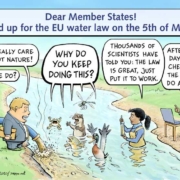
Ministers Council (Environment) on March 5 in Brussels: ministers are invited to support the water framework directive in its current form

Prior to the exchange of views between Ministers on the evaluation of water legislation at the meeting of the Council (Environment) on 5 March 2020, we would like to call Ministries attention on the importance of the follow-up of this evaluation for securing healthy freshwater resources in Europe. We kindly encourage Ministers to come together with 375000+ citizens, nearly 6000 scientists, and 130+ civil society organisations and take a strong stand in support of maintaining the Water Framework Directive in its current form.

Currently, 60% of our rivers and lakes in Europe are not in good status. The next decade will be crucial for combating climate change and environmental protection as says differents report from IPBES, AEE 1.

The relevance of the Water Framework Directive can no longer be questioned – the fitness check conclusions 2 highlighting the EU Water Framework Directive to be “fit for purpose”, acknowledging that the objectives of the law “are as relevant now as they were at the time of the adoption”. These conclusions are an unparalleled opportunity to speed-up the efforts on water protection, but also challenge climate change, water scarcity and pollutants of emerging concern for whom the report says that the Water Framework Directive flexible enough to accommodate this emerging pressures.

While we are heading towards the deadline for the 3rd River Basin Management Plans, due by the end of 2021, river basin authorities need legal certainty to be able to plan and finance  the measures that will truly help achieve good status in all surface and ground waters, a goal that we all share.

The EU Biodiversity Strategy for 2030, the Farm to Fork Strategy and the Zero Pollution Action Plan offer tremendous opportunities to address hydromorphological, diffuse and point source pollution pressures on European rivers and lakes. The European Green Deal can and should be harnessed to the objective of reaching a good water status in 2027, not hampered by an unresolved debate.

We therefore urge the ministers to affirm their position and their commitment not to modify the Water Framework Directive.

_________________

The Intergovernmental Science-Policy Platform on Biodiversity and Ecosystem Services (IPBES) reported that aquatic ecosystems are among the most degraded in the world. The World Economic Forum’s Global Risks Report 2020 has determined water crisis’s to be one of the top 5 global risks 5 years in a row (2015-2020). And according to a recent publication by the European Environmental Agency (EEA) the key impacts climate change will have on Europe are increased droughts and heavy rainfall and floods.

2 Since October of 2017, the European Commission announced the fitness check of the Water Framework and Floods Directives. 3 years later, after an extensive evaluation and search for evidence, the process has come to a crossroads. The fitness check conclusions stated clearly “The fact that the WFD’s objectives have not been reached fully yet is largely due to insufficient funding, slow implementation and insufficient integration of environmental objectives in sectoral policies, and not due to a deficiency in the legislation.” Moreover a recent analysis on the WFD conducted by the Leibniz Institute of Freshwater Ecology reaches the same conclusions as to the fitness check: “Reasons for the poor performance are not down to the Water Framework Directive itself. In fact, this is a technically sound and expedient policy document.”

More info  

Ilisu Dam Reservoir has reached Hasankeyf town (Turkey)

Statement of the Hasankeyf Coordination

Ilisu Dam Reservoir has reached Hasankeyf town – Apocalypse is Impending!

The filling of the controversial Ilisu Dam continues despite the ongoing strong critic and protests by the affected communities along the Tigris River and civil society organizations from all over Turkey. Almost two weeks ago the raising dam reservoir has reached the 12,000 years old town Hasankeyf which is one of the most magnificent cultural and natural heritage sites at our planet. The planned “apocalypse” by the Turkish government is becoming slowly reality!

Situation in the Tigris Valley

Caught unprepared and uninformed, the residents of the mainly Kurdish populated Tigris Valley are unjustly made to emigrate from their homeland. Many people, especially in the province of Siirt, had to evacuate their villages without taking some of their belongings because the water was rising quickly.

What has been criticized by us and other in the last two decades is happening step by step and displaced people are confronted with poverishment in the new target settlements. While it is planned to flood 85 villages completely and 124 villages partially, the State Water Management (DSİ) has built only four new settlements, which forces tens of thousands of people to emigrate to Siirt, Batman, Diyarbakır and other big cities with meagre compensation rates. Among them are over ten thousand landless people who have not received any compensation at all. These people are supported by neither the DSİ, nor the trustee-appointed municipalities.

Situation in Hasankeyf

Having approached the district center of Hasankeyf in late December, the water level of the Ilisu Dam has been rising since July. Up to date around 35 villages have been already flooded in the last months.

While hundreds of families have been evacuated from Hasankeyf to New Hasankeyf – the resettlement site 2 km in the north – one by one since August 2019, in the last 2 months 40 families still lived in Old Hasankeyf as they have become homeless and do not know where they will bring their animals. They had access to only one tea house and a grocery store. Given water only for one hour a day, the families staying in Hasankeyf are now facing enforced displacement. Their number is now decreasing with the entering into the city.

When the historical bazaar was demolished with construction equipments in November, Hasankeyf received another blow. With the demolition of the bazaar, structures going back 2 thousand years were uncovered. The ‘rescue excavation’ undertaken by the Ministry of Culture for these structures sparked criticisms.

Construction equipments keep damaging historical fabric in other sites and the 80 meters high barrier set up around Hasankeyf Castle and constituting a crime in terms of landscape keeps on rising.

The people who have moved to New Hasankeyf are not content with their situation. As tourists come neither to old nor to new Hasankeyf, thousands of people have significant less income and are faced with the risk of becoming unemployed. In addition to financial difficulties, another important problem in New Hasankeyf is that the water coming from the tap is undrinkable. That is why daily many people transport drinkable water from Hasankeyf to New Hasankeyf. While the people of Hasankeyf used to live in and with water, they now have difficulties in access potable water. If people are not provided with job opportunities and if the problem of drinking water persists, people will have likely to emigrate from New Hasankeyf as well. If this happens, the vast majority of New Hasankey’s population will not consist of local people. The people of Hasankeyf are now against the Ilısu Project more than ever before.

We can stop it despite everything

The directly affected people from Hasankeyf and the 199 villages raise their critic more than ever against the Ilisu Project as they experience the expected disastrous social, cultural and ecological impacts. Almost the whole society in the affected provinces in the Tigris basin consider this project of destruction, eploitation and domination as a big loss and oppression.

We can stop the apocalypse that has unfolded in the Tigris Valley despite all the destruction that has been brought about. We are not tired of repeating that it is never too late for Hasankeyf and the Tigris River. No matter at what point we abandon the Ilısu Project, it will be to the benefit of us and next generations!

In 2019 in Turkey, groups more diverse than ever before stood up against Ilısu project and indicated that Hasankeyf had to be saved. This reaction should be prompted again by every person and organization and the government should be requested to stop filling the Ilısu Dam. It is urgent, we have no time to lose!

IT IS NOT TOO LATE FOR HASANKEYF AND THE TIGRIS RIVER!

Remarks:
1) This is a link showing the first days of the reaching dam reservoir in Hasankeyf: https://www.youtube.com/watch?v=QXAjqW-M7s4&feature=youtu.be
2) At the website you can find more pictures which you can use by citing the Hasankeyf Coordination or the Initiative to Keep Hasankeyf Alive.
3) You can find this statement at the website of the Initiative to Keep Hasankeyf Alive: http://www.hasankeyfgirisimi.net/?p=1426

17.01.2020
Hasankeyf Coordination (Initiative to Keep Hasankeyf is part of it)

Twitter (Turkish and English): @HasankeyfKoord and @hasankeyfdicle
Facebook (Almost only Turkish): @hasankeyfyasatmagirisimi
Email: hasankeyfgirisimi@gmail.com
More information (Turkish and English): www.hasankeyfgirisimi.net


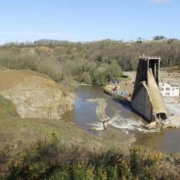
An overview of the Sélune conference by the AFB has just been published

The French Agency for Biodiversity has just published its latest issue :

– Effacement de barrages, Quand la Sélune reprend son cours, – 24 au 26 septembre 2019, Les Rencontres, OFB, n°70,  déc.2019, french
Dam removal: The Sélune River free to run – 24 to 26 september 2019, Les Rencontres, OFB, n°70,  déc.2019, english

This 6-page issue is entirely devoted to the Sélune conference held from September 24 to 26 in Rennes and Avranches.

A more detailed 60-page book on the conference communications is also being prepared.