
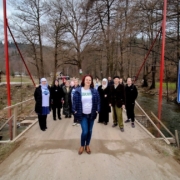
Photo : Maida Bilal received the award on behalf of the all the brave women of Kruščica. © Goldman Prize
++ River defenders from Bosnia and Herzegovina win the Goldman Environmental Prize ++ For the second time in the past three years an activist has received this prestigious award for campaigning against hydropower in the Balkans. ++ See the Riverwatch Press Release below
San Francisco, Kruščica, Vienna, Radolfzell, June 16th, 2021. On Wednesday evening (16.00 local time), Maida Bilal received the renowned 2021 Goldman Environmental Prize on behalf of the “brave women of Kruščica”. The prize is endowed with 200,000 USD. The Jury justified their decision on the grounds that hydropower is not green, and is one of the greatest threats to wild rivers and the people living along their banks. Maida Bilal and the other women fought for one of the last free-flowing rivers in Europe – and won. The group of women from the village of Kruščica in Bosnia and Herzegovina had occupied a bridge over their river for over 500 days and nights – despite violent eviction attempts by the police and even during the long, cold winter – and thereby prevented the construction of two hydropower plants.
The international foundation EuroNatur had already recognised their extraordinary courage and persistence with the 2019 EuroNatur Prize. Gabriel Schwaderer, Executive Director of EuroNatur, has welcomed the decision of the jury: “The commitment of these courageous women to their natural livelihoods is exemplary. I am delighted that the EuroNatur laureates will attract international attention with the awarding of the Goldman Prize, the so-called ‘Green Nobel Prize’”
This is the second time in the last three years that this award has gone to activists fighting against the construction of hydropower in the Balkans. In 2019, Ana Colovic Lesoska from North Macedonia was honoured for campaigning against dam projects in her country. “This is, as far as I know, a novelty and an extraordinary motivation for all those who stand up for the Blue Heart of Europe. It is also a political signal to the governments of the region as well as to the EU, financial institutions and banks to keep their hands off Balkan rivers.” said Ulrich Eichelmann, CEO of Riverwatch.
Background information
Further information
Christian Stielow – EuroNatur, christian.stielow@euronatur.org, Tel.: +49 (0)7732 – 92 72 15
Cornelia Wieser – Riverwatch, cornelia.wieser@riverwatch.eu, Tel.: +43 (0)6504544784
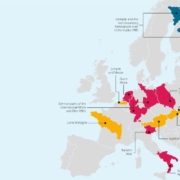
Living River Europe coalition including WWF and EEB and ERN present a preliminary assessment of river basin management plans
Under the title “THE FINAL SPRINT FOR EUROPE’S RIVERS” and “NGO ANALYSIS OF 2022- 2027 DRAFT RIVER BASIN MANAGEMENT PLANS”, WWF, EEB and other partners of the Living Rivers Coalition have presented a first analysis of the draft river basin management plans shortly before the end of the official public participation under the Water Framework Directive.
According to this analysis, 11 of the 13 river basins considered will not meet the WFD objectives by 2027. In almost half of the cases, the indicators examined on pollution, continuity, high and low water management, agriculture, hydropower, coal mining and renaturation measures were found to be largely insufficient. In addition to insufficient funding, the report cites the persistent lack of policy integration in areas such as agriculture, energy and infrastructure, as well as the frequent use of exemptions as the main reasons.
The report is available on the EEB website:
https://eeb.org/library/the-final-sprint-for-europes-river-report/
The WWF / Living Rivers Coalition press release can be found here:
https://www.wwf.eu/?uNewsID=3697866
Indeed, from July 5 to 11, Dam Removal Europe joins the Big Jump with its crowdfunding action in favor of dam removal projects.
This year, the theme of the Big Jump is “Free Rivers”. This means that the Big Jump is dedicated to the removal of dams and other obstacles on rivers across Europe, in order to bring them back to life.
To raise awareness of the dramatic situation represented by the existence of more than a million obstacles and, at the same time, to launch very concrete actions on the ground, we are launching a crowdfunding week from 5 to 11 July 2021, at the same time as the Big Jump.
This operation allows any group or organization to register a dam to demolish. They can then relay this project to their networks and get donations to carry out their river action.
Register your dam removal project before June 20th by following all the information given in the document available here.
It will then be able to benefit from the crowdfunding week planned from July 5 to 11!
Several texts, supported by ill-informed or ill-intentioned deputies and senators, from the lobbies of the protection of mills and small hydroelectricity, will be voted during the month of June in the Senate and then in the Assembly. They brutally call into question more than 25 years of national efforts and investments to give back to the rivers, sources of life of our territories, their essential functionalities to nature and to our societies and totally ignore the impacts on the already very degraded natural aquatic environments.
The Collectif Rivières Naturelles led by our association, with already 3300 supporters via the current petition, is opposed to these texts. It has written personally to each member of parliament and senator to appeal to their responsibility and ask them not to support these texts which are far from the general interest and completely out of step with the environmental emergency, the commitments of France and the European imperatives.
> Read the letter of the Collectif Rivières Naturelles (French only)
> Read the press release ((French only)

The project “In search of water” is a participatory science program launched by the French Office of Biodiversity, to which every French citizen can contribute.
Its objective: to improve the knowledge of the flow of our rivers,
How can we do this? By completing the existing scientific data with your personal observations of the flow of rivers
Indeed, the level of the rivers is subject to more or less extreme variations which tend to increase. Is this a consequence of global warming? Or of the inappropriate exploitation of water resources? It is the observation of each one that will allow us to analyze and understand these phenomena.
Become an observer of the project!
All the information to find by clicking here
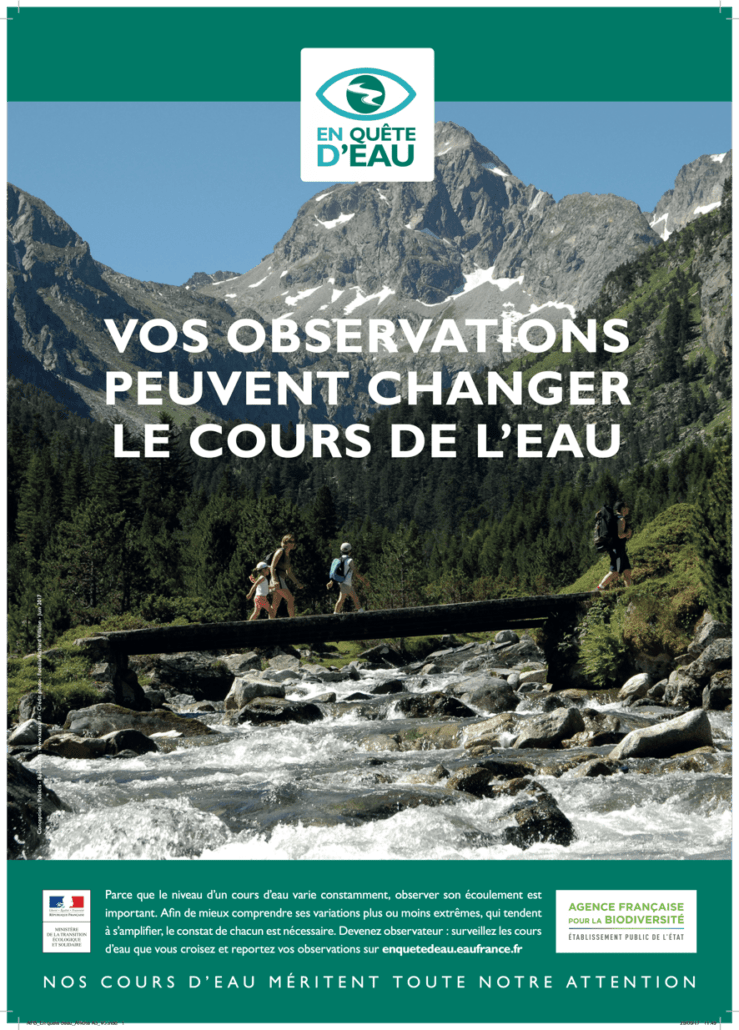
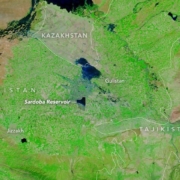
PHOTO / The reservoir on May 8 2020, showing the emptied reservoir and the extent of the flood water across Uzbek-Kazakh border
[image by: Lauren Dauphin/NASA Earth Observatory]
article from coalition Rivers Without Boundaries
A year passed since May 1, 2020, when on the territory of Sirdaryo region of Uzbekistan, a breakthrough of the reservoir dam occurred, causing a flood. Buildings, roads, communications were destroyed. More than 60 thousand residents were evacuated in Uzbekistan and similar number in flooded districts of Kazakhstan. According to official data, 6 people died during the incident.
On April 30, at a briefing, First Deputy Minister of Emergency Situations, Major General Abdulla Kuldoshev named several general factors that led to the collapse of the Sardoba dam in Uzbekistan.
According to the General the Ministry of Water Resources failed to organize oversight on planning, design and construction work at a proper level. For example, The Rules for the Sardoba reservoir operation had not been approved by responsible officials prior to its filling. This process grossly violated technical and regulatory requirements.
Secondly, the design company UzGip LLC, in the process of preparing the working design documentation for the reservoir, made changes arbitrarily without observing the requirements established by the approved Feasibility Study. The working design documentation did not take into account the structural and seismic safety of the dam.
Thirdly, the contractor organization Uzbekistan Railways JSC and other subcontractors allowed the density of the foundation and the body of the dam, as well as the thickness of the filter and protective stone layer to be below the design parameters. (In other words they were saving on construction materials and skipped due stages in construction process).
For making mistakes and overlooking shortcomings in the design, construction and operation of the dam, 17 officials and responsible managers of the designer and construction organizations were brought to criminal responsibility. The indictment against them has been sent to the Supreme Court for review (however the court proceedings from day 1 were declared a “state secret”).
According to the General, now, within the framework of the criminal case, investigative actions are continuing on likely embezzlement of budget funds allocated for the construction of the reservoir. The court will soon give a legal assessment of the actions of all officials involved in the case. Additional information will be provided to the public then….
All in all this communication has not revealed anything new, compared with what public and experts knew soon after the accident. Although awkward attempts to blame weather, climate and burrowing pests (such as catfish and rodents) for the dam collapse were finally abandoned, still ordinary engineers and managers will be persecuted to shield from accusations higher-up officials.
People unhappy with how the government handles compensation and restoration were silenced in various ways, according to “The Diplomat”. Freedom of press was seriously limited on this case after several outlets linked possible corruption and mismanagement at construction site to Senator Sanginov, now the head of Uzbek Hydropower Company. Meanwhile a later investigation by Bellingcat and RFE have discovered that similar companies, allegedly linked to Sanginov, are also responsible for development of a large high-mountain reservoir at a new presidential residence inside a natural area strictly protected since soviet times and now used for trophy hunting. Topalang Water Construction Co. majority owned by a son of senator Sanginov was likely the general contractor for this new secret reservoir, which does not appear on books of Water Ministry. The construction became known once downstream villages experience water shortages, since the whole Shovvozsoy river went dry due to reservoir filling since 2018.
Unfortunately the promise of Uzbek leadership to investigate Sardoba dam catastrophe and make sure that those responsible get punished and corrupt hydro-engineering system is rectified have not been fulfilled so far and hopes for that are fading away.
This year, Dam Removal Europe International Seminar is being organized by WWF (Germany, Austria and Switzerland), Dam Removal Europe partners, and in cooperation with regional and international partners. It will take place online from 4 to 7 May 2021 (every afternoon from 2 to 5 p.m. Central European Time).
ERN will be among the speakers on the subject of the removal of large dams on the Selune.
You can still register !
>> Find the whole program and register online
A report released on 19 April 2021 by WWF shows that 935 river obstacles present a strong potential for removal in France.
The study demonstrates the massive potential of barrier removal to restore free-flowing rivers in Europe.
The report ‘The potential of barrier removal to reconnect Europe’s rivers’ analyses a sample of 30,000 barriers on large and medium-sized rivers in Europe, and assesses their reconnection potential for the whole continent, the EU27, and by country, based on the length of river which could be reconnected and the ecological quality of reconnected rivers which could be achieved through barrier removal.
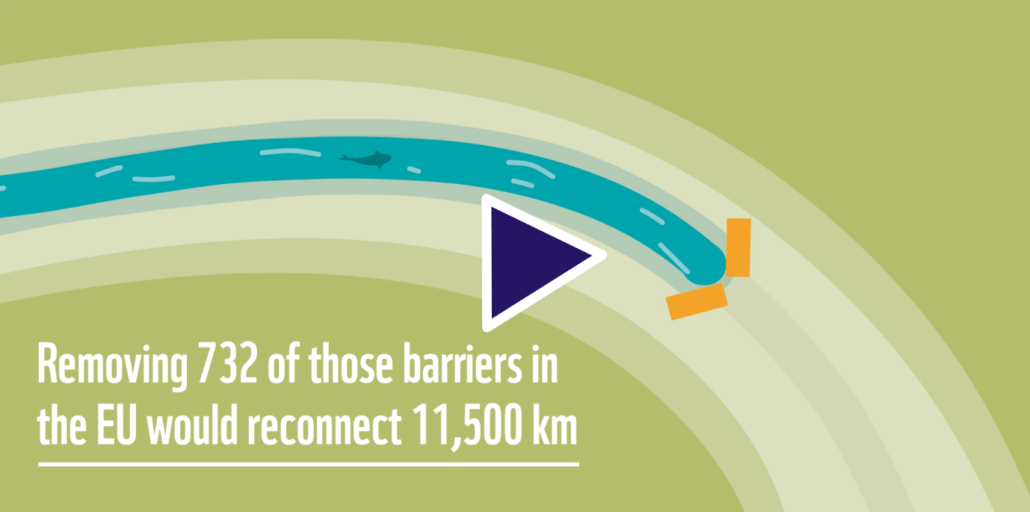
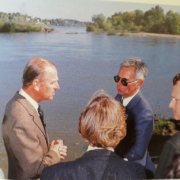
Photo: Prince Philip visiting the Bec d’Allier, in 1988. Copyright Pierre Jeannin
Many people have learned, on April 9th, the death of Prince Philip, husband of the Queen of England, Elizabeth II. But fewer remember the important role he played in the protection of the Loire, at the time of the fights led by the Loire Vivante Committee against 4 major dam projects* (more info here, only in french). On October 14, 1988, during a visit to the Bec d’Allier (confluence of the Loire and the Allier), the Prince launched for the first time the famous phrase “Vive la Loire Sauvage”. During this press conference, he said that “the ambitious plans to develop the Loire Valley have attracted a lot of attention, outside of France. And have caused, I must say, some concern. …] We would like to see a reasonable compromise between human interests and the maintenance of conditions that allow the systems and species of the natural environment to survive. […] A reflection is worthwhile to ensure that future generations will not have to bear the consequences of hasty decisions and the cost of unnecessary mistakes. ”
As President Emeritus of WWF International, he was supporting the opponents of the dams, giving a nice media boost to the fight, which was ultimately victorious since the dams were not built.
This commitment of the Prince to rivers predates the fights on the Loire… Indeed, as early as 1984, he was present on the Danube, between Vienna and Budapest, a still wild part of the river, threatened at the time by dam projects, and now a National Park!
If we had asked him “Draw us a Salmon”, no doubt this great Prince would have done it with pleasure…
It is with emotion that we pay this tribute to the man in love with rivers that he was.
ERN France
8 rue Crozatier
43000 Le Puy en Velay
+33 (0)4.71.05.57.88
ERN is the official WWF Freshwater Partner in France and cooperates with WWF Switzerland, Austria, Netherlands and others




 Lauren Dauphin/NASA Earth Observatory]
 Pierre JEANNIN