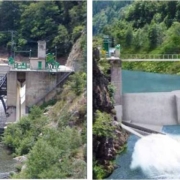
Micro-hydropower plants are in the media ! Investigation of their impacts, by Lorène Lavocat, French journalist

Lorène Lavocat, reporter for Reporterre, carried out a survey on micro hydropower plants. At the beginning of March 2019, two interesting articles on the micro-hydropower plants that we invite you to read, as well as a passage in the show La Tête au Carré on the public radio France Inter!

> Listen to the radio show La Tête au Carré (March 8th, 19) by clicking HERE (french only)

> Article 1/1 : The multiplication of microbarrings threatens the last wild rivers , by Lorène Lavocat, (Reporterre, March 8, 2019) “Hydropower has been permanently installed in the French energy mix, but its promoters, touting” the most beautiful “electricities”, want to equip more rivers with micro-hydropower, much to the chagrin of associations for the defense of aquatic biodiversity. “ Read more (french only)

> Article 2/2 : In the Haute-Loire, the opposition goes up against projects of mini-hydroelectric plants,  by Lorène Lavocat, (Reporterre, March 9, 2019) “A storable energy, generated locally, without pollutant discharges … The micro-hydropower plants have serious assets. Which do not carry the adhesion of the associations of defense of the environment and the concerned inhabitants, as in Chamalières-sur-Loire or Chanteuges.” Read more (french only)

375,000+ citizens tell the European Commission “Hands off our water law!”

Public consultation ended yesterday 12 March and #protectwater campaign managed to mobilise 375,386 people from across Europe and beyond to stand up for our strong EU water law!
Citizens have spoken up loud and clear in numbers that neither the European Commission nor Member States can turn a blind eye to
Our deepest thanks and congratulations to all citizens and NGOs who participated.

Read Press release from Living Rivers Europe
Brussels, 13 March 2019 :

375,386 people have called on the European Commission to defend Europe’s strong water law, making the EU’s public consultation on the legislation one of the largest ever in the history of the European Union. This law is critical to ensure that Europe’s rivers, lakes and wetlands are protected and brought back to good health.

The NGO-led #ProtectWater campaign inspired citizens across Europe and beyond to take a stand for Europe’s rivers, lakes and wetlands, and the strong law which protects them, the EU Water Framework Directive, during the European Commission’s ongoing fitness-check

“375,386 citizens have spoken up for Europe’s precious rivers, lakes and wetlands, and against their ongoing destruction. They have told their governments loud and clear not to undermine the EU water law – decision-makers must now listen up and take these voices seriously”, said Ester Asin, Director of WWF’s European Policy Office, “With 60% of Europe’s waters in a critical state, the need for action from Member States is urgent. They were meant to put a stop to this destruction when they signed up to the Water Framework Directive in 2000, but, instead, have spent the best part of two decades brazenly side-stepping their commitments and not implementing it. We urge them to own up to their inaction today and, instead of pushing for this law to be changed, take citizens’ views on board.”

 “One need only look elsewhere in the world to see that Europe is incredibly fortunate  to have a general and cross-border legal framework in the shape of the Water Framework Directive to protect its rivers, lakes and  wetlands, underlined Roberto Epple, President of the European Rivers Network,  “It would be shameful to weaken it. Citizens have understood that. Member States should respect this and move up a gear to achieve the results outlined in this text, which can be considered a treasure.”

The #ProtectWater campaign was led by WWF, the European Environmental Bureau, the European Anglers Alliance, the European Rivers Network and Wetlands International – who together form the Living Rivers Europe Coalition. It facilitated citizens’ participation in the European Commission’s public consultation on the Water Framework Directive (the only opportunity for the general public to have its say during the EU fitness-check) to express their clear opposition to changing the legislation. It was launched in October 2018 and went on to be supported by more than 130 civil society organisations, including national partners and offices of Greenpeace, BirdLife and Friends of the Earth, as well as unions.

 The EU’s official analysis of the public consultation, which closed on 11 March, is likely to be published in the autumn of 2019, with the final decision on the future of the legislation expected by the first half of 2020. As Living Rivers Europe, we will be there every step of the way to ensure that the Water Framework Directive remains intact, and will continue to push for this visionary legislation to be fully implemented by Member States and enforced by the European Commission so that it that the vast majority of Europe’s waters are returned to good health by 2027 (at the absolute latest).

 Download press release (in english)

Contact:
Sophie Bauer, Communications Officer (Freshwater)
WWF European Policy Office
sbauer@wwf.eu
+32 471 05 25 1

Notes to the editor:

About the state of water in Europe:

About the #ProtectWater campaign:

  • The goal of #ProtectWater is simple: to defend the Water Framework Directive (WFD) and in doing so, protect Europe’s rivers, lakes, groundwater and wetlands, and the wildlife they house, for generations to come.
  • The campaign was led by Living Rivers Europe (WWF’s European network, the European Anglers Alliance, European Environmental Bureau, European Rivers Network, and Wetlands International), who together represent a movement of over 40 million people across Europe.
  • 130+ civil society groups went on to support the campaign
  • The campaign allowed anyone to easily take part in the European Commission’s public consultation on the evaluation of EU water policy, which includes the WFD.
  • By filling in the e-action’s form (available on livingrivers.eu as well as individual organisations’ websites), individuals could quickly and easily send the suggested response to the public consultation to the European Commission on their behalf.
  • For more information, please visit livingrivers.eu

About the EU Water Framework Directive (WFD):

  • The WFD is one of the EU’s most progressive pieces of environmental legislation. It requires the protection, enhancement and restoration of our rivers, wetlands, lakes and coastal waters.
  • Under the WFD, EU governments have committed to ensure no deterioration and achieve good status for the vast majority of all water bodies by 2015, and at the very latest by 2027.
  • The WFD is currently undergoing its standard review in the form of a ‘fitness check’. Every piece of EU legislation goes through this process. The fitness check will look at the relevance, effectiveness, efficiency, coherence and EU added value of the WFD (and its ‘daughter’ directives) and the Floods Directive. It includes the ongoing stakeholder consultation and public consultation.

Recommendations for improving the implementation of the Water Framework Directive:

The following recommendations outline some of the actions Member States and the Commission need to take to ensure no further deterioration occurs and that the majority of water bodies in the EU achieve good status by 2027.

  • Member States should develop more effective and ambitious third-cycle river basin management plans (2021-2027) and associated programmes of measures to bring European waters to good status by 2027.
  • Member States should significantly restrict their use of exemptions to exceptional cases only. To uphold the purpose and effect of the WFD, the European Commission should use enforcement measures to facilitate significant reduction in the use of exemptions.
  • Member States should strictly apply the non-deterioration principle and
    precautionary approach. They must protect remaining free-flowing, unaltered
    and clean stretches of rivers for their biodiversity and ecological values and
    not leave them open to further hydropower development and modifications
    for inland navigation.
  • Member States should increase the uptake of nature-based solutions and
    dam removal to ensure that freshwater biodiversity can spread back into
    degraded areas.
  • Member States should apply in full the ‘polluter/user pays principle’ in line with the WFD, ensuring that water pricing reflects the true value of water and that all users, including agriculture, contribute to the full costs of water services in a more equitable way, the European Commission should take prompt and
    effective enforcement actions to ensure introduction of adequate water pricing.
  • Member States should improve transparency and enable effective public
    participation in river basin management planning and application of
    exemptions (e.g. Article 4.7 WFD).
  • Member States and the European Commission should ensure coherence between management and conservation of water ecosystems and relevant sectoral policies (most notably energy, agriculture, transport, flood management).
  • Member States and the Commission should improve procedures and introduce effective tools for preventing, detecting and sanctioning breaches of established water and conservation laws.
Partial removal of the Poutès dam (France) : Favorable opinion by the investigation Commissioner (public consultation)- Read the reaction by regional NGOs

Favorable opinion by the investigation Commissioner (public consultation). Regional NGOs support the project but ask for improvement of the project governance.
Read the french NGO  press release

20190304_CP_Poutes_FINAL

#ProtectWater : we reached 340 000 signatures ! Consultation extended until March 12

We now have reached 340,000 signatures, which means that our campaign is now one of the top 3 largest public consultations in the history of the European Union!

THANK YOU to everyone who has signed!

Others can still do it until March 12 inclusive (extended) … and contribute to this incredible campaign too!

SIGN HERE until March 12


Vjosa : Albania fails to comply with Energy Community Law

Extract from Press release in common from Euronatur/ Ecoalbanian / Riverwatch

++ NGOs file complaint against Albania ++ Hydropower projects on Vjosa river clearly breach Energy Community rules ++

Tirana, Radolfzell, Vienna, February 26th, 2019.

Today, the Energy Community Secretariat received a complaint against the Albanian Government (find attached). EcoAlbania, Riverwatch and EuroNatur – the three organisations behind the campaign for the protection of the Vjosa River in Albania – have raised concerns about the procedures for the Kalivaç and Poçem hydropower projects (HPP) not being in line with Energy Community rules.

This is the first time a complaint has been filed with the Energy Community regarding hydropower developments in Albania… Read more


European Commission publish today his latest report on WFD implementation

25 februar 2019
EU Commission’s latest report on its implementation, published today, paints a bleak picture. Despite the EU’s strong water legislation, Europe’s rivers are suffering.
Although some progress has been made, Member States are not on track to bring Europe’s rivers, lakes, wetlands, streams, groundwater, transitional and coastal waters to good health by 2027.
The report provides yet more evidence that Member States are seriously undermining their legal commitments and, in doing so, threatening the availability of water for nature and for people.
You can access the European Commission’s reports here, but not all are available yet. For now there are links only to the short report from the Commission.
=> You can also read the pressereleases by major NGOs : WWF EPO’s    Wetlands International    EEB

European Court for Human Rights takes no responsability for Hasankyef (Ilisu Dam in Turkey)

Extract from Press Release 2019/02/21 of “Initiative to Keep Hasankeyf Alive” (Ilisu Dam in Turkey)

On Februar the 21th, the European Court for Human Rights (ECHR) has rejected the appeal for conserving the archaeological site Hasankeyf and the surrounding Tigris Valley which is threatened by the Ilisu Dam and Hydroelectric Power Plant Project in the Kurdistan region of Turkey.

The decision of the ECtHR is more than regrettable. This cultural and natural heritage site – inhabitated continously – is inarguably one of the most important heritage sites in Turkey, Middle East, and Europe.

It is a shame that the ECHR has avoided to take any responsibility. In a period when the justice system of Turkey has started not to exist any more it could have given support to many people at the Tigris River and in all over Turkey campaigning for defending their livelihoods and heritage and against destructive and exploitative investment projects. However struggles will continue.

What is criticize here in substance is that European institutions claims to have high democratic standards, but is not able to take responsibility in a crucial case like Hasankeyf and the Tigris River.

More info on our web page https://www.ern.org/fr/dam-watch/

or on  www.hasankeyfgirisimi.net
Contact : Ercan Ayboga /Initiative to Keep Hasankeyf Alive
hasankeyfgirisimi(a)gmail.com

European Commission to take Spain to court over destruction of Doñana Wetlands

The European Commission announced last week that it would be referring Spain to the European Court of Justice (ECJ) over the serious deterioration of the Doñana wetlands, and for its failure to implement the Water Framework Directive/WFD and the Birds and Habitats Directives

Free Selune river : the timeline become clearer !

On the Sélune river, in Normandy, the timeline of dismantling is becoming clearer. The Vezins dam, whose sediment management has been completed, will be erased from April / May 2019.

For that of La Roche which drinks, further downstream, the deadline is 2021.

More information on our free Sélune page


Review on the 1st European Rivers Summit – Sarajevo 2018

Photo : Copyright Luka Tomac (Art) and Flying Pangolin Film

This post comes from the web site Riverwatch

++ 250 people attend Summit to save Europe’s rivers and stop the damming ++ Participants call upon EU and Heads of State to stop funding hydropower ++

Sarajevo, September 30th, 2018. Between September 27th and 29th, Sarajevo became the center of European river conservationists and dam opponents. At the first European Rivers Summit, about 250 people from over 30 countries discussed how to stop the destruction of Europe’s rivers from hydropower, how to protect the last free-flowing river jewels in the long run and how to restore those already destroyed (a full list of topics can be found in the Summit Program).

Participants formulated a list of demands addressed to relevant decision makers in politics and industry. In this declaration, Europe’s river conservationists call upon the European Commission, the Energy Community, international banks and national governments to stop promoting and funding hydropower projects as green and renewable energy source and tighten environmental criteria. These demands aim to help the successful implementation of the EU Water Framework Directive in order to bring rivers back to a good ecological state by 2027.

Today, rivers are the most threatened habitats on Earth. 81% of global freshwater wildlife populations have been lost – higher than in any other ecosystem. According to the European Environmental Bureau (EEB) European waterways are degraded to a point where they can no longer sustain functioning ecosystems. The main threat to river’s health is the massive expansion of hydropower, boosted by the green myth and funding methods such as feed-in tariffs.  In EU, 25,000 hydropower plants are registered, according to the EEB. This figure does not even include small hydropower plants – the actual figure is therefore much larger. Almost two thirds of European rivers are in a bad ecological state.

“We have to stop the dam craze. Europe’s rivers have long paid for our energy-hungry lifestyle with their integrity. The last intact rivers must remain free-flowing“, says Ulrich Eichelmann, CEO of Riverwatch.

Hydropower plants not only fundamentally destroy the biodiversity of riverine habitats but also turn a dynamic river into a monotonous stagnant waterbody. Moreover, hydropower is not even a carbon-neutral source of energy as dam reservoirs are a major source of greenhouse-gas emissions. In addition, dams also have dire social costs. Worldwide, between 500 and 750 million people suffer from direct or indirect impacts of dams,

“Hydropower is a destructive, outdated technology that, today, can be easily substituted with modern sources of renewable energy, such as solar power“, Natasa Crnkovic, president of the Center for Environment in Bosnia and Herzegovina

Fortunately, there is one region in Europe which still hosts free-flowing rivers: the Balkans. However, even these last jewels are under massive attack by about 2,800 projected hydropower plants. To make a statement against this destruction, the first European Rivers Summit was held in Sarajevo. Starting this year, a European Rivers Summit will be held every two years in a different region in Europe. The next summit will be held in Portugal in 2020.

Background information

  • Declaration for DOWNLOAD
  • The First European Rivers Summit was carried out by Riverwatch (Austria) and the Center for Environment (Bosnia and Herzegovina) and organized within the framework of a newly formed alliance of several European NGOs with the purpose to save Europe’s rivers and stop the dams. These organisations include Riverwatch, EuroNatur, WWF Adria, Wetlands International, and Rios livres (GEOTA) from Portugal.

  • Big finish of the Summit was the Concert for Balkan Rivers in the Sarajevo city centre, organized with in the campaign “Save the Blue Heart of Europe”. Popular musicians Rambo Amadeus (Montenegro), Eda Zari (Albania), Tamara Obrovac (Croatia) and Damir Imamovic (Bosnia-Herzegovina) raised their voices for free Balkan rivers and against the dams in front of hundreds of people.

For more information contact