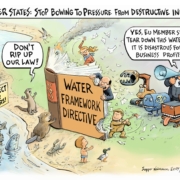
Unsustainable industries, including industrial agriculture, hydropower, and coal mining, are lobbying for devastating changes the Water Framework Directive.
A new paper from NGOs (WEAKENING THE EU WATER LAW: INDUSTRY’S WISH LIST) shows that, if ever put into effect, such changes would give these sectors the green light to undertake even more destructive activities, potentially causing havoc on our rivers and lakes. But, far from obliging these sectors to clean up their act, some Member States have compiled a strikingly similar wish list, raising serious questions as to where their true interests lie.
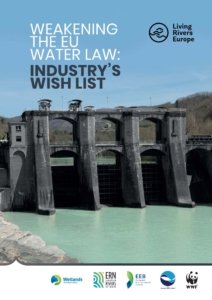 This document, published ahead of an informal meeting of the Environment Council in Bucharest, Romania on 20 and 21 May and reflected in a letter sent to the Environment Ministers of EU Member States, launch the second step of the campaign lead by Living Rivers Europe to ensure the integrity of the WFD, and follows the #Protectwater campaign during which more than 375,000 citizens expressed their wish for the WFD to remain unchanged.
Read the letter adress to UE Environment Ministers
Access to our campaign page
Read Press release by Living Rivers Europe
Brussels, 15 May 2019

Unsustainable industries, including industrial agriculture, hydropower, and coal mining, are lobbying for devastating changes to the EU water law – the Water Framework Directive (WFD).
A new paper from environmental groups [1] shows that, if ever put into effect, such changes would give these sectors the green light to undertake even more destructive activities, potentially causing havoc on our rivers and lakes. But, far from obliging these sectors to clean up their act, some Member States have compiled a strikingly similar wish list, raising serious questions as to where their true interests lie.
The paper, developed by WWF, EEB, Wetlands International, the European Anglers Alliance and European Rivers Network – who together form the Living Rivers Europe coalition – is published ahead of an informal meeting of the Environment Council in Bucharest, Romania on 20 and 21 May. Environment Ministers from all EU Member States will come together to discuss, amongst other topics, issues related to water management across the EU. The gathering comes in the wake of scientists declaring a state of ecological emergency, with extensive research confirming that nearly 75% of freshwater resources are now devoted to agriculture alone, and freshwater ecosystems are showing the highest rate of decline.
“Rivers, lakes and wetlands are our life-support systems, but they are being annihilated under our very eyes. We have the legal tool to stop this – the EU water law – but Member States must actively stand up to the sectors that pollute and destroy the most”, said Andreas Baumüller, Head of Natural Resources at WWF’s European Policy Office. “Through the civil society-led #ProtectWater campaign, more than 375,000 citizens called for the water law to remain unchanged. Member States’ alignment with the positions of business lobbies begs the question: Do they really have the best interests of their citizens at heart?”
The briefing shows the clear alignment between the wishes of some Member States and those of lobby groups representing the interests of the agriculture, hydropower and mining sectors, as well as German industry associations (comprised of representatives of the construction, chemicals, and pharmaceuticals industries, amongst others). These parties want to weaken the WFD’s ambitious scope and environmental objectives, and attack two of the law’s most visionary cornerstones – the “one-out, all-out principle”, as well as the “non-deterioration obligation”, both crucial in assessing the health of freshwater bodies.
Where they differ is in their reasoning, which is completely contradictory – whilst Member States argue that these changes are needed to maintain ambition in EU water management, industry groups ask for changes because the current system is too ambitious.
“Industry groups and some EU member states are calling for the same changes to the EU water law – but, bizarrely enough, how they justify the need for these changes is poles apart: Whilst some governments say they are trying to be more ambitious to protect water, the industry groups say they want these changes because the current rules are too stringent. So, if Member States want to be truly ambitious, the current law needs to be kept and the focus needs to be on properly implementing it to protect the environment and human health,” said Sergiy Moroz, Water and Biodiversity Policy Officer at the EEB.
These arguments and questions have also been reflected in a letter sent by Living Rivers Europe to the Environment Ministers of EU Member States ahead of next week’s meeting in Bucharest.
ENDS
Download pdf
Contact:
Sophie Bauer, Communications Officer (Freshwater)
WWF European Policy Office
sbauer@wwf.eu
+32 471 05 25 1
[1] Living Rivers Europe, 2019, Weakening the EU water law: Industry’s wish list
[2] According to the “one-out, all-out principle”, a water body (such as a river, lake or wetland) is only considered healthy if all the quality elements (for example the flow, whether it is biodiversity-rich, whether there are chemical substances) are in good status, and the overall status is defined by the quality element in the lowest class.
[3] Within the Water Framework Directive, Member States must ensure that the current state of of any given water body does not deteriorate any further.
[4] Officials from several Member States have drafted a paper on the Future of the EU Water Policy for the meeting of EU Water Directors in November 2018. The paper put forward several amendments to the WFD.
Notes to the editor:
About the EU Water Framework Directive (WFD)
- The WFD is one of the EU’s most progressive pieces of environmental legislation. It requires the protection, enhancement and restoration of our rivers, wetlands, lakes and coastal waters.
- Under the WFD, EU governments have committed to ensure no deterioration and achieve good status for the vast majority of all water bodies by 2015, and at the very latest by 2027.
- The WFD requires Member States to aim to achieve at least good status in each water body within their river basin districts. Each Member State must produce a plan for each of the river basin districts within its territory. Member States should also coordinate the preparation of River Basin Management Plans (RBMPs) for international river basin districts (iRBDs).
- Plans must include objectives for each water body, reasons for not achieving objectives where relevant, and the programme of measures required to meet the objectives.
- In line with the WFD, the European Commission is required to publish a report on the implementation of the Directive every six years. The report has to include among other things a review of progress in the implementation of the Directive and a survey of the RBMPs submitted in accordance with Article 15, including suggestions for the improvement of future plans. First reports assessing RBMPs were published by the Commission in 2012; this report looks at 2nd cycle of River Basin Management Plans (2015-2021).
- The Commission at the same time also published a report on the implementation of Floods Directive (FD), assessing flood risk management plans (FRMPs), member states were required to submit in 2015.
- Where implemented, the WFD has proved to be effective in achieving its goals of good water status and non-deterioration, successfully balancing environmental, social and economic requirements.
- The WFD is currently undergoing its standard review in the form of a ‘fitness check’. Every piece of EU legislation goes through this process. The fitness check will look at the relevance, effectiveness, efficiency, coherence and EU added value of the WFD (and its ‘daughter’ directives) and the Floods Directive. It includes the ongoing stakeholder consultation and public consultation.