Rapport du WWF et TNC : « Une connexion fluide : un avenir renouvelable pour les rivières, le climat et la population »

Le WWF et The Nature Conservancy ont publié ce 13 mai, à la veille du Congrès mondial de l’hydroélectricité qui se tient à Paris du 14 au 16 mai, un rapport important sur l’accélération de la révolution des énergies renouvelables . Ce rapport s’intitule : « Une connexion fluide : un avenir renouvelable pour les rivières, le climat et la population »

Il montre comment sont conciliables les objectifs climatiques (maintenir le réchauffement en dessous de 1,5 degré) et énergétiques (fournir de l’électricité au milliard de personnes actuellement inaccessibles), sans sacrifier les dernières rivières libres de la planète, et donc en permettant le maintien de tous les services essentiels rendus par ces ecosystèmes.

Le rapport est une collaboration entre WWF, TNC, UICN, le Stimson Center, l’Université de Californie, Berkeley, l’Université de Californie, Los Angeles, l’Université de Manchester et l’Institut Woods pour l’environnement de l’Université Stanford.

> Lire le résumé en français

> Lire le rapport complet en anglais

L’avenir des rivières de l’UE: un nouveau document présente la liste des souhaits dévastateurs des lobbies industriels

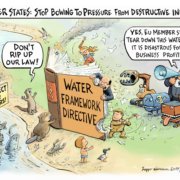
Les industries non durables, dont l’agriculture industrielle, l’hydroélectricité et les industries minières, font pression pour des modifications dévastatrices de la directive-cadre sur l’eau (DCE).

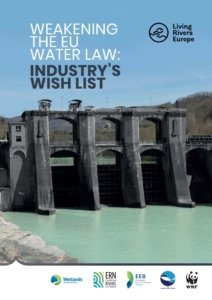
Le nouveau document des ONG (WEAKENING THE EU WATER LAW: INDUSTRY’S WISH LIST) montre que si les souhaits sont exhaussés, certaines modifications donneraient le feu vert pour développer des activités encore plus destructrices, ce qui pourrait causer des ravages à nos cours d’eau et lacs. Cependant, loin d’obliger ces acteurs à modifier leurs pratiques, certains États Membres ont dressé une liste de souhaits tout à fait similaire, soulevant de sérieuses questions quant à la définition de leurs véritables intérêts.

Ce papier, publié avant la réunion informelle du Conseil « Environnement » à Bucarest, en Roumanie, les 20 et 21 mai, et repris dans une lettre adressée aux ministres de l’Environnement des États membres de l’UE, lance la deuxième étape de la campagne menée par Living Rivers Europe pour garantir l’intégrité de la DCE et fait suite à la campagne #Protectwater au cours de laquelle plus de 375 000 citoyens ont exprimé leur souhaite que la DCE reste inchangée.

Télécharger le rapport (anglais)

Lire la lettre adressée aux Ministres de l’Environnement de l’UE

Accéder à la page de la campagne


Read Press release from Living Rivers Europe (anglais)
Brussels, 15 May 2019


Unsustainable industries, including industrial agriculture, hydropower, and coal mining, are lobbying for devastating changes to the EU water law – the Water Framework Directive (WFD).

A new paper from environmental groups [1] shows that, if ever put into effect, such changes would give these sectors the green light to undertake even more destructive activities, potentially causing havoc on our rivers and lakes. But, far from obliging these sectors to clean up their act, some Member States have compiled a strikingly similar wish list, raising serious questions as to where their true interests lie.

The paper, developed by WWF, EEB, Wetlands International, the European Anglers Alliance and European Rivers Network – who together form the Living Rivers Europe coalition – is published ahead of an informal meeting of the Environment Council in Bucharest, Romania on 20 and 21 May. Environment Ministers from all EU Member States will come together to discuss, amongst other topics, issues related to water management across the EU. The gathering comes in the wake of scientists declaring a state of ecological emergency, with extensive research confirming that nearly 75% of freshwater resources are now devoted to agriculture alone, and freshwater ecosystems are showing the highest rate of decline.

“Rivers, lakes and wetlands are our life-support systems, but they are being annihilated under our very eyes. We have the legal tool to stop this – the EU water law – but Member States must actively stand up to the sectors that pollute and destroy the most”, said Andreas Baumüller, Head of Natural Resources at  WWF’s European Policy Office. “Through the civil society-led #ProtectWater campaign, more than 375,000 citizens called for the water law to remain unchanged. Member States’ alignment with the positions of business lobbies begs the question: Do they really have the best interests of their citizens at heart?”

The briefing shows the clear alignment between the wishes of some Member States and those of lobby groups representing the interests of the agriculture, hydropower and mining sectors, as well as German industry associations (comprised of representatives of the construction, chemicals, and pharmaceuticals industries, amongst others). These parties want to weaken the WFD’s ambitious scope and environmental objectives, and attack two of the law’s most visionary cornerstones – the “one-out, all-out principle”, as well as the “non-deterioration obligation”, both crucial in assessing the health of freshwater bodies.

Where they differ is in their reasoning, which is completely contradictory – whilst Member States argue that these changes are needed to maintain ambition in EU water management, industry groups ask for changes because the current system is too ambitious.

« Industry groups and some EU member states are calling for the same changes to the EU water law – but, bizarrely enough, how they justify the need for these changes is poles apart: Whilst some governments say they are trying to be more ambitious to protect water, the industry groups say they want these changes because the current rules are too stringent. So, if Member States want to be truly ambitious, the current law needs to be kept and the focus needs to be on properly implementing it to protect the environment and human health, » said Sergiy Moroz, Water and Biodiversity Policy Officer at the EEB.

These arguments and questions have also been reflected in a letter sent by Living Rivers Europe to the Environment Ministers of EU Member States ahead of next week’s meeting in Bucharest.

ENDS

Télécharger le pdf

Contact:
Sophie Bauer, Communications Officer (Freshwater)
WWF European Policy Office
sbauer@wwf.eu
+32 471 05 25 1

[1] Living Rivers Europe, 2019, Weakening the EU water law: Industry’s wish list

[2] According to the “one-out, all-out principle”, a water body (such as a  river, lake or wetland) is only considered healthy if all the quality elements (for example the flow, whether it is biodiversity-rich, whether there are chemical substances) are in good status, and the overall status is defined by the quality element in the lowest class.

[3] Within the Water Framework Directive, Member States must ensure that the current state of of any given water body does not deteriorate any further.

[4] Officials from several Member States have drafted a paper on the Future of the EU Water Policy for the meeting of EU Water Directors in November 2018. The paper put forward several amendments to the WFD.

Notes to the editor:

About the EU Water Framework Directive (WFD)

  • The WFD is one of the EU’s most progressive pieces of environmental legislation. It requires the protection, enhancement and restoration of our rivers, wetlands, lakes and coastal waters.
  • Under the WFD, EU governments have committed to ensure no deterioration and achieve good status for the vast majority of all water bodies by 2015, and at the very latest by 2027.
  • The WFD requires Member States to aim to achieve at least good status in each water body within their river basin districts. Each Member State must produce a plan for each of the river basin districts within its territory. Member States should also coordinate the preparation of River Basin Management Plans (RBMPs) for international river basin districts (iRBDs).
  • Plans must include objectives for each water body, reasons for not achieving objectives where relevant, and the programme of measures required to meet the objectives.
  • In line with the WFD, the European Commission is required to publish a report on the implementation of the Directive every six years. The report has to include among other things a review of progress in the implementation of the Directive and a survey of the RBMPs submitted in accordance with Article 15, including suggestions for the improvement of future plans. First reports assessing RBMPs were published by the Commission in 2012; this report looks at 2nd cycle of River Basin Management Plans (2015-2021).
  • The Commission at the same time also published a report on the implementation of Floods Directive (FD), assessing flood risk management plans (FRMPs), member states were required to submit in 2015.
  • Where implemented, the WFD has proved to be effective in achieving its goals of good water status and non-deterioration, successfully balancing environmental, social and economic requirements.
  • The WFD is currently undergoing its standard review in the form of a ‘fitness check’. Every piece of EU legislation goes through this process. The fitness check will look at the relevance, effectiveness, efficiency, coherence and EU added value of the WFD (and its ‘daughter’ directives) and the Floods Directive. It includes the ongoing stakeholder consultation and public consultation.
logo Living Rivers Europe

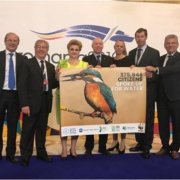
375,000+citoyens disent à l’Europe « Gardez notre loi sur l’Eau”

La consultation publique de la Commission Européenne sur la Directive Cadre d’Eau s’est achevée hier, mercredi 12 mars.
375 386 personnes ont demandé à la Commission européenne de défendre cette législation. Cette consultation publique de l’UE devient ainsi l’une des plus importantes de toute l’histoire de l’Union européenne.
Les citoyens ont parlé haut et fort et ni la Commission Européenne ni les États membres ne pourront ignorer ce chiffre.

Un grand merci et toutes nos félicitations à tous les citoyens et ONG qui ont participé.
Les travaux de Living Rivers Europe ne s’arrêtent pas à la mobilisation pour la consultation publique, la coalition LRE continue de suivre les travaux de la commission.

Lire le Communiqué de presse de Living Rivers Europe (en anglais)
Brussels, 13 March 2019

375,386 people have called on the European Commission to defend Europe’s strong water law, making the EU’s public consultation on the legislation one of the largest ever in the history of the European Union. This law is critical to ensure that Europe’s rivers, lakes and wetlands are protected and brought back to good health.

The NGO-led #ProtectWater campaign inspired citizens across Europe and beyond to take a stand for Europe’s rivers, lakes and wetlands, and the strong law which protects them, the EU Water Framework Directive, during the European Commission’s ongoing fitness-check

“375,386 citizens have spoken up for Europe’s precious rivers, lakes and wetlands, and against their ongoing destruction. They have told their governments loud and clear not to undermine the EU water law – decision-makers must now listen up and take these voices seriously”, said Ester Asin, Director of WWF’s European Policy Office, “With 60% of Europe’s waters in a critical state, the need for action from Member States is urgent. They were meant to put a stop to this destruction when they signed up to the Water Framework Directive in 2000, but, instead, have spent the best part of two decades brazenly side-stepping their commitments and not implementing it. We urge them to own up to their inaction today and, instead of pushing for this law to be changed, take citizens’ views on board.”

 “One need only look elsewhere in the world to see that Europe is incredibly fortunate  to have a general and cross-border legal framework in the shape of the Water Framework Directive to protect its rivers, lakes and  wetlands, underlined Roberto Epple, President of the European Rivers Network,  “It would be shameful to weaken it. Citizens have understood that. Member States should respect this and move up a gear to achieve the results outlined in this text, which can be considered a treasure.”

The #ProtectWater campaign was led by WWF, the European Environmental Bureau, the European Anglers Alliance, the European Rivers Network and Wetlands International – who together form the Living Rivers Europe Coalition. It facilitated citizens’ participation in the European Commission’s public consultation on the Water Framework Directive (the only opportunity for the general public to have its say during the EU fitness-check) to express their clear opposition to changing the legislation. It was launched in October 2018 and went on to be supported by more than 130 civil society organisations, including national partners and offices of Greenpeace, BirdLife and Friends of the Earth, as well as unions.

 The EU’s official analysis of the public consultation, which closed on 11 March, is likely to be published in the autumn of 2019, with the final decision on the future of the legislation expected by the first half of 2020. As Living Rivers Europe, we will be there every step of the way to ensure that the Water Framework Directive remains intact, and will continue to push for this visionary legislation to be fully implemented by Member States and enforced by the European Commission so that it that the vast majority of Europe’s waters are returned to good health by 2027 (at the absolute latest).

 Telecharger le communiqué de presse complet (en anglais)

Contact:
Sophie Bauer, Communications Officer (Freshwater)
WWF European Policy Office
sbauer@wwf.eu
+32 471 05 25 1

Notes to the editor:

About the state of water in Europe:

About the #ProtectWater campaign:

  • The goal of #ProtectWater is simple: to defend the Water Framework Directive (WFD) and in doing so, protect Europe’s rivers, lakes, groundwater and wetlands, and the wildlife they house, for generations to come.
  • The campaign was led by Living Rivers Europe (WWF’s European network, the European Anglers Alliance, European Environmental Bureau, European Rivers Network, and Wetlands International), who together represent a movement of over 40 million people across Europe.
  • 130+ civil society groups went on to support the campaign
  • The campaign allowed anyone to easily take part in the European Commission’s public consultation on the evaluation of EU water policy, which includes the WFD.
  • By filling in the e-action’s form (available on livingrivers.eu as well as individual organisations’ websites), individuals could quickly and easily send the suggested response to the public consultation to the European Commission on their behalf.
  • For more information, please visit livingrivers.eu

About the EU Water Framework Directive (WFD):

  • The WFD is one of the EU’s most progressive pieces of environmental legislation. It requires the protection, enhancement and restoration of our rivers, wetlands, lakes and coastal waters.
  • Under the WFD, EU governments have committed to ensure no deterioration and achieve good status for the vast majority of all water bodies by 2015, and at the very latest by 2027.
  • The WFD is currently undergoing its standard review in the form of a ‘fitness check’. Every piece of EU legislation goes through this process. The fitness check will look at the relevance, effectiveness, efficiency, coherence and EU added value of the WFD (and its ‘daughter’ directives) and the Floods Directive. It includes the ongoing stakeholder consultation and public consultation.

Recommendations for improving the implementation of the Water Framework Directive:

The following recommendations outline some of the actions Member States and the Commission need to take to ensure no further deterioration occurs and that the majority of water bodies in the EU achieve good status by 2027.

  • Member States should develop more effective and ambitious third-cycle river basin management plans (2021-2027) and associated programmes of measures to bring European waters to good status by 2027.
  • Member States should significantly restrict their use of exemptions to exceptional cases only. To uphold the purpose and effect of the WFD, the European Commission should use enforcement measures to facilitate significant reduction in the use of exemptions.
  • Member States should strictly apply the non-deterioration principle and
    precautionary approach. They must protect remaining free-flowing, unaltered
    and clean stretches of rivers for their biodiversity and ecological values and
    not leave them open to further hydropower development and modifications
    for inland navigation.
  • Member States should increase the uptake of nature-based solutions and
    dam removal to ensure that freshwater biodiversity can spread back into
    degraded areas.
  • Member States should apply in full the ‘polluter/user pays principle’ in line with the WFD, ensuring that water pricing reflects the true value of water and that all users, including agriculture, contribute to the full costs of water services in a more equitable way, the European Commission should take prompt and
    effective enforcement actions to ensure introduction of adequate water pricing.
  • Member States should improve transparency and enable effective public
    participation in river basin management planning and application of
    exemptions (e.g. Article 4.7 WFD).
  • Member States and the European Commission should ensure coherence between management and conservation of water ecosystems and relevant sectoral policies (most notably energy, agriculture, transport, flood management).
  • Member States and the Commission should improve procedures and introduce effective tools for preventing, detecting and sanctioning breaches of established water and conservation laws.
logo Living Rivers Europe

#ProtectWater : on dépasse les 340 000 signatures ! On continue jusqu’au 12 mars…

#ProtectWater : on a dépassé les 340 000 signatures … ce qui signifie que notre campagne figure désormais dans le top 3 des plus grandes consultations publiques de l’histoire de l’Union européenne !

MERCI à tous ceux d’entre vous qui ont signé !

Les autres peuvent encore le faire jusqu’au 12 mars inclus (la campagne est prolongée !) … et contribuer eux-aussi à cette incroyable aventure !

Je signe ici avant le 12 mars


logo Living Rivers Europe

La Commission Européenne publie aujourd’hui son dernier rapport sur la mise en oeuvre de la DCE

25 février 2019

Le dernier rapport de la Commission Européenne sur sa mise en œuvre, publié aujourd’hui, dresse un tableau sombre. Malgré la forte législation de l’UE sur l’eau, les rivières européennes sont en souffrance…

Bien que des progrès aient été accomplis, les États membres ne sont pas sur la bonne voie pour parvenir à assainir d’ici 2027 les rivières, les lacs, les zones humides, les cours d’eau, les nappes souterraines, les eaux de transition et les eaux côtières en Europe. Le rapport fournit une preuve supplémentaire que les États membres portent gravement atteinte à leurs engagements juridiques et, ce faisant, menacent la disponibilité de l’eau pour la nature et pour les hommes.

Vous pouvez accéder aux rapports de la Commission Européenne ici, mais tous ne sont pas encore disponibles. Pour le moment, il existe uniquement des liens  vers le rapport résumé de la Commission.

=> Lire le communiqué de presse de la Commission Européenne
=> Lire aussi les communiqués de presse des ONGs suivantes :
WWF EPO’s
Wetlands International
European Environnemtal Bureau (EEB)

La Commission européenne poursuivra l’Espagne en justice pour la destruction de Doñana

La Commission européenne a annoncé la semaine dernière son intention de traduire l’Espagne devant la Cour de justice des Communautés européennes au sujet de la grave détérioration des zones humides de Doñana et de sa non-application de la directive-cadre sur l’eau / DCE et des directives concernant les oiseaux et les habitats.


#ProtectWater : A ce jour, 200 000 signatures grâce à vous !

La campagne #ProtectWater a permis de passer le cap des 200 000 signatures auprès de l’Europe (en savoir plus).

MERCI à tous ceux d’entre vous qui ont signé !

On continue…. Faites circuler l’information autour de vous pour atteindre 300 000 signatures ! L’EAU réelle le vaut bien !

#ProtectWater : 200,000 signatures !! MERCI ! from European Rivers Network on Vimeo.

logo Living Rivers Europe

Révision de la DCE : le document mettant en péril la DCE n’a pas été approuvé à la réunion des Directeurs de l’Eau!

Bonne nouvelle : Le document rédigé par un groupe de représentants des gouvernements n’a pas été approuvé à la réunion des Directeurs de l’Eau le 29 Novembre dernier !

Pour rappel ce document, comprenait une série de propositions de modifications de la DCE qui, si jamais elles étaient mises en œuvre, constitueraient un affaiblissement significatif de la législation  !!

La lettre envoyée aux Directeurs de l’Eau au nom de la coalition Living Rivers Europe, ainsi que toutes les autres lettres envoyées séparément ainsi que les actions de communication ont été explicitement reconnues dans la discussion et dans le rapport final de la réunion! Félicitations!!

C’est un succès majeur pour Living Rivers Europe.


Révision de la DCE : Living Rivers Europe écrit aux Directeurs de l’Eau

La coalition Living Rivers Europe (European Anglers Alliance, EEB, Réseau des fleuves européens, Wetlands International et WWF) a envoyé aux Directeurs de l’Eau, en amont de leur réunion à Vienne le 29 et 30 novembre, une lettre afin d’exprimer ses profondes préoccupations quant au processus et au contenu des travaux du groupe de consultation sur l’avenir de la directive-cadre sur l’eau (DCE). LRE exhorte les Directeurs de l’Eau de ne pas approuver le document du Groupe de Consultation sur le « Futur de la Directive Cadre Eau « .

Lire la lettre (anglais)

Voir aussi la news du 8 novembre

Logo ERN, petit format

Les pneus de véhicule et les vêtements synthétiques sont deux des principales causes de pollution microplastique par les ménages (Foe UK)

L’étude britannique a estimé que seules quatre sources principales livrent chaque année entre 9 000 et 32 ​​000 tonnes de microplastiques dans les voies navigables.

L’abrasion des pneus et le lavage de vêtements synthétiques, tels que les polaires, constituent les deux principales causes.

Lorsque les gens lavent des vêtements en matière synthétique, des résidus passent dans les eaux usées car il n’y a pas de système pour récupérer ces minuscules fibres de plastique. Ils finissent par se retrouver dans les rivières ou dans l’environnement marin. Dans certaines régions d’Europe, on estime que les deux tiers des vêtements sont fabriqués à partir de matériaux synthétiques.
Des études récentes ont montré que le plastique finissait dans le corps humain.

lien vers l’étude (anglais)

lire aussi la version anglais de cette news (plus complèt)