Logo Openrivers

Open Rivers Programme call open and helpdesk support

the Open Rivers Programme call will be opening shortly, on 21 February.


The call will be for barrier identification projects, preparation and demolition. Just a reminder that ORP have also extended the opportunity for public entities to apply. There are however restrictions to consider, including 50% co-funding.


A DRE helpdesk is in place to support organisations from South Eastern Europe with their applications, an initiative coordinated by WWF, WFMF and ERN, through funding from Open Rivers Programme project “Scaling Up Dam Removal in South Eastern Europe”.


If you are thinking about developing a dam removal project, please join us in a series of meetings where we will explain more about Open Rivers Programme, help review your proposal and where you can gain valuable insights from ORP grantees.


Important information for those of you who are planning to submit an ORP

  1. Magda Jentgena from WWF Latvia will be presenting about her project on 22 Feb 11:00 CET. Please join us, to celebrate Magda’s work and to hear more about the Dam removal work in Latvia!
  2. There are a series of meetings to explain more about ORP funding and discuss the Expression of Interest and how we can help you in the process (introduction, review process & Q&A) hosted by the DRE Helpdesk. Please choose one of these dates to participate (28 Feb, 7 March, 14 March).
  3. If you would like to make use of the Helpdesk review process. The internal deadline is 14 March (this takes into account easter holidays).
  4. ORP will host a Q&A on 12 March at 16:00-17:00. This is coordinated by ORP. As soon as we have information regarding registration, we will let you know.

Read the helpdesk flyer to find out more about what we can do for you.

Let corinne.ronot@rivernet.org  know if you are taking part in one of these meetings, so that we can send you the links.
Historic milestone for rivers: Emptying of the Iron Gate dam on the Klamath River to prepare its removal

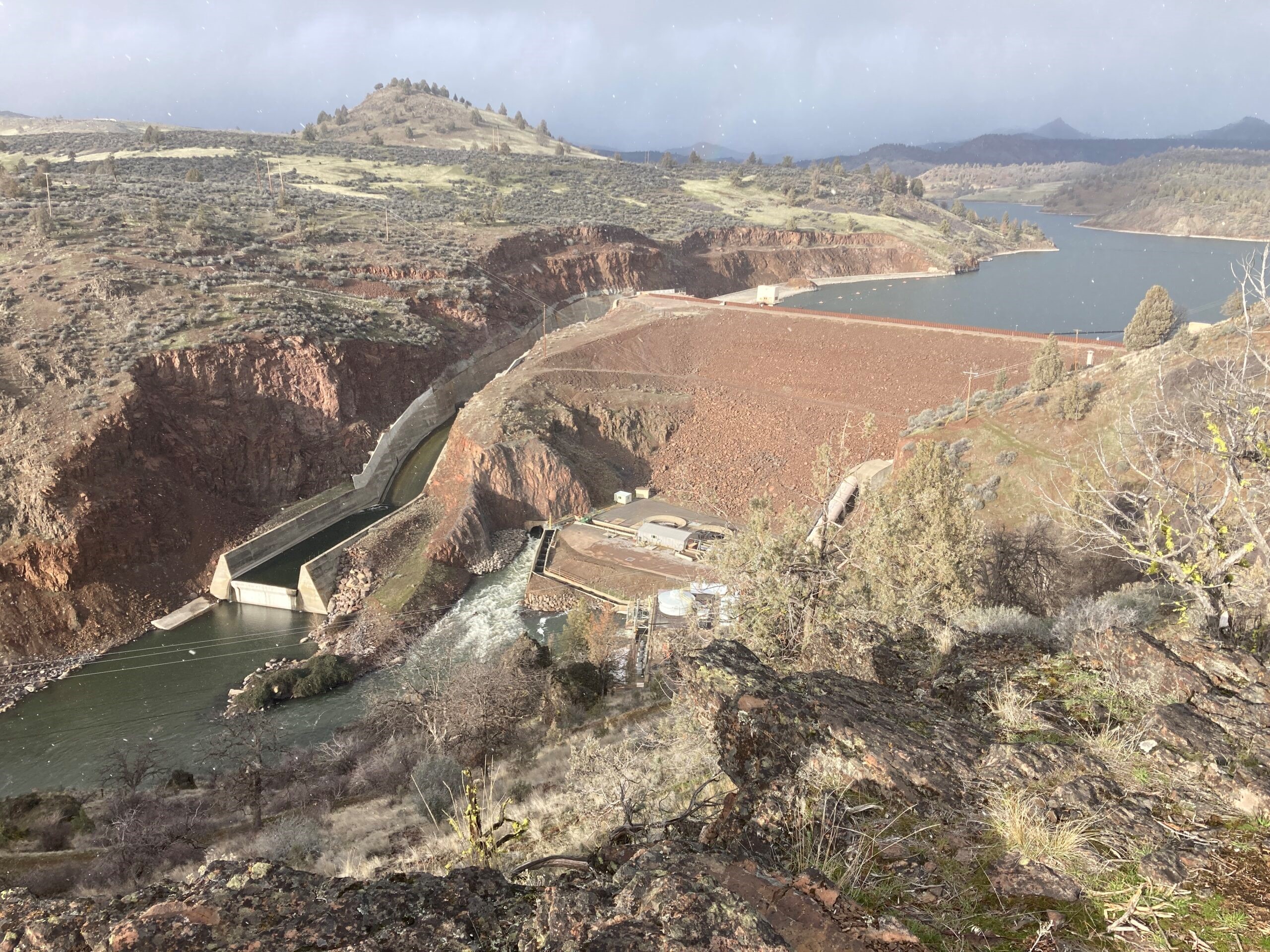
The largest dam removal and river restoration project in the history of the United States is taking a major step toward the removal of all hydroelectric dams on the Klamath River in northern California and southern Oregon. The drawdown (draining) of Iron Gate Reservoir began early January so that Iron Gate Dam can be removed later this year. Two other dams, Copco #1 and JC Boyle, will likewise begin to drain in the coming weeks and be fully removed in the summer/fall timeframe. Copco #2, the smallest of the four dams slated for removal, was demolished in October 2023.

IRONGATE dam Klamath

For more than 100 years, these artificial barriers have blocked the migration of several species, like salmon and steelhead trout, impeding them from reaching over 400 miles of habitat. Not only the animals have been harmed. Water quality has been severely damaged, impacting the Hupa, Yurok, and Karuk tribal communities whose livelihoods depend on a healthy river.

To turn the tide, this monumental project symbolizes a collective effort to repair a century of obstruction to fish migration, celebrate indigenous heritage, and ensure the long-term vitality of the Klamath River ecosystem. The project integrates the growing movement to remove more dams and free rivers across the USA, a trend that has also been scaling up in Europe in the past decade through the combined action of several organisations integrating the Dam Removal Europe coalition.

This article is an extract from the article published by Dam Removal Europe (read the complet article)

A dam project on the last wild stretch of the Rhône river!

The STOP Barrage Rhonergia collective is alerting the public to the construction by CNR of a hydroelectric dam on the last wild stretch of the Rhône river in the communes of St Romain de Jalionas (38) and Loyettes (01). This old-fashioned project, already abandoned in 1990, is a waste of public money, even though it will provide little energy. It is a project with irreversible impacts on an already fragile biodiversity.

Prior consultation on the Rhônergia project began on 1 December 2023, for a statutory period of 3 months, until 29 February 2024, in parallel with the initial studies.

You can consult the contributions on the consultation site managed by the CNDP by clicking on the following link ACCESS TO CONTRIBUTIONS and contribute yourself if you have any information.

Studies are available, including one by ZABR on the risks downstream of the project (drinking water supply for the Lyon conurbation, pollution, river level and temperature) https://concertation-rhonergia.fr/fr/documentation 

A call for alternative solutions has also been launched: https://concertation-rhonergia.fr/fr/la-concertation/les-alternatives-l-appel-a-contribution . These alternatives will be presented to the general public at the public meeting (open to all) on Tuesday 23 January 2024 in Saint-Vulbas.

Sign the petition to say no to the dam project: https://www.change.org/p/stop-au-barrage-rhonergia-sur-le-dernier-tron%C3%A7on-sauvage-du-fleuve-rh%C3%B4ne
For more information, see the collective’s website: https://www.stopbarrage.fr/ The collective is apolitical, made up of citizens from nearly 20 communes in our region.
Website dedicated to the consultation: https://concertation-rhonergia.fr/fr/le-projet

Read ERN-SOS Loire Vivante contribution

15 days to go until 2 February, World Wetlands Day!

In a couple of weeks, we’ll be celebrating wetlands all over France and the world!

530 events have already been approved for WWD 2024.

From 2 to 29 February, organise or take part in an event on the theme: “Wetlands, sources of human well-being”.

Our 2023-2024 webinars are online: flood risk, ecological continuity, hydric stress, etc.

With between 70 and 90 people registered for each webinar, SOS Loire Vivante – ERN is helping to raise awareness of the issues surrounding water and rivers.
Watch the replays of our webinars from December 2023 and January 2024 (french only):

9 January 2024: Flood risk: “How can technology help us respond better to flood risk?” more info and programme here
19 December 2023: Law, Hydro & Ecological Continuity, more info and programme here , organised in partnership with Réseau RivièresTV, the Centre de Ressources Cours d’eau and supported by the French Office for Biodiversity (OFB)
5 December 2023: Water stress and water savings on the Allier, more info and programme here

All our webinars since 2020 (french only)

30 years of the victory for a living Loire

On 4 January 1994, precisely 30 years ago, the Interministerial Council decided to definitively abandon the construction of the large Serre de la Fare dam. This was a major victory for the Loire and SOS Loire Vivante, supported by numerous NGOs.

See our press release for the 30th anniversary of the victory (french only)

At the same time, Michel Barnier, then Minister for the Environment, published the first Plan Loire Grandeur Nature, which not only included the abandonment of the Serre de la Fare, but also blocked other dam projects and launched a brand new exemplary policy for the management of the Loire River.

This decision put an end to 5 years of occupation of the site (Plage au Pont de Chadron).

“We want to be proud of the Loire, proud of a beautiful, free, natural Loire and proud of a living, active, enterprising Loire”.
– Michel Barnier, former French Minister for the Environment –

To find out more about the Plan Loire Grandeur Nature, visit our page on the subject: https://www.ern.org/fr/le-plan-loire-grandeur-nature/ (french only)

A special Montpezat rivernews has just been published!

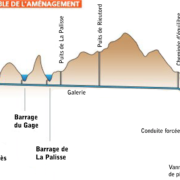
Our latest Rivernews december / january 2024  is devoted entirely to the Montpezat hydroelectric complex and provides an update on the volumes stored and transferred in 2023. Allg figures are to be confirmed during January 2024 and will be updated if necessary on our dedicated webpages.

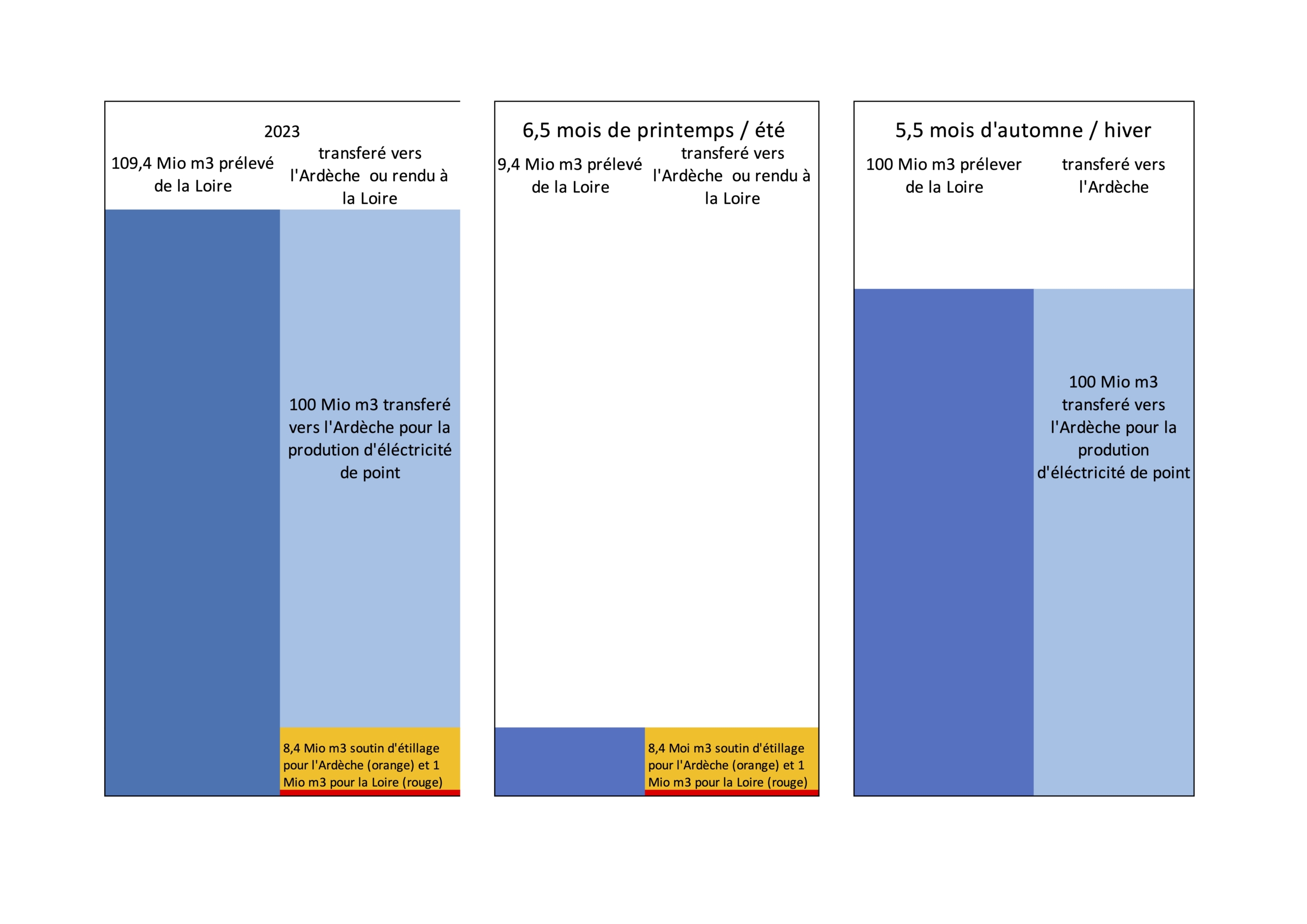
In 2023, 108.4 million m3 were transferred to the Ardèche (compared with 220 million m3 in the “best” years). Most of this, 100 Mio m3, was taken from the Loire in autumn and transferred in winter for peak electricity production. The significant drop in rainfall in autumn/winter resulted in a 50% reduction in winter turbines compared with the past. In spring, 9.4 Moi m3 were stored in the reservoirs on the Loire side and used to support the low-water levels of the Ardèche (8.4 Moi m3) and the Loire (1 Moi m3), in line with the low-water support objectives. The year 2023 had got off to a bad start, however, and it seemed impossible to fill the reservoirs at the La Palisse, Gage and Issarlès dams, but the weather came to the complex’s rescue in the last few weeks, just before the summer period, which means that the Issarlès lake must remain open to tourists.

See also our other articles:

  • Raising the La Palisse dam: good idea or bad idea?
  • Immersion at the Citizens’ March for equitable water sharing between the Loire and Ardèche rivers
  • Children send us a message: Some of the winners of the 2022-2023 edition of Rivière d’Images et Fleuves de Mots, environmental education project

Read our newsletter (in french only)


Figures for 2023
Volumes stored and transferred to the Ardèche or returned to the Loire

Free Flow Conference 2024: Full programme out now!

The World Fish Migration Foundation and the Institute of Fisheries Management, invite you to a 3-day conference about the protection and restoration of Free-Flowing Rivers in Europe.

Gathering policy makers, river managers, ecologists, researchers, students, and industry, this international event expects +400 delegates from all over Europe and the rest of the world.

View the full programme 

When & Where: April 15-17, 2024 in Groningen, the Netherlands

Official website: https://freeflowconference.eu 

Registrations are open until April 1, 2024. Register here!

Salmon Comeback Rhine: Visit to the fish pass construction site

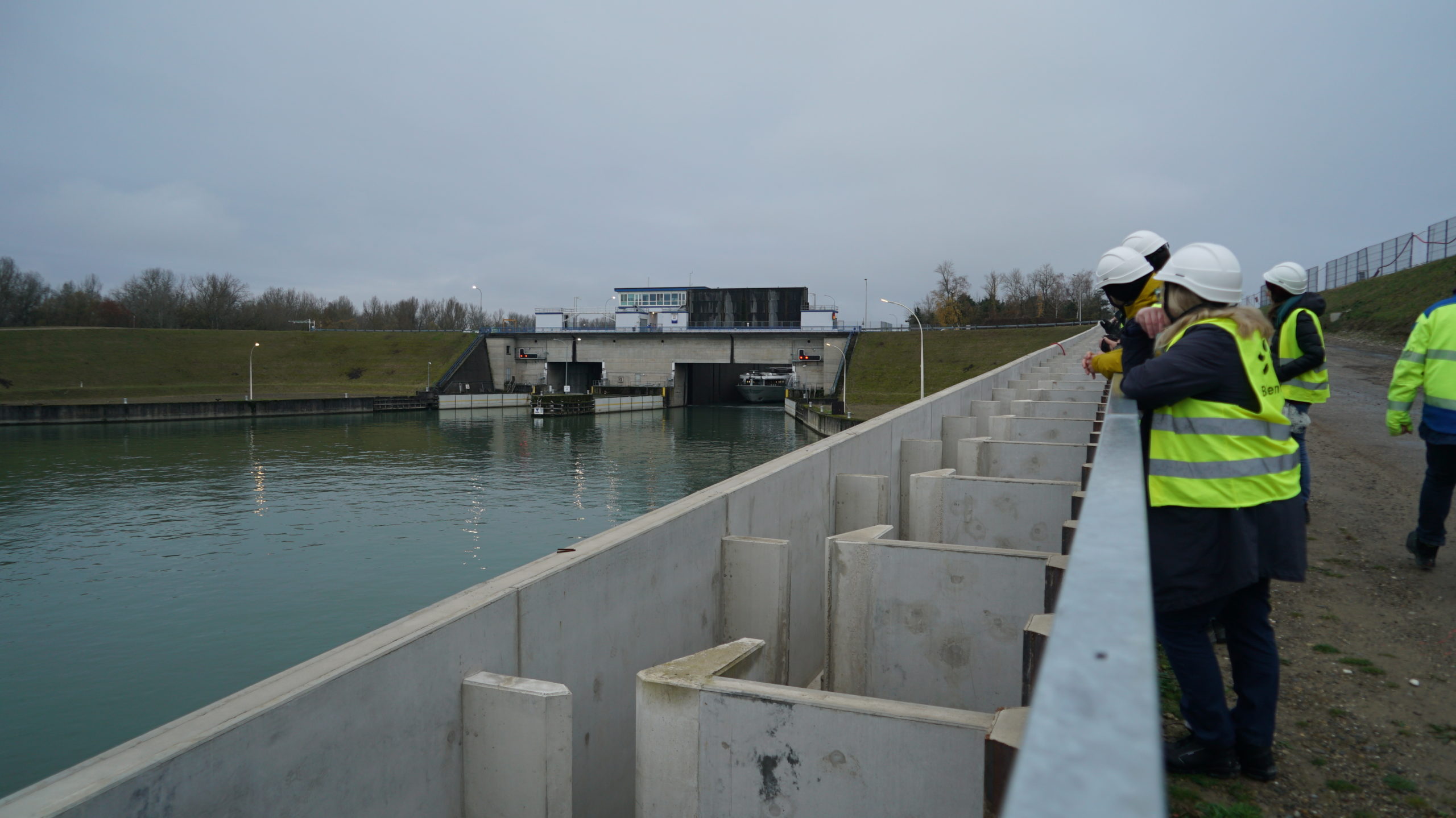
From Thursday 30 November to Friday 1 December, the ERN team travelled down the Rhine to see the progress of the fish passes under construction at the Marckholsheim and Rhinau sites. These projects, managed by EDF, represent an investment of several tens of millions of euros to protect the Rhine’s large migratory species. The two projects, which are identical, are being carried out with a slight time lag of 8 months between the two sites.
These fish passes have several entrances on each side of the power station, on the left and right banks, enabling each fish to find its way to the pass. To pass from the left bank to the right bank, the fish will use a “bridge” that will pass over the power station. This will take them a total of 1 kilometre to get around the power station. The fishways will span a 13 m difference in height, and consist of more than 90 upstream pools with a 20 cm drop between each pool.
Friday morning was devoted to a meeting in Kembs to monitor the renaturation of the Rhine island.

More info about Salmoncomeback Rhine campaign


© ERN

© ERN

National Biodiversity Strategy 2030 to preserve and restore biodiversity

France presents its new strategy for preserving and restoring biodiversity.

The aim of the National Biodiversity Strategy 2030 is to halt and then reverse the loss of biodiversity. It gives concrete expression to France’s commitment by proposing 40 specific measures in 4 axis:

1: Reduce the pressures on biodiversity
2: Restore degraded biodiversity wherever possible
3: Mobilise all stakeholders
4: Guarantee the means to achieve these ambitions

The National Biodiversity Strategy 2030 (SNB) reflects France’s international commitments under the Convention on Biological Diversity, and is the national implementation of the Kunming-Montreal Global Biodiversity Framework adopted in December 2022 in Montreal.