Logo Openrivers

Open Rivers Programme continues to support projects in France and across Europe

72 projects supported by the Open Rivers programme throughout Europe and a new call for projects underway

At the beginning of November 2023, the Open Rivers Programme* launched a new call for projects to provide financial support for the removal of weirs and dams. Applications can be sent in until 8 December.

After two years of the implementation of the Open Rivers Programme, 72 projects are supported throughout Europe, either underway or completed, contributing to the achievement of the objective of 25,000 km of freeflowing rivers by 2030 in Europe, voted on 09/11/2023 by the European Parliament as part of the Restoration Naturation Law. It is a significant support for restoring rivers in Europe, including in France where legislation to restore ecological continuity is frequently attacked to slow the momentum and hamper the efforts made by a community of stakeholders to restore our rivers effectively and sustainably in favour of energy issues of little interest.

France is one of the pioneers of the dam and weir removal movement in Europe, which began in 1998, and the results are encouraging, not only in terms of reconnecting river habitats but also in terms of increasing functionality and reducing the risk of flooding. Other European countries, such as Finland, Spain and Sweden, also see dam removal as a viable solution for restoring rivers. Elsewhere, however, tools are still lacking, particularly in Eastern Europe, to facilitate the implementation of such measures. This is why ERN, together with regional and international partners (World Fish Migration Foundation (WFMF), Fauna & Flora, MedINA Greece, Wetlands International (WI), WWF Netherlands, Slovakia, and Adria) are running a project with the Open Rivers Programme to facilitate and accelerate the removal of barriers in 4 target countries: Croatia, Greece, Romania and Slovakia. These countries have all the conditions needed to develop, inspire and raise awareness of the benefits of this tool for restoring nature: high ecological potential, emerging opportunities and projects, strong community involvement (more info).

In this context, WWF, WFMF and ERN are organising Q&A sessions to answer technical questions from potential projects on 15 and 20 November. Interested parties can contact corinne.ronot@rivernet.org  The next Open Rivers application session is scheduled for the end of February for all grant categories.

Latest news on French projects run by ERN and its local partners

Since 2021 and the launch of the programme, ERN has applied with several local partners for preliminary studies and works, and 6 projects have been selected.

In 2022-2023 ERN worked with the SYMBA on the Open Rivers Programme application to restore the Tardoire, an european eel river. After six months of works to removed four obsoletes weirs, the river was flowing again on more than 20 kms. After just a few months, the riverbed was unrecognisable, and habitats were quickly recreated (more info). To make this story happened Open Rivers Programme funded 100% of the works, because even the local stakeholders were all in favour of the project, the States at this moment was not in a position to finance such project. A 12 minutes movie in French and English subtitle relate the project and the stakeholders involvement.

Latest, ERN and its local partners obtained two new preliminary study projects for the removal of small obsolete weirs. One is located in the Eyrieux river basin (Ardèche catchement) and is run by the SMEC and the other is in the Branugues river basin (Cère and Dordogne catchement) and is run by the SMDMCA. These two projects are located in preserved area with high biodiversity potential and will allowed to reconnect habitats for fish (trout) and white-clawed crayfish, increase their range, and improve the resilience and morphology of the river. A great opportunity to restore the functionality of the river through a simple acte : remove obsolete barrieres on rivers.

More info

* Open Rivers Programme is a foundation funded by Arcadia which aims to restore endangered European rivers by supporting interventions that lead to the removal of small dams and the restoration of river flow and biodiversity.
 

Download press release 

A look back at the Conference Salmons an People 3, another step towards saving salmon

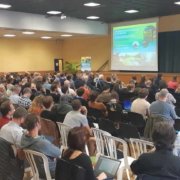
Over the two days of Thursday and Friday 19 and 20 October 2023, 100 people took part each day, with a total of 7 different nationalities (France, Germany, England, Ireland, Canada, Denmark and the United States) came to listen to original presentations and debate with speakers from all over France (from the Gaves, the Rhine, the Garonne and, of course, the Loire-Allier), as well as international experts, local players, government representatives, researchers, engineers, associations, hydro-electricity companies and other users (VNF, professional fishermen, recreational fishermen, etc.). ). The various presentations highlighted the current issues surrounding the conservation of wild salmon, from their impact on the high seas to the heart of the rivers.


In the run-up to the event, SOS Loire Vivante – ERN worked in partnership with schools and after-school care centres in the Loire basin on a project to raise awareness of the river and hold creative workshops on salmon. The paintings and works produced by the children were exhibited at the conference. Fifty students from the Brioude Bonnefont agricultural college, some of whom had taken part in the educational programme, attended the Thursday morning plenary session, and two Brioude nursery classes surprised us by visiting the exhibition on the Friday morning.


More than sixty people also took part in the meal organised at the Hotel Restaurant la Crèche, a venue that was once home to experienced salmon fishermen. During the meal, two 15-minute videos on restoring ecological continuity by removing dams were shown.


Friday afternoon marked a break with the rest of the programme by refocusing the discussions on the Loire. The round table provided an opportunity for constructive discussion, and for unblocking positions so that we could finally move towards a shared roadmap.


On Saturday, 35 people took part in the day’s visit, including some new participants. After a visit to the Maison du Saumon et de la Rivière in Brioude, which includes aquariums showing the species found on the Allier and the history of the Brivadois region around salmon, two itineraries were proposed:


Itinerary 1: Visit to the Allier valley between Brioude and Chanteuges, with a “virtual” visit to the “new Poutès dam” due to the vigipirate plan preventing visits to the site, in partnership with EDF, and a visit to the National Wild Salmon Conservatory de Chanteuges, with Nature A Lier.


Itinerary 2: Visit to the Alagnon basin, where major efforts have been made to restore ecological continuity: visits to dams that have been removed and restored in the basin: Grand Pont, Chambezon, Massiac, Stalapos), in partnership with SIGAL.


Presentations, summaries and photos are online. The replay and summary will follow shortly on the following page : Colloque « Des Saumons et des Hommes 3 » 19-21 Oct 2023 à Brioude – SOS LOIRE VIVANTE

International conference “Salmons & people “: Registration now open

The salmo salar – extinction or restoration?
We need a shared roadmap!

Salmon is in decline in France, as is biodiversity in general. Migration statistics are clear: fewer and fewer migratory fish are reaching their best spawning grounds, particularly those on long rivers, such as the Loire-Allier axis….
All hope is not yet lost, however, as there are promising examples where rigorous, jointly-developed measures have resulted in an upward trend. Despite climate change.
Ten years after the last meeting, SOS Loire Vivante – ERN is organizing a new event in an attempt to unite the players around a common roadmap. Probably the last chance!

> More info and registration


Logo Openrivers

Open Rivers : Second weir removed on the Tardoire !

Save the date : international colloquium “Des Saumons et des Hommes 3 ” 19-21 October 2023 – Brioude (France)

Ten years after the last meeting, SOS Loire Vivante – ERN is organising a new conference on the Loire salmon. This is an opportunity to take stock of the situation of the Atlantic salmon in the Loire and elsewhere. National and international experts will try to understand the reasons for the decline despite restoration efforts and whether our actions are still in line with current and future challenges.
Is it due to climate change or to phenomena at sea or in the river? During the health check and the presentation of the results of restoration actions, we will compare the case of the Loire with other highly migratory river basins such as the Rhine, the Elbe, the Adour, the Garonne, the Sélune, etc,
Are you interested in this event?

  Sign up to receive all the news in the coming months

France/Sélune River : the large Roche qui boit dam removed

– The “La Roche qui boit” dam has been removed!
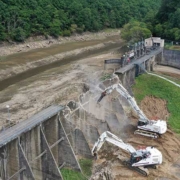
After many postponements, the second 17-metre high dam “La Roche qui boit” on the Sélune has been demolished. A 45-metre wide breach has already been opened to allow the flow of any floods. The remaining sides of the 120 m wide structure and the renaturation work should be completed by the end of 2022. After the demolition of the 37 m high Vezins dam two years ago, the ecological continuity of the historic salmon river Sélune is now restored after about 100 years. In the main river alone, more than 60 km are free and allow access to former spawning sites. Salmons could swim up the Sélune from the Baie Saint Michel during the next salmon migration, at the latest in spring 2023. Two castillons (salmon that have only spent one year at sea) have already been observed by specialists just downstream of the “Roche qui boit”. The campaign for a free Sélune led by associations including ERN, the French Fishing Federation, FNE and others will have lasted 20 years. A great success!


Copyright : ERN – Roberto Epple

> more information 


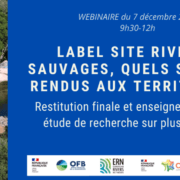
[Replay-Webinar] What services do wild rivers provide?

The replay of the webinar on wild river services is online.

This webinar presents the results of a study conducted on 3 watersheds labeled “Wild Rivers Site”. It highlights the main technical and scientific, social, environmental, territorial and economic lessons learned from the ecosystem services generated by rivers in very good ecological condition.

The research and development contract on the ecosystem services of wild rivers in connection with the ecological label “Site Wild Rivers” is carried out by the French Office of Biodiversity (FOB) in partnership with ERN France, Association du Réseau Rivières Sauvages and Cerema.

Following a first study of the ecosystem services of the Taravo watershed financed by the department of South Corsica, the related study, financed by the OFB, concerns 3 labeled watersheds: the Esteron (06), the Léguer (22) and the Nant-Bénin (73).

It has been followed by agents of territorial services and National Parks. It is in the process of being finalized, with this seminar being one of the stages.

To discover it, chapter by chapter in french only, go to: https://professionnels.ofb.fr/fr/node/1405

7th Dam Removal Europe seminar

ANP|WWF Portugal, World Fish Migration Foundation, Wetlands International and The Nature Conservancy invite you to the 7th Dam Removal Europe seminar, an event that will be held, for the first time, in Lisbon, Portugal, where the dam removal process is starting.

This time, the objective is to increase the general commitment and know-how on dam removal, to make it as effective as possible and to initiate new funding mechanisms and policy changes. Speakers from Europe and beyond will share their best practices.

The event will consist of a two-day conference and a third day devoted to a field trip to a river restoration site. The seminar is part of the global celebrations of World Fish Migration Day and one of the highlights will be the Portuguese premiere of the documentary DAMBUSTERS.

ERN, official partner, will participate in the event with a live broadcast on the Romanche river where Roberto Epple, president of the association, will present the destruction of 4 dams on this river.

You will meet river basin authorities, ministries, mayors, political decision makers, European project managers, water agencies, companies, engineers, researchers, students, social experts and the public interested in free flowing rivers.

To register and access the program, click here!


An overview of the Sélune conference by the AFB has just been published

The French Agency for Biodiversity has just published its latest issue :

– Effacement de barrages, Quand la Sélune reprend son cours, – 24 au 26 septembre 2019, Les Rencontres, OFB, n°70,  déc.2019, french
Dam removal: The Sélune River free to run – 24 to 26 september 2019, Les Rencontres, OFB, n°70,  déc.2019, english

This 6-page issue is entirely devoted to the Sélune conference held from September 24 to 26 in Rennes and Avranches.

A more detailed 60-page book on the conference communications is also being prepared.

Presse release : Conference ” Selune Valley Revival” success on all fronts !

Communiqué de presse du 20 octobre 2019

download press release (in french only)

Du 24 au 26 septembre 2019,s’est tenu à Rennes et à Avranches le 5ème colloque international sur la restauration de la continuité écologique des cours d’eau et les effacements de barrages. L’excellent accueil des partenaires locaux, des services de l’Etat, mais aussi des différents prestataires a permis à tous d’apprécier, en plus des conférences, la gastronomie et les paysages locaux. European Rivers Network les remercie encore vivement.

Cet évènement réussi a suscité l’intérêt d’un large public démontré par le nombre et la diversité d’acteurs présents (plus de 200 participants de 20 pays différents, acteurs locaux ou nationaux, élus, services de l’Etat, gestionnaires, entreprises privées, associations).

Afin qu’un plus large public bénéficie des débats du colloque, European Rivers Network a mis en ligne l’ensemble des 26 présentations,en français et en anglais,depuis la page internet du colloque sur www.ern.org. Par ailleurs, ERN étudie, avec ses partenaires,la possibilité d’offrir une restitution synthétique et grand public du colloque, sous une forme qui reste à définir.

Pour les participants,l’évènement a tenu ses promesses, les échanges ont été très riches. Le colloque a notamment permis de motiver les acteurs qui travaillent avec engagement pour restaurer la qualité des rivières, de faire connaître et vivre leur réseau, de partager des retours d’expériences français et internationaux,utiles pour de futurs projets et de prendre conscience de l’impact sociologique de l’arasement d’un grand barrage.L’excellence technique d’un tel projet doit se doubler d’une véritable«ingénierie sociale», c’est-à-dire d’une réelle concertation locale, allant bien au-delà de l’enquête publique.

«Au-delà du «pour» ou «contre» le projet d’arasement de la Sélune, ce sont les échanges, les leçons apprises durant le colloque et les appels à l’apaisement et à la concertation qui doivent être retenus et entendus. Le pourquoi de l’enlèvement des barrages, nécessaire pour l’intérêt collectif, mais mal compris, ne doit pas continuer de bloquer les volontés d’avancer et les initiatives déjà nombreuses sur le territoire.Le projet de la Sélune est unique d’un point de vue technique et scientifique:nous souhaitons pour ce magnifique territoire que l’intelligence collective fasse émerger un projet d’avenir porté localement sur la Sélune libre.»dit Roberto Epple,Président-fondateur d’ERN.

Ce colloque aura aussi montré que la Sélune n’est pas un cas isolé, que partout en Europe et au-delà, depuis 20 ans, des acteurs relèvent avec succès le défi fou de restaurer les habitats de nos derniers poissons migrateurs, nos vallées et la qualité de l’eau pour tous les usagers.Le prochain colloque sur la continuité écologique et les effacements de barrages aura lieu en Allemagne (Bavière) au Printemps 2020.