Big Jump 2018: Citizens jumping in rivers & lakes across 18 European countries to protect the future of our waters (PR WWF/ERN)
Citizens jumping in rivers & lakes across 18 European countries to protect the future of our waters (PR WWF/ERN)
ERN / WWF Press release Monday 9 July – 10.30am
Citizens jumping in rivers & lakes across 18 European countries to protect the future of our waters
Yesterday, thousands of people across Europe jumped into rivers, streams and lakes in more than 160 European ‘Big Jump’ events. Groups of families and friends were jumping to make a statement and protect our rivers and lakes, and to show that Member States must follow the positive spirit of the EU water law which they committed to: “Water is not a commercial product like any other but, rather, a heritage which must be protected, defended and treated as such”, as stated in the introduction of the EU Water Framework Directive.
The public engagement event saw people jumping, diving, wading, kayaking in 18 European countries from Spain to Poland. The Big Jump is an annual event founded by European Rivers Network that has taken place since 2002. WWF offices across Europe organised 48 Big Jump events, and used this occasion to kickstart its #ProtectWater campaign to save the EU Water Framework Directive, a crucial legal instrument to protect Europe’s freshwater ecosystems.
A landmark policy to its core, the Water Framework Directive recognises that, if we are to secure a sufficient supply of good quality water in the future, we must conserve our freshwater ecosystems. “This Big Jump has shown that people love rivers and lakes. It is a place of pleasure, joy and fun. The abundance of wildlife makes these ecosystems a special place for our threatened nature. However, it is very worrying that Member States have been skirting around their legal commitments under EU water laws for the majority of the past two decades. It is high time to understand that water is the base of all life on earth and not a commercial product like any other,” says Andreas Baumüller, Head of Natural Resources at WWF’s European Policy Office.
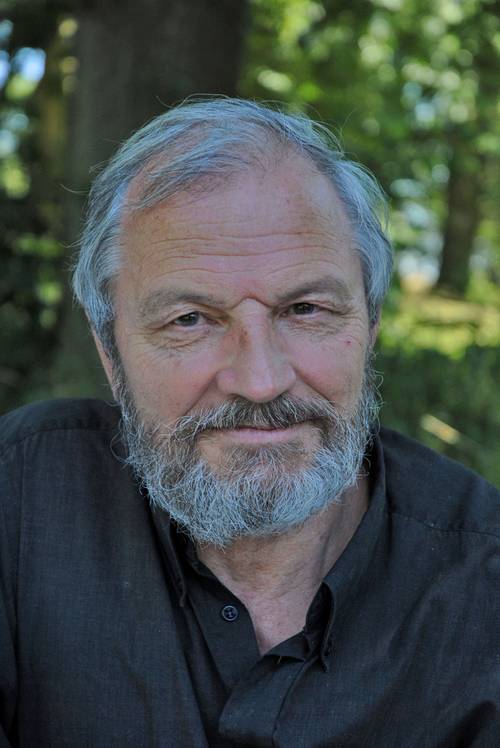
“Sunday was a fun day out in places that people love but with a serious purpose: Europe’s leaders must do more to protect our wonderful waterways,” stated Roberto Epple, founder of the Big Jump and chair of European Rivers Network.
NOTES TO THE EDITOR
Facts about the Big Jump
Founded by the European Rivers Network in 2002, the Big Jump is an open source event that aims to remind people of how valuable Europe’s rivers, lakes and wetlands are. The Big Jump seeks to inspire people to remember the powerful ties that bind them to freshwater ecosystems, and encourage them to join the fight to save them.
Since 2002, around 200,000 people have taken part before in over 2000 events.
Facts about the WFD
By restoring people’s connection to rivers and lakes, the Big Jump seeks to build support for efforts to protect and restore Europe’s freshwater systems – the goal of the EU’s world-leading Water Framework Directive (WFD). This directive is now under review and the Big Jump 2018 sent a clear message to the continent’s decision-makers to not weaken these laws, but to implement them.
- The WFD is one of the EU’s most progressive pieces of environmental legislation. It requires the protection, enhancement and restoration of our rivers, wetlands, lakes and coastal waters, but Member States are currently failing make it work on the ground;
- Under the Water Framework Directive, EU governments have committed to ensure no deterioration and achieve good status for the vast majority of all water bodies by 2015, and at the very latest by 2027;
- Where implemented, the Water Framework Directive has proved to be effective in achieving its goals of good water status and non-deterioration, successfully balancing environmental, social and economic requirements.
The Water Framework Directive is currently undergoing its standard review in the form of a ‘fitness check’. Every piece of EU legislation goes through this process. The fitness check will look at the relevance, effectiveness, efficiency, coherence and EU added value of the Water Framework Directive (and its ‘daughters’) and the Floods Directive. This will include a stakeholder consultation and a public consultation, which is expected to be launched in September 2018.
Contact info
Liesbeth Van den Bossche
EU Campaigner – WWF European Policy Office
lvandenbossche@wwf.eu +32 477 81 10 20
Roberto Epple
Chair of European Rivers Network roberto.epple@ern.org +33 6 08 62 12 67
Congratulations : nice BIG JUMPs accross Europe !
160 Big Jump in 18 countries ! Congratulations !
United Kingdom, Denmark, Germany, Belgium, France, Spain, Italy, Switzerland, Austria, Serbia, Hungary, Croatia, Slovakia, Poland, Ukraine, Turkey and Israel were there ! Thank you very much !
See pictures from few BIG JUMP in our Facebook « Big Jump For Rivers »
Next Big Jump is 14 July 2019, save the date !
Big Jump : Today 10 000 citizens jump into rivers
Today 10 000 citizens will celebrate the rivers and jump in the water. More information
European waters getting cleaner, but big challenges remain (PR/ EEA)
Press release from European Environement Agency, 3 July 2018
Image © EEA/Peter Kristensen
We must increase efforts to ensure our waters are as clean and resilient as they should be — our own well-being and the health of our vital water and marine ecosystems depend on it. This is critical to the long-term sustainability of our waters and in meeting our long-term goals of living well within the limits of our planet.
Hans Bruyninckx, EEA Executive Director
EU Member States have made marked efforts to improve water quality, by improving wastewater treatment and lowering the runoff of pollutants from farmland, according to the EEA report ‘European waters — assessment of status and pressures 2018’. Measures have also been taken to make barriers passable to migrating fish and restore degraded aquatic ecosystems.
While Europe’s ground water bodies, like aquifers, are in good health in most cases, only 40% of monitored lakes, rivers, estuaries and coastal waters achieved the the EU Water Framework Directive’s minimum ‘good’ or ‘high’ ecological status during the 2010-2015 monitoring period, according to the report. The last EEA assessment in 2012 found a similar level of water bodies meeting ‘good’ or ‘high’ ecological status. The EEA assessment also looked at the quantitative state and over-abstraction of Europe’s groundwater and the overall chemical status of water bodies.
The EEA report gives an updated health check on over 130,000 surface and groundwater bodies monitored by EU Member States, based on the data collected and reported from more than 160 so-called River Basin Management Plans covering the period 2010 to 2015.
‘Thanks to the implementation of European water legislation in the Member States, the quality of Europe’s freshwater is gradually improving, but much more needs to be done before all lakes, rivers, coastal waters and groundwater bodies are in good status. Tackling pollution from agriculture, industry and households requires joint efforts from all water users throughout Europe,’ said Karmenu Vella, EU Commissioner for Environment, Maritime Affairs and Fisheries.
‘We must increase efforts to ensure our waters are as clean and resilient as they should be — our own well-being and the health of our vital water and marine ecosystems depend on it. This is critical to the long-term sustainability of our waters and in meeting our long-term goals of living well within the limits of our planet,’ said Hans Bruyninckx, EEA Executive Director.
The EEA water assessment is the second since 2012. Knowledge of Europe’s waters has grown significantly since then, providing a better understanding of the status, the problems that lead to failure in achieving ‘good status’ and the measures implemented to generate improvement. The EEA report complements a forthcoming European Commission report, which will assess to what extent the Member States comply with the Water Framework Directive. This Directive sets out a framework on how to assess, manage, protect and improve water quality across the EU. It requires Member States to produce River Basin Management Plans (RBMPs) as well as a Programme of Measures to improve water quality.
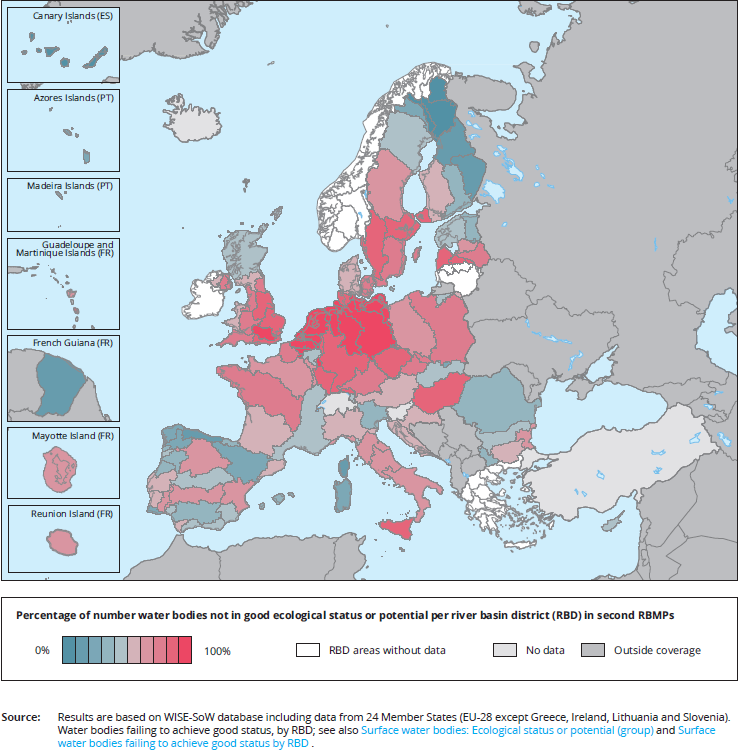
Percentage of surface water bodies in less than good ecological status by River Basin Districts
Note: Percentage based on known ecological status or potential (without unknown status). Caution is needed when comparing results between Member States, as the results can be significantly affected by the methodology applied by individual Member States.
Other key findings
- Compared to surface waters, groundwater sources generally have the best status. Good chemical status has been achieved for 74% of the groundwater area, while 89 % of the area achieved good quantitative status. The reasons for not meeting the minimum targets were mostly due to contamination of water sites by nitrates from agricultural run-off, salt intrusion, and the seeping of hazardous chemicals from contaminated sites (e.g. industrial sites, mining areas or waste storage).
- Northern Scandinavia, northern United Kingdom (Scotland) and Estonia, as well as Slovakia, Romania, and several river basin districts in the Mediterranean region show a high proportion of surface water bodies in high or good ecological status. In contrast, many of the central European river basin districts, with higher population density and more intensive agriculture, show the highest proportion of water bodies failing to achieve good ecological status.
- Only 38% of monitored lakes, rivers and other surface water bodies are in good chemical status — with concentrations of pollutants not exceeding environmental quality EU-wide standards.
- In most Member States, a few substances account for poor chemical status, the most common being mercury. Once widely used in thermometers, batteries, and paints, mercury continues to be found in water samples, followed by cadmium, which is used in phosphate fertilisers and in metal production.
- The Water Framework Directive and RBMPs have significantly improved water management across the EU. Many Member States have invested in better ecological and chemical monitoring programmes, with more monitoring sites, more quality elements assessed and more chemicals analysed. This has led to increased availability of information and provides a much better understanding of status and pressures. The Water Framework Directive has also generated a substantial effort across EU Member States to reduce sources of pollution from agriculture, industry and households, as well as in a more natural flow of rivers and the removal of obstacles to fish migration, generating benefits for nature and protection against floods.
EU water quality target
Achieving good status involves meeting certain standards for the ecology, chemistry and quantity of waters. Ecological status is the best overall indicator of how healthy a body of water is. It takes into account how pollution, habitat degradation, climate change, and other pressures like the number of man-made dams impact the quality of the water.
The top pressures responsible hindering progress in meeting the EU targets include barriers like dams, land reclamation, and channelization, which change the flow of rivers or streams; diffuse source pollution like farm run-off; and point source pollution such as waste water discharge from sewers. The main impacts on surface water bodies are nutrient enrichment, chemical pollution and altered habitats due to morphological changes.
Monitoring and reporting are the main tools used to classify the health of EU waters. EU Member States define the status based on a scale from high, good, and moderate to poor and bad status for surface waters and two classes, good or poor, for groundwater. Monitoring is meant to track the effectiveness of measures to clean up water bodies and achieve the EU’s ‘good status’ target.
EU Member States are currently in their second monitoring and reporting cycle (2015-2021) under the EU Water Framework Directive. This round includes 89,000 rivers, 18,000 lakes, 13,000 groundwater sites, and 3,600 coastal and estuary waters. Reporting from Greece, Ireland, Lithuania and from parts of Spain could not be included in the report.”
WFD Fitness Check ! Be ready !
The Water Framework Directive (WFD), which has made great works in protecting and restoring our rivers, lakes and groundwaters, is under fitness check by the European Commission.
To make our voices heard, and protect our rivers, get ready to participate at the public consultation which will be launched in september or october 2018.
We must show that people care about our rivers and don’t want this ambitious and important policy for our living well to be weakened. To protect our lakes and rivers we need to protect the WFD
Sign up (on our Big Jump website) to get informed of the launch of the public consultation. www.bigjump.org/en/participant-form/
Read more www.ern.org/en/living-rivers-europe
We need your help to upgrade our statement to our governments : we need to preserve the ambition of the WFD.
Big Jump, J-6 ! Are you ready ?
One simple jump. It’s easy for us – but it means a lot to our rivers. Come and join us to protect our rivers on Sunday 8 July. Yes, that’s the day of the Big Jump.
List of events and registration on www.bigjump.org
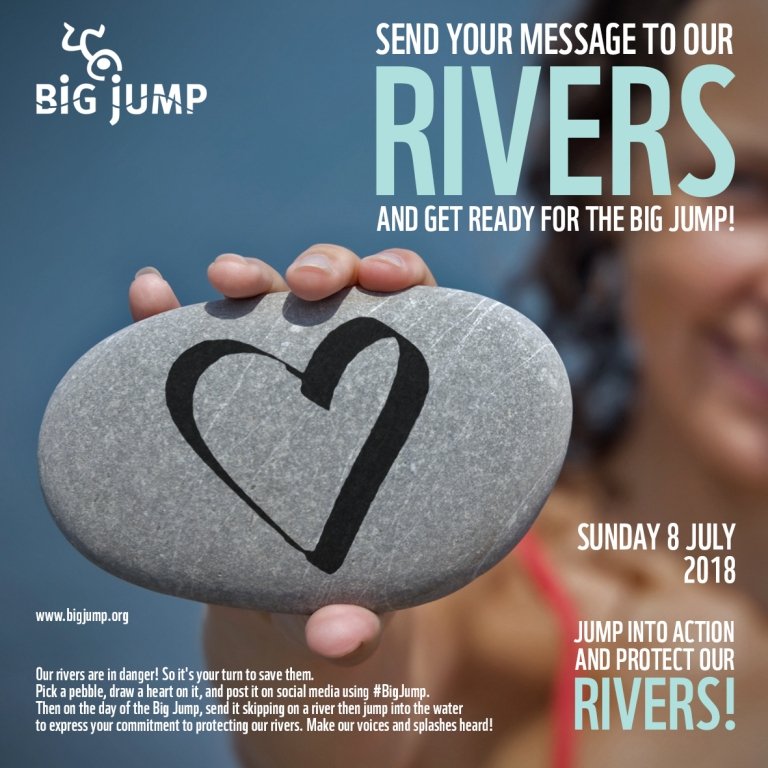
To send a message to our government, grab a pebble, draw a heart on it to express you care about our rivers. Then on the day of the Big Jump, send it skipping into a river near to you. Share on social media !
Big Jump is a European wide event that raises awareness about our rivers, and brings people together to express their willingness to protect them.
#ProtectWater #BigJump #BigJumpForRivers

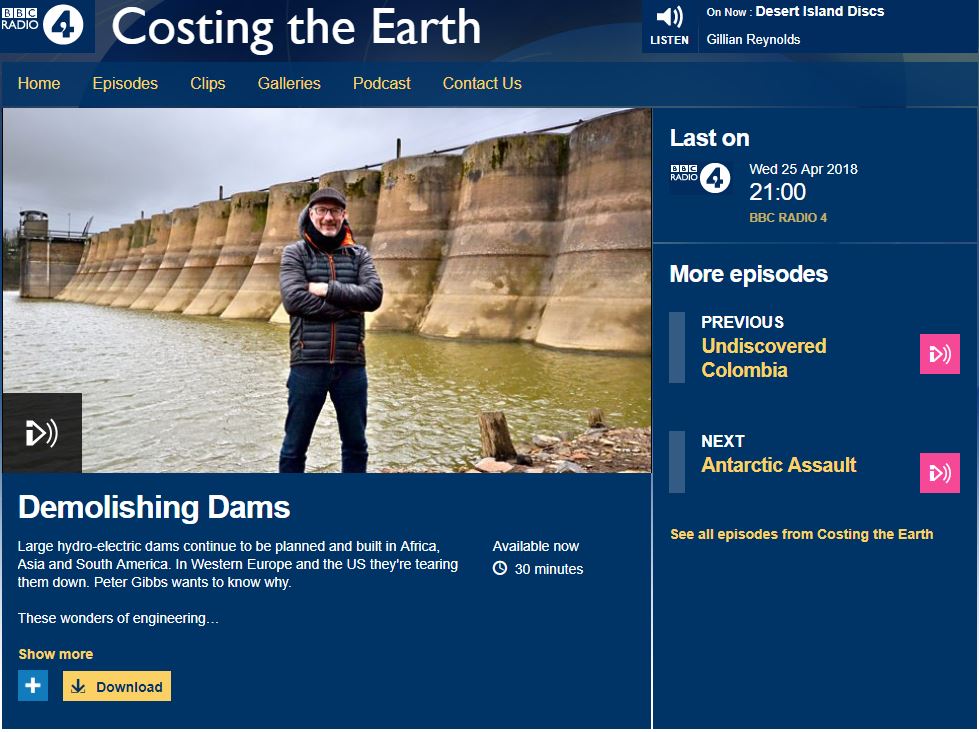
Sélune dam removal : BBC radio investigate
In April, the BBC radio came to Normandy to report on the Sélune dams removal.
Listen to Normandie Grands Migrateurs, INRA, SAGE de la Sélune and Amis du Barrage interviews (english) : www.bbc.co.uk/programmes/b09zxl85
15 of May : First screening in France of the film «Blue Heart», produce by Patagonia
Patagonia will present his new movie “Blue Heart” in France the 15 of May 2018, at Paris Mk2 cinema.
Second movie produce by Patagonia after Dam Nation, this film is part of the campaign “Save the Blue Heart of Europe“.
ERN France (Roberto Epple) is invited to participate to the debate which will follow the screening. Zoé Heart, Patagonia’s ambassadress will also be present.
Watch the trailer :
All screening dates : https://blueheart.patagonia.com/intl/en/film