World Fish Migration Day – Exceptional visit of the “New Poutès” in France

On the occasion of the World Migratory Fish Day, of which ERN is an official partner, SOS Loire Vivante organizes in cooperation with EDF two guided tours of the “Nouveau Poutès” dam.

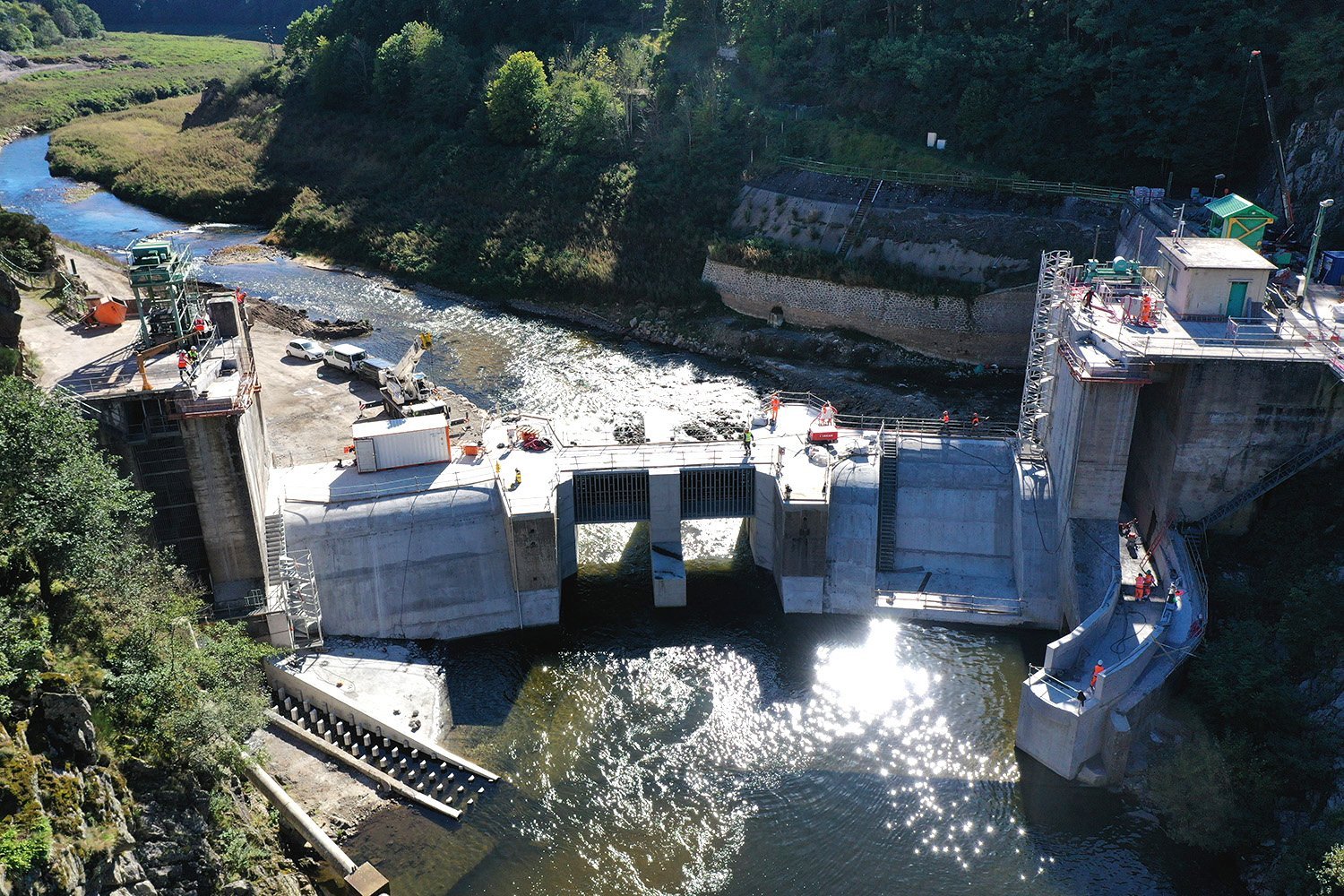
Indeed, in the Haut Allier, the works at the Poutès dam are now completed! Since the end of 2021, the dam is reconfigured to allow the free circulation of the last wild salmon populations during 3 months per year while maintaining about 85% of the hydroelectricity production.

To know MORE about the World Migratory Fish Day

Become aware of the relationship between humans and fish

Freshwater fish are the emblems of living rivers, indicators of good quality of the environment and vector of the development of sustainable activities on the territories. 15,000 species of freshwater fish and more particularly the 1,100 species of migratory fish are in danger. They no longer travel freely because of the numerous developments carried out on our rivers over the last few centuries (dams, weirs, etc.). To accomplish their migration, which is essential for their complete life cycle, they are now dependent on our policies and our commitments to restore and protect our rivers.More info on https://worldfishmigrationday.com/ but also Twitter, Facebook, Insta
 

Visit of the “Nouveau Poutès” dam organized by SOS Loire Vivante on May 21

On the occasion of the World Migratory Fish Day on May 21, SOS Loire vivante and EDF invite you to explore this exemplary site.
After many years of partial leveling and reconfiguration work, the result of our struggle, the site is now finished. By opening two huge gates, it allows migratory fish to pass through for 3 months a year, the rest of the year the water is turbined while respecting a minimum flow of 5m3/s for the Allier between Poutès and Monistrol d’Allier.
Reserve your place as soon as possible

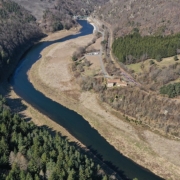
France : “Nouveau Poutès dam” : observation of the lenght of the reservoir

> Watch the ERN Video “Overflight of the Allier River upstream of the Poutès dam” 

Only since the second week of March it has been possible to turbine. Indeed, since the closing of the gates, the Allier had never exceeded the reserved flow (5m3/sec). According to EDF, the operating tests were positive.

On March 15, with a total flow of 15m3/sec, we were able to observe the creation of a reservoir over a few hundred meters. Further upstream, the Allier, deeper than in the ‘transparency’ mode of the dam over a few hundred meters, remained in its former minor bed with a good current favorable to migration.

On Thursday March 24th, this time with a total flow of the Allier of 10M3/sec, SOS Loire Vivante – ERN  flew over the site at high altitude with a drone to better observe the evolution of the bed and the water retention area. In addition, with the authorization of EDF, we flew at low altitude as close as possible to the dam and the water intake. The observations of March 15 were confirmed.

> Watch the ERN Video “Overflight of the Allier River upstream of the Poutès dam” 

May 21, 2022 is World Migratory Fish Day !

May 21, 2022 is World Migratory Fish Day !

Organized every two years by the World Fish Migration Foundation, this day honors free-flowing rivers and migratory fish, which are often threatened. This day, many organizations around the world organize events on the theme “Reconnecting fish, rivers and people”. Already 95 events open to the public are registered, and it is not over.

> Check out the events

> Any association or individual can get involved and register an event.
Organize an event

> Take part in the actions organized by SOS Loire Vivante / ERN:
Virtual visit of the “New Poutès” dam completely reconfigured for salmon migration.

The location of the dam on the upper Allier river is of crucial importance: it determines the access of the salmon to the best spawning areas for the Loire-Allier strain of salmon, a unique strain able to migrate over long distances!

SOS Loire Vivante / ERN will organize a visit to the “new Poutès” dam and will record the visit and conduct interviews on site.

Other actions are being organized by SOS Loire Vivante.


> Website of the world fish migration day

France : Public policies to safeguard the Loire Salmon : a total incoherence !

France: PUBLIC POLICIES TO SAFEGUARD THE LOIRE SALMON: A TOTAL INCOHERENCE!

On the Allier, while EDF is completing work on the “new Poutès”, which will improve the situation of the salmon in the Allier, its own subsidiary, SHEMA, is building a hydroelectric power station that will perpetuate the negative impacts of the Vichy dam, which will reduce to nothing the efforts made upstream. Absurd and revolting!

>>read the complet Press release (in french only) edited by ERN-SOS Loire vivante and other NGO


This autumn, on the Poutès dam (river Allier)…

On September 29th, on the almost finished construction site of the new dam of Poutès (Allier),
the installed gates were lifted for the 1st time, just in time for the arrival of the salmons!

Ideal conditions for a free circulation of migratory fish and sediments…

The beginning of the hydroelectric production is planned for Spring 2022.

Read the press release (french)

2021 sept. /New gates have been installed and lifted on Poutes dam!  photo R. Epple ERN

>> More infos on “le Nouveau Poutès”

Allier river (France) : The work on the Poutès dam in the spotlight

The work of the New Poutès on the Allier river has recently been highlighted in the french national medias.

At first, an article, by Martine Valo, was published in the famous daily newspaper Le Monde on 25/02/2021, entitled “Le barrage de Poutès s’ouvre pour laisser filer vers l’Atlantique les saumons sauvages de l’Allier”.

>> See the article of Le Monde of 25/02/2021

It was followed closely by two reports in the television news of France 2 and TF1 of which here are the extracts:

>> Extract from the 8:00 pm news of March 04, 2021 on FR2 (3’29)

>> Extract from the 8:00 pm news of March 07, 2021 on TF1 (3’54)

See our pages for more infos on Poutes Dam

Hydropower in Europe : Transformation – not development (WWF Report)

European rivers are the most fragmented in the world, contributing to the rapid decline in freshwater biodiversity.
As a result, a drastic transformation of the hydropower sector is urgently needed to reduce its environmental
impact. This can be achieved through several steps: the first one is to stop building new hydropower plants which worsen the fragmentation of rivers and lead to the loss of precious habitats and species.

The second step is to lessen the environmental impact of existing plants through plant environmental refurbishment. From ecological flows to acquiring knowledge on fish migration patterns, hydropower plants can be adapted and managed in a more nature- sensitive manner, as illustrated by a case study on the Allier River in the Loire Valley, France.

The third step is the restoration of the rivers’ natural functions,
in particular continuity and habitats. The case study on the construction of a reproduction channel next to the Imatra hydropower plant in Finland, illustrates active restoration measures that should be taken to complement mitigation measures at the plant itself.

download the WWF Report :  https://www.wwf.eu/what_we_do/water/?uNewsID=2329866 


Documentary “Salmons and Men”

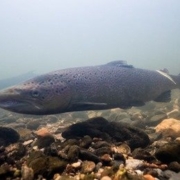
Photo : Saumon atlantique dans la rivière Allier.© Stéphane Granzotto

Directed by Stéphane Granzotto, this film was broadcast on France 3 Auvergne-Rhône-Alpes in November 2020.
This documentary is about the Atlantic Salmon (Loire Allier strain), and focuses on the journey of the species on the Allier River, a tributary of the Loire River (France). Among the obstacles presented, the Vichy dam or the Poutès dam and its redevelopment in favor of the migration of the Salmon.

Film again available in full on vimeo : To be seen here


In 2021, ERN will tell you a story in pictures…. but which one??

….the story of the restoration of ecological continuity in France, of course !

Please support our project before December 18

In 2021, our association ERN is going to realize a series of several short films, on the policy of restoration of the ecological continuity in France * : ” For free and living rivers: erase, modify and avoid ” (Project n°1)

To conduct its project, ERN has been selected among others in the framework of MobBiodiv’2020 by the Ministry of Ecological Transition and the French Office for Biodiversity (OFB).

Until December 18, citizens can vote to elect a “Coup de coeur du public” among the 47 projects.

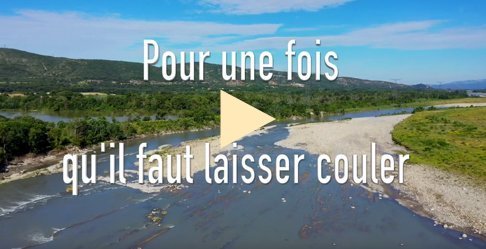
Watch our trailer here

VOTE : Did you like it?  Just click here and vote for ERN’s project n°1 “Erase, Modify, Avoid – for living rivers” (Attention, to vote, you have to go to the very bottom of the page!). Thanks !


* Indeed, France is a leader in Europe in restoring ecological continuity in particular by erasing small and large cross-cutting structures. Since 1997, it has acquired recognized know-how through innovative policies and major projects. The period 2020-2022 will be marked by large-scale river restoration projects on an international scale: the removal of two large dams on the Sélune and the complete reconfiguration of the Poutès dam on the Haut Allier.
It is to tell and share the French experience that ERN has planned to produce a series of audiovisual modules for the general public, as well as micro-videos for social networks. Broadcasting is planned on a national and international scale.