The exhibition “The Journey of a Grain of Sand” has just opened

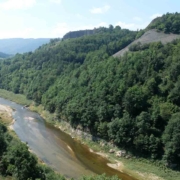
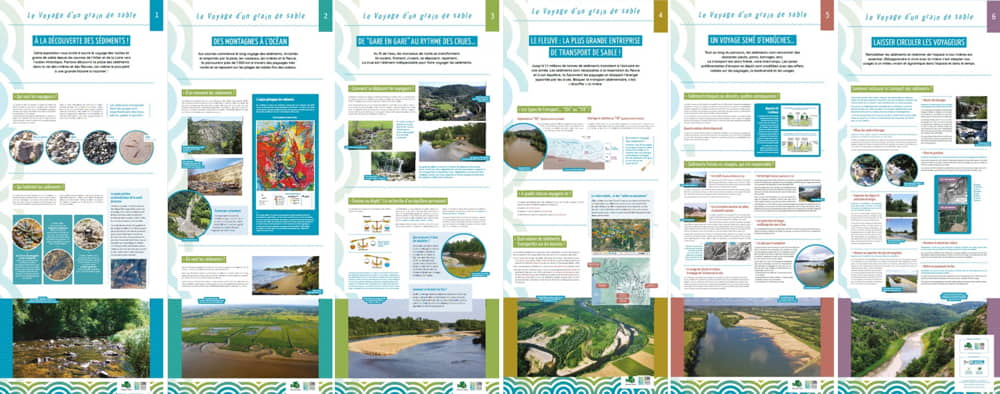
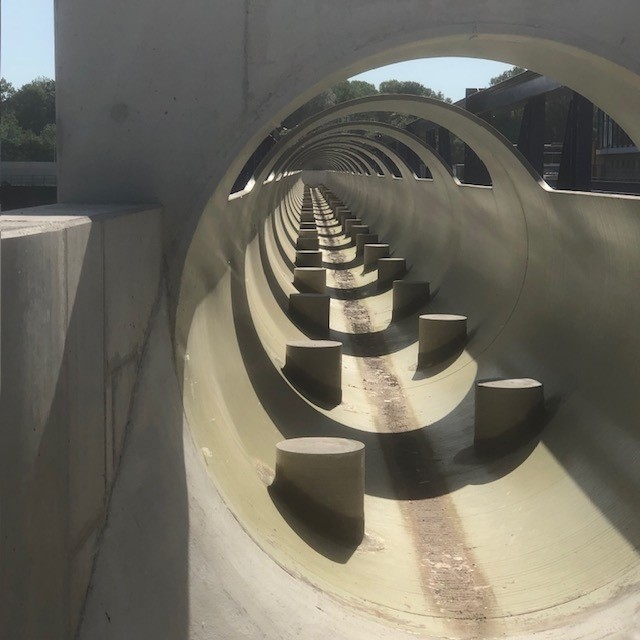
This exhibition, organized by SOS Loire Vivante – ERN with support from the Loire-Bretagne Water Agency as part of the Haut-Allier territorial contract, invites you to follow the journey of rocks and grains of sand from the headwaters of the Allier to the Atlantic Ocean. You’ll learn about their role in how rivers function and the vital role that flooding plays in maintaining healthy rivers. You’ll see how human activities can disrupt sediment transport. Many restoration projects are possible, from upstream to downstream, and have in fact been carried out on the Allier and the Loire. Come check out the six panels! (in french only) :

Panel 1: Discovering Sediments
Panel 2: From the Mountains to the Ocean
Panel 3: “From Station to Station” to the Rhythm of Floods…
Panel 4: The River: The Largest Sand Transport Company!
Panel 5: A Journey Full of Pitfalls…
Panel 6: Letting Travelers Pass

View the exhibition in PDF ; a printed version on an 85×200 roll-up banner is available for loan upon request—please contact us


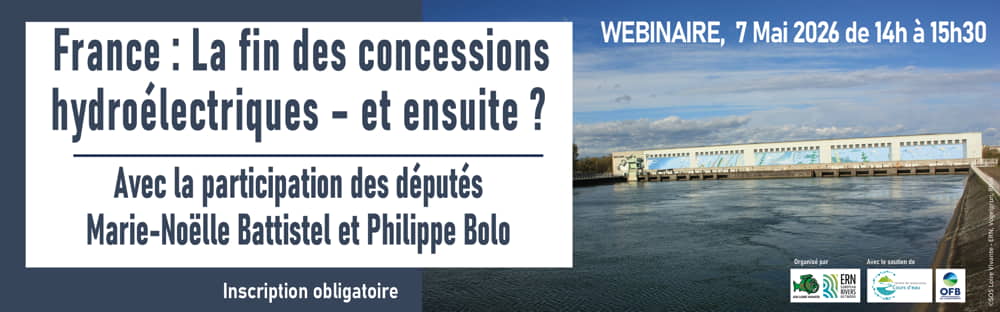
Exclusive webinar on the expiration of hydroelectric power concessions: Thursday, May 7, 2026, from 2:00 p.m. to 3:30 p.m.


Le projet de loi visant à relancer les investissements dans « la grande hydroélectricité » est en cours d’adoption. Ce texte vise à réformer le régime juridique des concessions hydroélectriques et faire cesser le contentieux européen.Pour nous expliquer ce qui va changer Marie-Noëlle Battistel (SOC, Isère) et Philippe Bolo (Dem, Maine-et-Loire), viendront nous présenter le projet de loi en rappelant le cadre, les implications pour les installations du territoire, les éventuels points encore en discussions et les problématiques que cela soulève.Programme : 45 min. de présentations , 45 min. Questions & RéponsesAnimation : Roberto Epple, Président SOS Loire Vivante – ERN et Corinne Ronot co-directrice SOS Loire VIvante=ERN


les questions essentielles qui seront abordées :– Quelles sont les différences entre le régime de concessions et les futures ‘autorisations’

– Quel est le parc d’équipement concerné, les concessions en cours sont-elles également concernées ?

– Quelle sera la gouvernance lors du changement de régime de chaque installation ? et pendant la phase d’exploitation ?

– L’Etat restera-t-il le propriétaire des barrages ?

– Quelle est la contrepartie pour l’Europe ? % d’énergie revendu ? à quel prix, à qui ?

– Est-ce une opportunité de réduire les impacts environnementaux des installations sur les milieux aquatiques ? Comment, Pourquoi ?

les panelistes (des représentants d’ONG, en cours d’invitation) viendront aussi poser leurs questions.

Si vous avez des questions complémentaires vous pouvez les envoyer à corinne.ronot (at)rivernet.org avant le 4 mai 2026. Elles seront compilées et relayées aux intervenants et panélistes sous réserve d’acceptation


Cet évènement s’adresse à un public large : gestionnaires des milieux aquatiques, ONG, services de l’Etat, citoyens.

Il a le soutien financier de l’OFB et participe aux actions du centre de ressource cours d’eau

Plus d’infos et inscription

Are there still rivers for migratory fish?

Registration is now open (in French only)

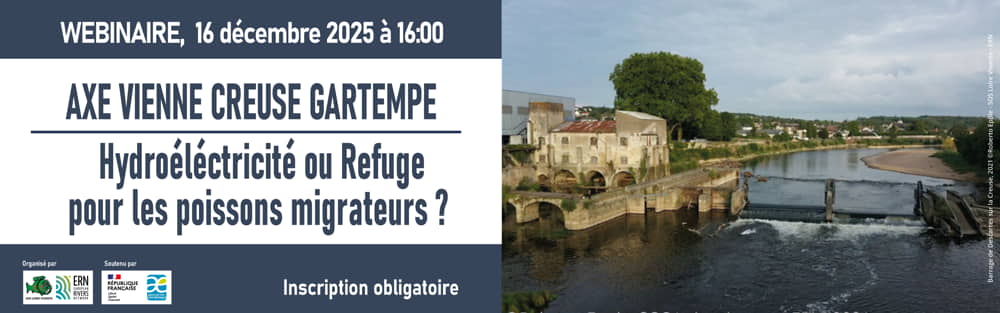
  • 16 December from 4pm to 6pm: Axe Vienne Creuse Gartempe – Hydroelectricity or Refuge for Migratory Fish ?

Registration (in French only)

The Creuse has been identified as a key area for migratory fish in the context of climate change. Restoring watercourses and water quality, removing pressures, reconnecting rivers and providing access to refuge areas will facilitate the resilience of watercourses and the return of migratory fish to our rivers.
However, due to the energy transition in particular, there has been an increase in projects to equip weirs with micro-hydroelectric power stations, perpetuating the fragmentation of waterways on strategic routes.
Can these rivers be both sources of hydroelectric power and refuges for biodiversity and endangered migratory fish?
Should we sacrifice biodiversity and water quality in the name of renewable energy, or demand radical solutions to restore the free movement of species and the health of our rivers?


Programme : 1h de présentations, 1h round table , Q&A 

by ERN-SOS Loire Vivante (Roberto Epple, Président, Corinne Ronot, Co-directrice)

Speakers

  • Bruno Bordeau, Président LOGRAMI : L’axe Vienne-Creuse-Gartempe, un refuge pour les poissons migrateurs ?
  • André Berne, Avocat du barreau de Paris : Le droit français au secours de la biodiversité ou de la production d’énergie renouvelable ?

Table ronde / Questions – réponses 

  • Gilles Deguet, représentant FNE au comité de bassin Loire Bretagne
  • Bruno Barbey, Directeur FDAAPPMA 36
  • Joël Herbach, Président Allier Sauvage
  • Lionel Martin, Président de la Fédération de Pêche de la Haute Loire
  • un représentant du secteur de la production hydroélectrique (sous réserve)

25,000 km of open waterways?

Registration is now open (in French only)

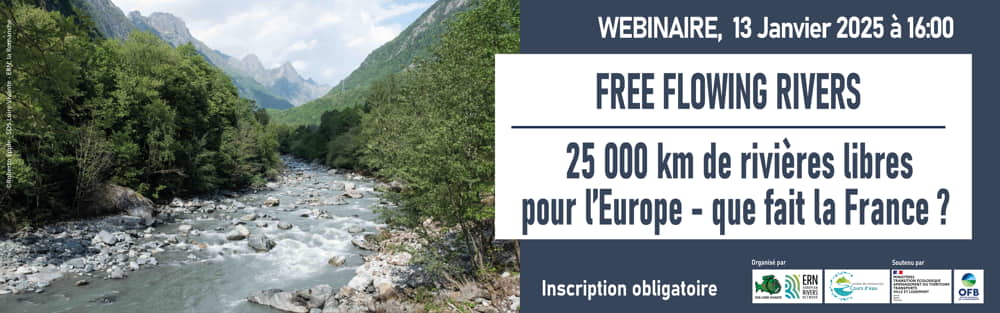
  • 13 January from 4pm to 6pm: 25,000 km of free-flowing rivers for Europe – what is France doing?


registration (in French only)

The European Union has set itself an ambitious target: to restore at least 25,000 km of free-flowing watercourses by 2030. Under Article 9 of the Nature Restoration Law (NRL), officially adopted on 18 August 2024, Member States must contribute to this target and propose their own contributions. Article 9 of the Nature Restoration Regulation aims to reverse the decline in biodiversity in Europe by 2030 and achieve healthy and resilient ecosystems, with a clear objective of reducing pressures. For watercourses, for example, removing obsolete obstacles is a priority.
But what is Europe’s definition of a free-flowing river? What methodology should be used to characterise them? What actions should be taken to contribute to the objective? What ambitions should we set ourselves?


1h de présentations, 1h round table / Q&A with public participation 

by  ERN- SOS Loire Vivante (Roberto Epple, Président, Corinne Ronot, Co-directrice)

with

  • Andrea Goltara, CIRF – Italian Centre for River Restoration,
  • Claire-Cécile Garnier, Cheffe du Bureau de la ressource en eau, des milieux aquatiques et de la pêche en eau douce, Direction de l’Eau et de la Biodiversité

  • Claire Baffert, Senior EU Policy Officer, Water & Climate Change Adaptation| WWF European Policy Office

  • Karl Kreutzenberger, OFB, Chargé de mission « Migrateurs amphihalins et hydromorphologie », membre ECOSTAT

Rhinau fish pass: work completed on schedule

The impressive Rhinau fish pass on the Rhine will be put in the water next week for testing.
The deadline for completion of the work has been met.

A large-scale monitoring system will keep track of how the fish pass is used.

©Daniel Reininger – Alsace Nature

More info


Fontgombault (in operation), Bénavent, Saint-Gaultier, Ruffec – the number of micro-power projects on the Creuse River continues to grow

At the end of October, the investigating commissioner issued a favorable opinion on the project to authorize the Moulin de Bénavent hydroelectric power station, brushing aside the five opinions of environmental protection associations, experts in the field of water and rivers. They had demonstrated that the project did not meet the challenges of restoring ecological continuity and migratory fish on a river classified as a priority axis and biological reservoir by the SDAGE and the national biodiversity strategy. Despite all the existing literature on the impact of weirs and received ideas, we can still read in the conclusions of the report that the structure “will protect the homes of towns and villages located downstream from the mill”!

Read the report of Bénavent public enquiry (french)

Read our views on the projects Bénavent, Saint- Gaultier (french)

Opening of the Poutès dam on Monday 7 October

As has been the case every year for the past 3 years, the large gates of the ‘New Poutès’ were opened in automn to allow the highly migratory fish free passage and a free access to the best spawning grounds.

This year, 67 salmon from the Loire-Allier axis passed through the fish pass on the right bank of the Vichy dam bridge, but it is estimated that around a hundred fish must have passed through.

After interrupting their migration to spend the summer between Vichy and Langeac in the Allier or its tributaries, the survivors have restarted their migration towards the Dore, Sioule or Alagnon, and of course the Allier, with the arrival of more favourable temperatures. Over the next few days, they will pass through the Brioude, Vielle Brioude and Langeac dams before reaching the new Poutès dam, where the sluice gates were lowered on Monday in anticipation of their arrival.

Last year, spawning grounds were observed upstream of the Poutès, indicating that more than a dozen fish had returned to the Upper Allier. It is not yet possible to count fish at Poutès when the gates are open, but observing the spawning grounds upstream is still a good indicator. About ten spawners are expected to pass this year.

The gates will remain open for 2 months before closing again to enable hydroelectric production to resume.


Watch our two 2-minute videos


and the webpage : ‘New Poutes dam‘

24 October : Expert Masterclass on Dam Removal : Register

As we approach the opening of the ORP call for proposals on October 29, WFMF, WWF, and ERN will host a 1 hour expert masterclass on dam removal with French expert Stéphane Weil from CATER Calvados Orne Manche, France .

He will present on the topic “: Restoring river continuity at a river or catchment scale. How to proceed ? Examples of approaches, technical and communication tools proposed by CATER COM in France”

This event aims to increase the visibility of ORP call and encourage a greater number of submissions.

Join us on October 24th, 2024, from 10:00 to 11:00 (CEST) via Zoom

Registration

World Rivers Day, another step towards freeing our rivers

This September, thanks to the support of the European Rivers Network under the Open Rivers Programme, a number of river barrier removal projects are scheduled in France, in sub-basins of the Dordogne, Loire, Gave de Pau and Rhône (see details in the press release).

After three years of implementation of the Open Rivers Programme, more than 140 projects have been supported throughout Europe, including around ten in France, thus contributing to achieving the objective of 25,000 km of free rivers by 2030 in Europe, as set out in the European regulation on nature restoration and measure 20 of the National Strategy for Biodiversity (SNB) 2030, which aims to strengthen actions in favour of ecological webs and remove their main obstacles. Faced with the consequences of climate change, removing weirs and dams that have no use or have a high impact is a key measure for limiting the warming of water, restoring access to refuge areas and increasing the resilience of habitats and species.

On World River Day, we feel it is important to point out that life in our rivers and the quality of our watercourses is still too severely degraded and that urgent action is needed to halt the erosion of biodiversity and cope with the effects of climate change. ‘Repairing rivers and making environments and species more resilient to variations in temperature and hydrology will depend solely on our actions and involvement. There is still a huge task to be done, and it is sometimes difficult to get people to accept it,’ explains Roberto Epple, President of the European Rivers Network. Yet these projects are the result of a long, complex and collective process, combining technical work and consultation, and sometimes militant struggle. So each ecological restoration project is a source of pride, an event to be celebrated that contributes to restoring our shared heritage.

The projects taking part in the Open Rivers Programme are located in sensitive, protected areas with high biodiversity potential, and will help to reconnect habitats for fish (trout, lamprey, salmon), white-clawed crayfish and pearl mussels. ‘By re-establishing the natural dynamics of the watercourse and facilitating the movement of species, we are restoring the system and the complex interactions between living beings and their environments, and providing an additional opportunity to adapt to climate change. These are ‘no-regrets’ measures that benefit everyone,’ explains Corinne Ronot, Project Manager at the European Rivers Network. A range of highly ambitious projects that the European Rivers Network has submitted to the Open Rivers Programme for funding, sometimes in addition to that provided by the French Water Agencies.

Read presse release (in french)
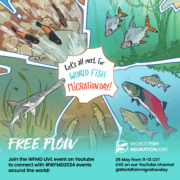
World Migratory Fish Day: Watch and share our videos

To mark World Migratory Fish Day on Saturday 25 May, ERN-SOS Loire Vivante is launching three videos about Atlantic salmon and ecological continuity.

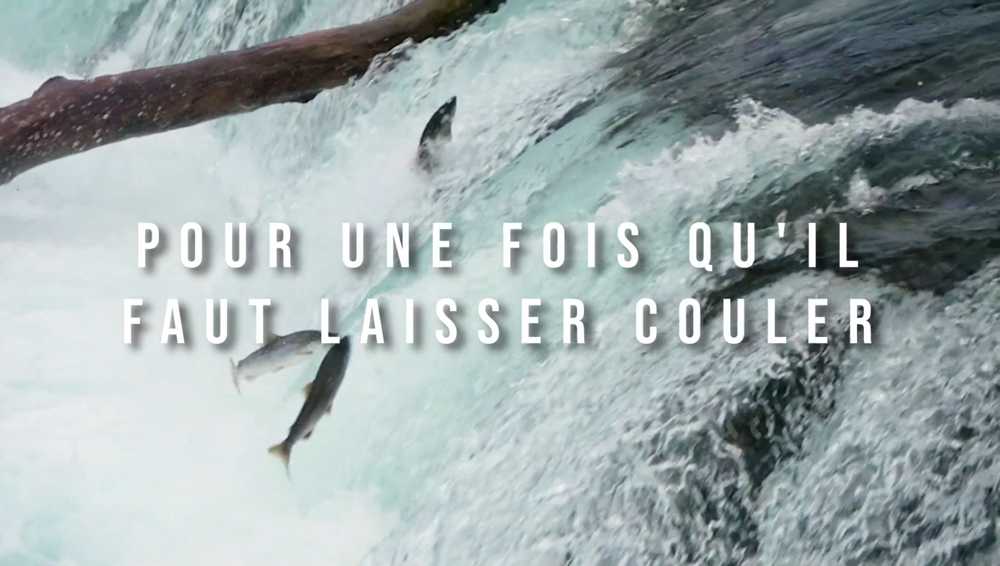
These videos are previews of remixed extracts from the documentary entitled “Pour une fois qu’il faut laisser couler”, which will be released shortly.

The 2-minute portrait and landscape modules presented here, in French and English, plunge you into the life of the Atlantic salmon in the Allier and Sélune rivers and present 2 major innovative and far-reaching actions that France has taken to restore access to the upstream areas of rivers and streams, the historic breeding grounds of the Atlantic salmon.

Discover these videos :

The New Poutès, the dam that opens for wild salmon 
watch the French version / watch the English version

Allier River : An obstacle course for salmon
watch the French version / watch the English version

France: The largest dam removal project in the world, 2017-2022
watch the French version / watch the English version


All the videos can also be viewed on our new YouTube channel: “Rivières Vivantes – Laisser Couler”: https://www.youtube.com/channel/UCjokCmOpXMcgD4ag3UY3ctg

Note :

  • France is the European leader in the restoration of ecological continuity, particularly through the removal of small and large transverse structures. Since 1997, it has built up recognised expertise through innovative policies and major international projects. At a time when the decline in populations of migratory fish and fish at the head of river basins, such as trout, is alarming, we need to pursue innovative actions that provide the most effective response to the challenges of biodiversity.
  • To publicise France’s experience, you will soon be able to watch the full documentary produced by ERN – SOS Loire Vivante as part of the OFB’s Mobbiodiv call for projects. The 3-part film, told from the point of view of our association, traces the history of the major events and projects that have marked the restoration of free movement of rivers in France from 1997 to the present day.
    “For once it’s time to let things flow
    part 1/3: Reopening river routes to large migratory species
    part 2/3: Reconnecting small and medium-sized rivers
    part 3/3: Rethinking and reconfiguring major blocking structures