Save the date : international colloquium “Des Saumons et des Hommes 3 ” 19-21 October 2023 – Brioude (France)

Ten years after the last meeting, SOS Loire Vivante – ERN is organising a new conference on the Loire salmon. This is an opportunity to take stock of the situation of the Atlantic salmon in the Loire and elsewhere. National and international experts will try to understand the reasons for the decline despite restoration efforts and whether our actions are still in line with current and future challenges.
Is it due to climate change or to phenomena at sea or in the river? During the health check and the presentation of the results of restoration actions, we will compare the case of the Loire with other highly migratory river basins such as the Rhine, the Elbe, the Adour, the Garonne, the Sélune, etc,
Are you interested in this event?

  Sign up to receive all the news in the coming months
Sélune dams removals in video (12 min)

The Sélune has been free since last autumn. After the dismantling of the two large dams, the path is free for sediment and migratory fish for almost 100 km.

In a 12-minute video (in French and English) with spectacular images, you can follow the steps of the renaturalisation:

Video in french https://vimeo.com/549070141
Video in english https://vimeo.com/546711100


More infos about the Sélune


Open letter: Counting on new hydropower to accelerate Renewable Energy deployment in Europe is irresponsible

ERN and more than 100 NGOs write to EU negotiators asking them to protect Europe’s rivers from new hydropower deployment in the revised Renewable Energy directive.
Already in 2020, 150 NGOs signed a manifesto asking EU decision-makers to stop new hydropower development in Europe.

Read the WWF press release:

 Ahead of the nextpolitical trilogue on the revision of the Renewable Energy Directive, more than 100 NGOs are sending an open letter to co-legislators from the European Parliament, European Commission and Council Presidency, asking them to exclude new hydropower from go-to areas as well as to include sustainability criteria recognizing that hydropower has direct impacts on freshwater ecosystems which must be mitigated.

 Because hydropower potential has been so exploited already in Europe, new hydropower would only make a small contribution to the energy transition, while causing immense damage to our waterways. According to WWF’s Living Planet Report 2022, freshwater species populations have seen the greatest overall global decline (83%), and within this species group, on average, monitored migratory fish populations have declined by 93% in Europe, making our continent the most affected.

Contact
Florian Cassier
Climate Communications Officer
fcassier@wwf.eu
+32 479 33 92 11

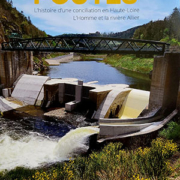
France: The New Poutès dam, partialy removed and now transparent will be inaugurated Oct. 24 – A book will be published

After a long struggle over 30 years, the New Poutès dam on the Upper Allier River, tributary of the Loire River, is officially inaugurated on 24 October 2022.

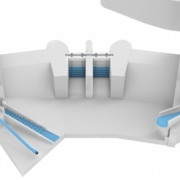
The dam, which was partialy removed from 20 m to 7 m, is now equipped with a fish lift and two huge gates. They are fully opened every year for 3 months and during floods and ensure good passage, especially for Europe’s last wild salmon. The downstream migration is also guaranteed by the low dam height of 6 m and the reduction of the length of the dam from 3.5 km to about 0.5 km. The project allow also the fully restoration of 20 km of the Allier River.

The “Nouveau Poutès” project has been co-constructed over the last 10 years by EDF, NGOs including ERN-SOS Loire Vivante, the municipalities and other stakeholders and can be described as the result of collective intelligence.
A book will be released in November 17 (in french only) > order the book and info in french

> more information on the “Nouveau Poutès” project


World Fish Migration Day – Exceptional visit of the “New Poutès” in France

On the occasion of the World Migratory Fish Day, of which ERN is an official partner, SOS Loire Vivante organizes in cooperation with EDF two guided tours of the “Nouveau Poutès” dam.

Indeed, in the Haut Allier, the works at the Poutès dam are now completed! Since the end of 2021, the dam is reconfigured to allow the free circulation of the last wild salmon populations during 3 months per year while maintaining about 85% of the hydroelectricity production.

To know MORE about the World Migratory Fish Day

Become aware of the relationship between humans and fish

Freshwater fish are the emblems of living rivers, indicators of good quality of the environment and vector of the development of sustainable activities on the territories. 15,000 species of freshwater fish and more particularly the 1,100 species of migratory fish are in danger. They no longer travel freely because of the numerous developments carried out on our rivers over the last few centuries (dams, weirs, etc.). To accomplish their migration, which is essential for their complete life cycle, they are now dependent on our policies and our commitments to restore and protect our rivers.More info on https://worldfishmigrationday.com/ but also Twitter, Facebook, Insta


Visit of the “Nouveau Poutès” dam organized by SOS Loire Vivante on May 21

On the occasion of the World Migratory Fish Day on May 21, SOS Loire vivante and EDF invite you to explore this exemplary site.
After many years of partial leveling and reconfiguration work, the result of our struggle, the site is now finished. By opening two huge gates, it allows migratory fish to pass through for 3 months a year, the rest of the year the water is turbined while respecting a minimum flow of 5m3/s for the Allier between Poutès and Monistrol d’Allier.
Reserve your place as soon as possible

France : “Nouveau Poutès dam” : observation of the lenght of the reservoir

> Watch the ERN Video “Overflight of the Allier River upstream of the Poutès dam” 

Only since the second week of March it has been possible to turbine. Indeed, since the closing of the gates, the Allier had never exceeded the reserved flow (5m3/sec). According to EDF, the operating tests were positive.

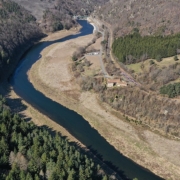
On March 15, with a total flow of 15m3/sec, we were able to observe the creation of a reservoir over a few hundred meters. Further upstream, the Allier, deeper than in the ‘transparency’ mode of the dam over a few hundred meters, remained in its former minor bed with a good current favorable to migration.

On Thursday March 24th, this time with a total flow of the Allier of 10M3/sec, SOS Loire Vivante – ERN  flew over the site at high altitude with a drone to better observe the evolution of the bed and the water retention area. In addition, with the authorization of EDF, we flew at low altitude as close as possible to the dam and the water intake. The observations of March 15 were confirmed.

> Watch the ERN Video “Overflight of the Allier River upstream of the Poutès dam” 

© 2016-2026 Tous droits réservés | European Rivers Network