
Water governance by the government and the Department of Agriculture won’t work
During the webinar on water governance and sharing, Thierry Burlot, President of the Loire-Bretagne River Basin Committee and President of the Cercle Français de l’Eau, discussed the measures needed to defuse the debate and improve governance and financing of the small and large water cycles.
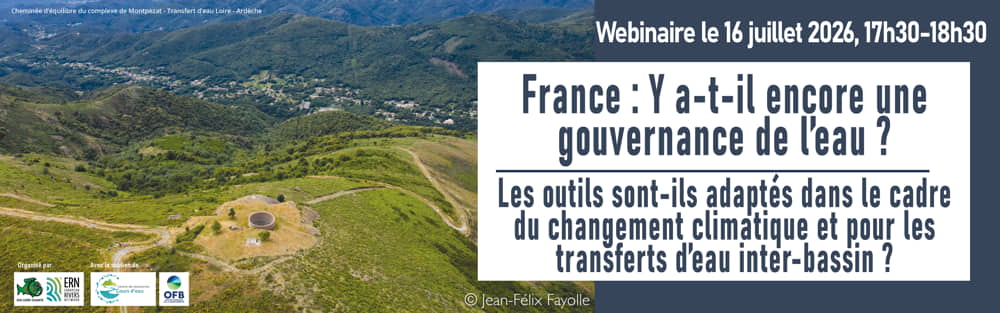
Key moments from the webinar, summary points (first part, from 5:00 to 33:00):
A recognition that the general public has failed to grasp the issues at stake: the goals we set for our rivers in the SDAGE plans are no longer understandable to the general public and elected officials; “the water sector has become too technical.”
The achievements of the 1964 law (recognition of hydrographic boundaries, participatory democracy, the “water pays for water” principle) have not held up:
There is no political legitimacy for the river. The hydrographic boundary is used to divide municipalities, intermunicipal communities, departments, and regions.
Water democracy does not exist. There is no “water parliament.” The parliament consists of the Senate and the National Assembly. Water governance—that is, the river basin committees—technically exists, but it is weak. It is ignored, given little attention, and sometimes even scorned, especially when it begins to make strong statements about the river.
Funding for the small water cycle (the “polluter pays” principle) worked well as long as we lived in abundance and focused primarily on drinking water and sanitation systems. But now that the government has called for funding to improve water quality, protect water catchments, carry out restoration projects, and implement agri-environmental and climate measures—in other words, the large water cycle—things are becoming more complicated. According to a study by the Cercle Français de l’Eau, if we are to adequately address the full water cycle and its financing, we are short about 15 billion euros per year. Should the small water cycle be expected to finance the full water cycle?
Even though it’s the same water, even though we’re talking about an essential resource, the governance and financing of the large and small water cycles are not at all the same.
Today we must realize that without water, we can do nothing, and that we need to make decisions collectively—through listening, empathy, and collaborative decision-making. But above all, we must not act as is currently done in the National Assembly or the Senate—or, more precisely, by declaring an “absolute emergency,” taking what I need, helping myself, and discussing it afterward.
We should certainly consider a new water law that is commensurate with the challenges at hand. We have to start from scratch when it comes to the water cycle. By properly managing this common good, we will foster development, but only to the extent of our regional capacities. The environment is not a constraint; it is an ambition. We must support those who protect the common good. When there is no more water left, that is when we will truly face a recession.
Droughts make us realize just how fragile we are. The economy, urbanization, the development of cities and rural areas, and agriculture all require water. We’ll need to foster solidarity among regions through bodies organized around watersheds, move beyond self-interest, and understand that water quality will depend on the efforts each of us makes.
The problem of floods and droughts is addressed through conservation, slowing the flow of water, storing water in the soil, and other measures that we’ll have to implement on the ground—even in areas that won’t necessarily benefit from them immediately. That’s where we need to show solidarity. The pressure on farms today can lead to frustration, which is understandable, but now is the time to look beyond our immediate concerns and think together—and it is a mistake to think that the government, acting alone with farmers, could solve this problem.
How to improve governance: watersheds, shared governance, solidarity among institutions, and funding. We have used rivers to separate people, to separate municipalities, to separate departments, and to separate regions. And today, rivers must bring us closer together.
The rest (Inter-basin water transfers: the debate must belong to the regions and citizen democracy) will be covered in an upcoming news update or is already available to listen to on the >> REPLAY




Leave a Reply
Want to join the discussion?Feel free to contribute!