25,000 km of open waterways?

Registration is now open (in French only)

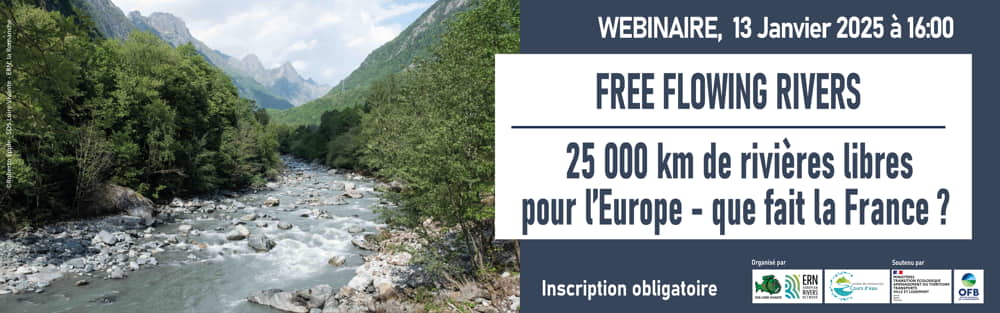
  • 13 January from 4pm to 6pm: 25,000 km of free-flowing rivers for Europe – what is France doing?

registration (in French only)

The European Union has set itself an ambitious target: to restore at least 25,000 km of free-flowing watercourses by 2030. Under Article 9 of the Nature Restoration Law (NRL), officially adopted on 18 August 2024, Member States must contribute to this target and propose their own contributions. Article 9 of the Nature Restoration Regulation aims to reverse the decline in biodiversity in Europe by 2030 and achieve healthy and resilient ecosystems, with a clear objective of reducing pressures. For watercourses, for example, removing obsolete obstacles is a priority.
But what is Europe’s definition of a free-flowing river? What methodology should be used to characterise them? What actions should be taken to contribute to the objective? What ambitions should we set ourselves?


1h de présentations, 1h round table / Q&A with public participation 

by  ERN- SOS Loire Vivante (Roberto Epple, Président, Corinne Ronot, Co-directrice)

with

  • Andrea Goltara, CIRF – Italian Centre for River Restoration,
  • Claire-Cécile Garnier, Cheffe du Bureau de la ressource en eau, des milieux aquatiques et de la pêche en eau douce, Direction de l’Eau et de la Biodiversité

  • Claire Baffert, Senior EU Policy Officer, Water & Climate Change Adaptation| WWF European Policy Office

  • Karl Kreutzenberger, OFB, Chargé de mission « Migrateurs amphihalins et hydromorphologie », membre ECOSTAT
Are there still rivers for migratory fish?

Registration is now open (in French only)

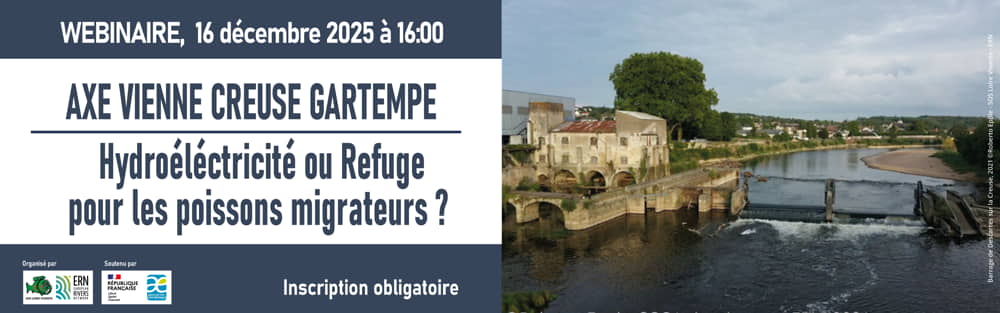
  • 16 December from 4pm to 6pm: Axe Vienne Creuse Gartempe – Hydroelectricity or Refuge for Migratory Fish ?

Registration (in French only)

The Creuse has been identified as a key area for migratory fish in the context of climate change. Restoring watercourses and water quality, removing pressures, reconnecting rivers and providing access to refuge areas will facilitate the resilience of watercourses and the return of migratory fish to our rivers.
However, due to the energy transition in particular, there has been an increase in projects to equip weirs with micro-hydroelectric power stations, perpetuating the fragmentation of waterways on strategic routes.
Can these rivers be both sources of hydroelectric power and refuges for biodiversity and endangered migratory fish?
Should we sacrifice biodiversity and water quality in the name of renewable energy, or demand radical solutions to restore the free movement of species and the health of our rivers?


Programme : 1h de présentations, 1h round table , Q&A 

by ERN-SOS Loire Vivante (Roberto Epple, Président, Corinne Ronot, Co-directrice)

Speakers

  • Bruno Bordeau, Président LOGRAMI : L’axe Vienne-Creuse-Gartempe, un refuge pour les poissons migrateurs ?
  • André Berne, Avocat du barreau de Paris : Le droit français au secours de la biodiversité ou de la production d’énergie renouvelable ?

Table ronde / Questions – réponses 

  • Gilles Deguet, représentant FNE au comité de bassin Loire Bretagne
  • Bruno Barbey, Directeur FDAAPPMA 36
  • Joël Herbach, Président Allier Sauvage
  • Lionel Martin, Président de la Fédération de Pêche de la Haute Loire
  • un représentant du secteur de la production hydroélectrique (sous réserve)

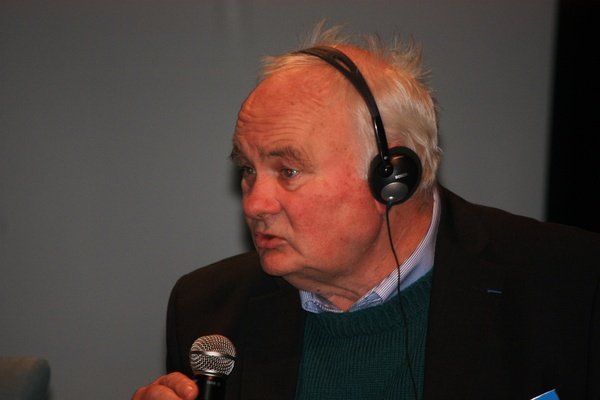
Tribute to Jean Wencker

It is with deep sadness that we learned of the death of Jean Wencker in August 2025.

Jean Wencker devoted much of his life to protecting the environment and restoring aquatic habitats. As former president and then vice-president of Alsace Nature, he represented the association in numerous bodies: the International Commission for the Protection of the Rhine (ICPR), the Rhine-Meuse Basin Committee, the Saumon-Rhin association, and the Salmoncomeback NGO coalition, which is committed to bringing salmon back to Basel.

During his various terms of office, he tirelessly defended the ecological continuity of waterways, the protection of the Doubs and Rhine rivers, and the return of migratory fish, particularly salmon. He grew up on the banks of the Rhine, which shaped his commitment. In 2015, during a conference in Huningue, he emotionally shared memories of his father bringing salmon home and spoke of the devastation of the alluvial forests for the construction of dams in Strasbourg and Gerstheim, a major ecological disaster. Among his successes was the renovation of the Franco-Swiss Châtelot hydroelectric power station on the Doubs, inaugurated in 2006 after more than thirty years of struggle.

ERN and the Salmoncomeback coalition pay tribute to his career and his struggles. May they continue to inspire all those who work to protect life. Our thoughts are with his family and loved ones.

Read also the tribute by Alsace Nature.

Jean Wencker lors du colloque international Salmon Summit à Huningue en 2015 – CR .ERN

Rhinau fish pass: work completed on schedule

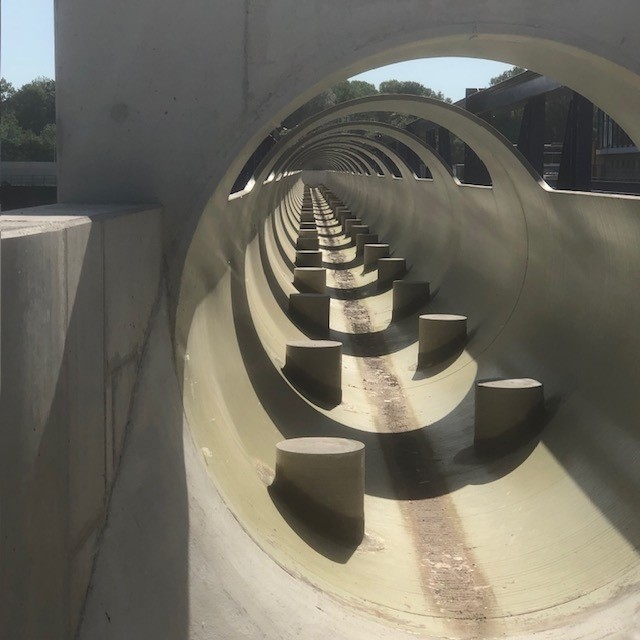
The impressive Rhinau fish pass on the Rhine will be put in the water next week for testing.
The deadline for completion of the work has been met.

A large-scale monitoring system will keep track of how the fish pass is used.

©Daniel Reininger – Alsace Nature

More info


Open Rivers Programme : Open Rivers Programme: Two new projects selected in partnership with ERN and SMDMCA

The Open Rivers Programme continues to support the restoration of river continuity in Europe.

Two new projects, supported by ERN in partnership with SMDMCA, have just been selected in the Cantal region of France: the Batitan and Moulin Bas weirs.

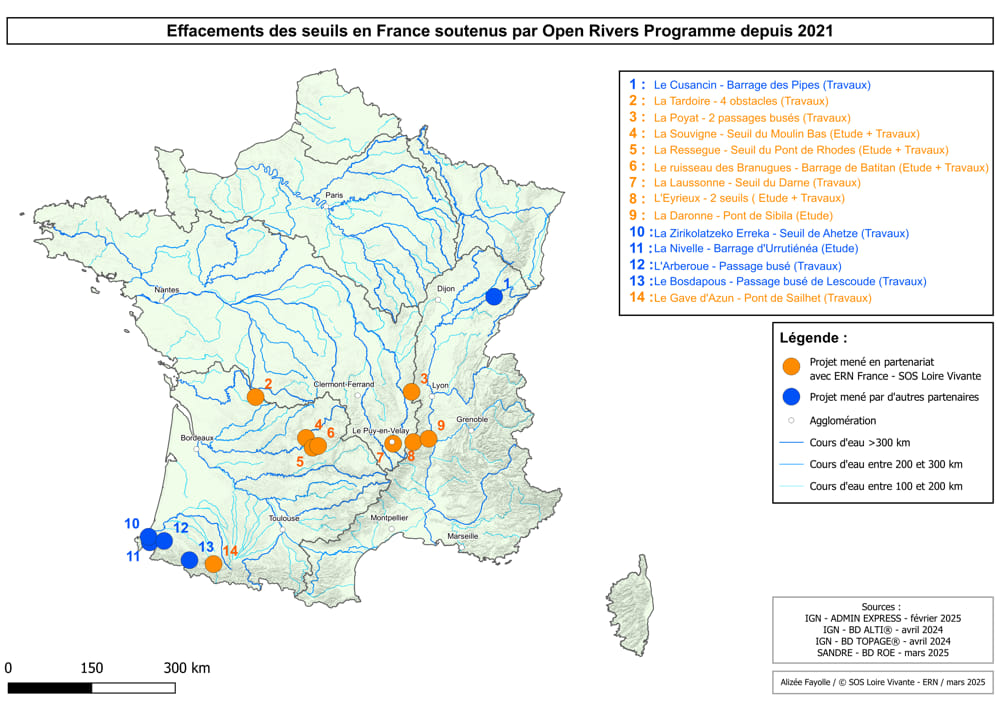
This brings to 13 the number of projects (studies or works) in partnership with ERN and the Open Rivers Programme in France.


Seuil de Moulin Bas ©SMDMCA

The Moulin Bas project

The Moulin Bas weir is located on the Souvigne stream, a tributary of the Dordogne. This watercourse, classified in lists 1 and 2 (L.214-17 du CE) is of great ecological importance. In 2018, the Souvigne was home to 8.4% of the spawning grounds for large salmonids in the Dordogne basin, according to a study carried out by ECOGEA for MIGADO. The Moulin Bas weir is an obstacle to migratory fish. It will therefore be removed during the works scheduled for autumn 2025, opening up 15 km of river, or 83% of the Souvigne’s length. Read more

Seuil de Batitan ©SMDMCA

The Batitan project

The Batitan dam is located on the Branugues stream, a tributary of the Cère, in the Cantal department. The Branugues stream is home to numerous species, including fario trout and river lamprey. As with the Moulin Bas project, work will start in autumn 2025, opening up more than 8 km of stream, or 87% of the creek. By eliminating this obstacle, it will be possible to restore upstream spawning habitats and bolster the trout population already present in the stream. Read more 


Upcoming webinar

Ahead of the next Open Rivers Programme call for projects, ERN will be organizing a webinar to present the program and eligibility criteria. (to be confirmed – May 20, 2025 in frenche).


Dates of the next Open Rivers Programme calls for projects

Summer session 2025: from June 9 to July 4, 2025 (decision and start of projects from November 2025)
Autumn session 2025: from October 6 to October 31, 2025 (decision and start of projects from March 2026).

Find out more about these projects and the Open Rivers program:


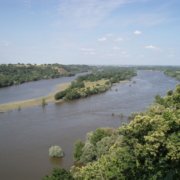
La loire à Champtoceau

Disparition de Philippe Auclerc et Laurent Roy : hommage

En ce début mars 2025, nous avons appris avec tristesse la disparition brutale de deux hommes passionnés et engagés pour les rivières : Philippe Auclerc, Rédacteur en chef pendant 25 ans de « La Loire et ses Terroirs » et de la lettre « Les Nouvelles du bassin de la Loire » et Laurent Roy, ancien Directeur de l’Eau et de la Biodiversité au Ministère de 2013 à 2015 et ancien Directeur de l’Agence de l’Eau Rhône Méditerranée Corse jusqu’en 2023. Notre association a eu la chance de travailler avec eux, ils ont souvent partagé les visions de notre association et leurs compétences ont fait avancer la cause des rivières.

Philippe Auclerc était un fin connaisseur du territoire ligérien et de ses acteurs. Son engagement pour la préservation de la Loire et de ses affluents était profond et sa plume était sincère et souvent aiguisés sur la description du jeu d’acteur et le sens de la gestion de l’Eau du bassin. Son travail a plusieurs fois croisé les actions de l’association SOS Loire Vivante, il est venu nous voir dès les débuts de notre combat dans les années 1990 et a encore récemment été le modérateur de notre dernier colloque « Des Saumons et des Hommes » à Brioude en 2023, un sujet qui l’animait fortement. À travers ses écrits, il a su sensibiliser un large public aux enjeux environnementaux et patrimoniaux de ce fleuve. La disparition de Philippe marque la fin d’une époque pour les passionnés de la Loire, c’était le seul encore aujourd’hui à informer de la vie du fleuve, avec un sens critique, de la source à l’estuaire. Nous espérons que son projet de relier les ligériens perdurent. Nos pensées vont à sa famille et ses proches.

Laurent Roy a également joué un rôle important en faveur des politiques de gestion de l’eau et de préservation de la biodiversité en France tout au long de sa carrière. Avec European Rivers Network nous avons pu le rencontrer plusieurs fois lorsqu’il était au Ministère et à l’Agence de l’Eau, notamment au sujet du rétablissement de la continuité écologique sur le Rhin ou en lien avec le projet du label « Sites Rivières Sauvages ». Homme de conviction, sa capacité à dialoguer et échanger de manière constructive en faisait une personnalité respectée dans le milieu. Nous présentons nos sincères condoléances à sa famille.

Fontgombault (in operation), Bénavent, Saint-Gaultier, Ruffec – the number of micro-power projects on the Creuse River continues to grow

At the end of October, the investigating commissioner issued a favorable opinion on the project to authorize the Moulin de Bénavent hydroelectric power station, brushing aside the five opinions of environmental protection associations, experts in the field of water and rivers. They had demonstrated that the project did not meet the challenges of restoring ecological continuity and migratory fish on a river classified as a priority axis and biological reservoir by the SDAGE and the national biodiversity strategy. Despite all the existing literature on the impact of weirs and received ideas, we can still read in the conclusions of the report that the structure “will protect the homes of towns and villages located downstream from the mill”!

Read the report of Bénavent public enquiry (french)

Read our views on the projects Bénavent, Saint- Gaultier (french)

New cycle of Tuesday Webinars: REGISTRATION OPEN

Public debate – also via videoconferencing and webinars

Register and take part in our next webinars. Already 3 new dates.

Programme details and registration here (in french only)

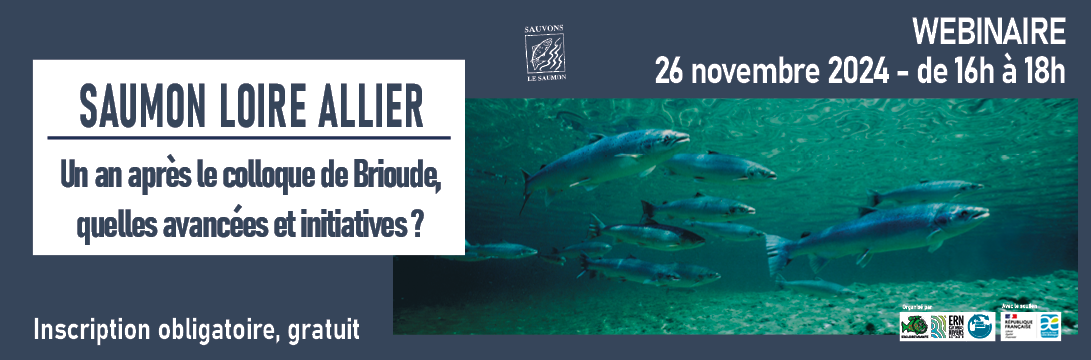
  • 26 novembre 2024 de 16h à 18h : « Saumon Loire Allier : où en est-on ?

  • 3 décembre 2024 : Les aménagements urbains de protection contre les inondations de Brives-Charensac à l’épreuve!

  • 21 janvier 2025 : La pollution microplastique sur le bassin de la Loire.

Opening of the Poutès dam on Monday 7 October

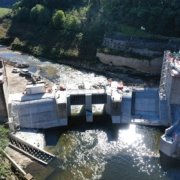
As has been the case every year for the past 3 years, the large gates of the ‘New Poutès’ were opened in automn to allow the highly migratory fish free passage and a free access to the best spawning grounds.

This year, 67 salmon from the Loire-Allier axis passed through the fish pass on the right bank of the Vichy dam bridge, but it is estimated that around a hundred fish must have passed through.

After interrupting their migration to spend the summer between Vichy and Langeac in the Allier or its tributaries, the survivors have restarted their migration towards the Dore, Sioule or Alagnon, and of course the Allier, with the arrival of more favourable temperatures. Over the next few days, they will pass through the Brioude, Vielle Brioude and Langeac dams before reaching the new Poutès dam, where the sluice gates were lowered on Monday in anticipation of their arrival.

Last year, spawning grounds were observed upstream of the Poutès, indicating that more than a dozen fish had returned to the Upper Allier. It is not yet possible to count fish at Poutès when the gates are open, but observing the spawning grounds upstream is still a good indicator. About ten spawners are expected to pass this year.

The gates will remain open for 2 months before closing again to enable hydroelectric production to resume.


Watch our two 2-minute videos


and the webpage : ‘New Poutes dam‘

24 October : Expert Masterclass on Dam Removal : Register

As we approach the opening of the ORP call for proposals on October 29, WFMF, WWF, and ERN will host a 1 hour expert masterclass on dam removal with French expert Stéphane Weil from CATER Calvados Orne Manche, France .

He will present on the topic “: Restoring river continuity at a river or catchment scale. How to proceed ? Examples of approaches, technical and communication tools proposed by CATER COM in France”

This event aims to increase the visibility of ORP call and encourage a greater number of submissions.

Join us on October 24th, 2024, from 10:00 to 11:00 (CEST) via Zoom

Registration