Civil society and water suppliers urge the European Commission not to weaken or remove fundamental water protection rules

On February 18, a group of associations representing the three pillars of the European Water Resilience Strategy published an open letter opposing the revision of the Water Framework Directive (WFD) announced by the European Commission for the second quarter of 2026.

The signatories, including environmental NGOs and stakeholders in the water sector, warn of the risk of weakening the text, even though its implementation remains incomplete in many Member States. “Rather than revising the WFD, its implementation must be accelerated,” they argue, emphasizing its crucial role in protecting ecosystems, food security, and adaptation to climate change.

The letter warns against premature revision, which could be motivated by industrial pressure, particularly to facilitate the extraction of raw materials. The associations call on the Commission to maintain a stable legal framework and to prioritize the application of existing rules.

European laws that protect our environment are under threat. Sign the petition

Our nature and our health are under attack. European laws that guaranteed clean water, pure air and diverse ecosystems, including the Water Framework Directive, are being quietly dismantled under the pretext of ‘simplification’ and ‘reducing red tape’.

More infos about the petition launched by the European NGO coalition #HandsOffNature, which requires our national and European leaders to uphold laws that protect people and nature.

  Together, let’s protect the EU law on Water! 

 Petition :


Are there still rivers for migratory fish?

Registration is now open (in French only)

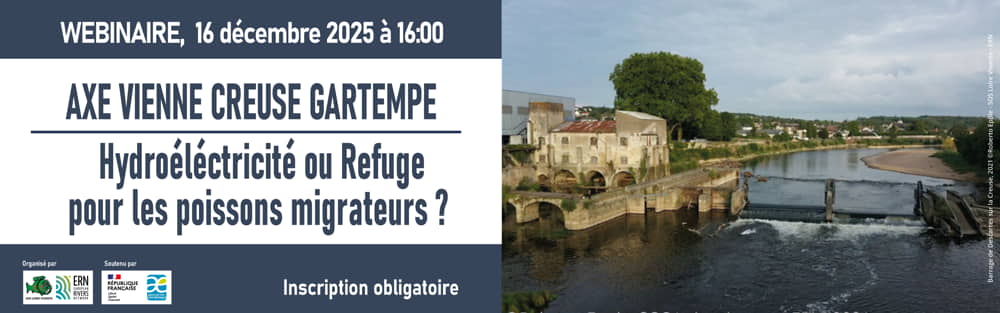
  • 16 December from 4pm to 6pm: Axe Vienne Creuse Gartempe – Hydroelectricity or Refuge for Migratory Fish ?

Registration (in French only)

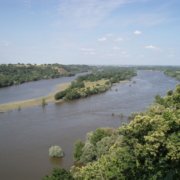
The Creuse has been identified as a key area for migratory fish in the context of climate change. Restoring watercourses and water quality, removing pressures, reconnecting rivers and providing access to refuge areas will facilitate the resilience of watercourses and the return of migratory fish to our rivers.
However, due to the energy transition in particular, there has been an increase in projects to equip weirs with micro-hydroelectric power stations, perpetuating the fragmentation of waterways on strategic routes.
Can these rivers be both sources of hydroelectric power and refuges for biodiversity and endangered migratory fish?
Should we sacrifice biodiversity and water quality in the name of renewable energy, or demand radical solutions to restore the free movement of species and the health of our rivers?


Programme : 1h de présentations, 1h round table , Q&A 

by ERN-SOS Loire Vivante (Roberto Epple, Président, Corinne Ronot, Co-directrice)

Speakers

  • Bruno Bordeau, Président LOGRAMI : L’axe Vienne-Creuse-Gartempe, un refuge pour les poissons migrateurs ?
  • André Berne, Avocat du barreau de Paris : Le droit français au secours de la biodiversité ou de la production d’énergie renouvelable ?

Table ronde / Questions – réponses 

  • Gilles Deguet, représentant FNE au comité de bassin Loire Bretagne
  • Bruno Barbey, Directeur FDAAPPMA 36
  • Joël Herbach, Président Allier Sauvage
  • Lionel Martin, Président de la Fédération de Pêche de la Haute Loire
  • un représentant du secteur de la production hydroélectrique (sous réserve)

Dam Removal Day: celebrate free flowing rivers: 2 new factsheets to understand dam and weir removals

“On Dam Removal Day, 8 October 2025, NGOs in France and Europe reaffirm their commitment to restoring waterways and removing obsolete artificial barriers. More than 1.2 million structures block the free flow of European rivers and weaken the biodiversity and resilience of aquatic ecosystems. It is estimated that more than 200,000 of these structures are unused, abandoned or obsolete. Most are small structures less than 3 metres high, such as sluice gates, weirs and culverts, which bear witness to past uses. Their cumulative impact on biodiversity and the functioning of watercourses is significant. These obstacles isolate vulnerable freshwater species already weakened by the effects of climate change, impact fish migration, and promote the deposition of fine sediments that clog the riverbed upstream of the structures, etc.”

(read press release , in french only)

To reaffirm the advantages of removing obsolete structures that have a significant impact, ERN has published two fact sheets on experiences of removal in France:

Removal of large dams on the Sélune, 4 pages, May 2025, ERN (french only)

For over a century, the Vezins and La Roche-qui-Boit dams interrupted the natural course of the river. Their removal allowed the Sélune to return to its original bed and natural dynamics. The result of many years of debate and scientific studies, this project restored ecological continuity and improved water quality throughout the watershed. Supported by numerous organisations, it will be scientifically monitored until 2027.

The initial results are already very promising. Atlantic salmon, European eels and sea lampreys have returned, natural sediment transport has resumed and biodiversity is increasing.

Removal of the Rhodes Bridge weir, 4 pages, May 2025, ERN (french only):

This document summarises the main stages and challenges of the project to remove the Rhodes Bridge weir, which has reconnected nearly 29 km of free-flowing rivers, benefiting local biodiversity and the quality of aquatic environments.

Vidéos and cases sutides on youtube chanel : Rivières Vivantes – Laisser Couler – YouTube

logo Living Rivers Europe

Living Rivers Europe recommendations to foster the implementation of the Water Framework Directive

Lobbies from the business, agriculture, and mining sectors – and even some Member States – are actively trying to weaken EU water laws.

They argue these laws are too costly, hinder economic activity, and complicate permitting processes.

These claims are unfounded and put the Water Framework Directive (WFD) in jeopardy.

We’re urging Commissioner Jessika Roswall to safeguard the EU water acquis and reject ANY attempt to include the WFD in the upcoming simplification Omnibus package!

Europe’s water security depends on a fragile hydrological cycle – already destabilised by pollution, land use, over-abstraction, and climate change.

Protecting water means access to safe drinking water, safe rivers and healthy food production.

Strong water laws are essential. Weakening them is simply NOT an option.

Read the letter

Tribute to Jean Wencker

It is with deep sadness that we learned of the death of Jean Wencker in August 2025.

Jean Wencker devoted much of his life to protecting the environment and restoring aquatic habitats. As former president and then vice-president of Alsace Nature, he represented the association in numerous bodies: the International Commission for the Protection of the Rhine (ICPR), the Rhine-Meuse Basin Committee, the Saumon-Rhin association, and the Salmoncomeback NGO coalition, which is committed to bringing salmon back to Basel.

During his various terms of office, he tirelessly defended the ecological continuity of waterways, the protection of the Doubs and Rhine rivers, and the return of migratory fish, particularly salmon. He grew up on the banks of the Rhine, which shaped his commitment. In 2015, during a conference in Huningue, he emotionally shared memories of his father bringing salmon home and spoke of the devastation of the alluvial forests for the construction of dams in Strasbourg and Gerstheim, a major ecological disaster. Among his successes was the renovation of the Franco-Swiss Châtelot hydroelectric power station on the Doubs, inaugurated in 2006 after more than thirty years of struggle.

ERN and the Salmoncomeback coalition pay tribute to his career and his struggles. May they continue to inspire all those who work to protect life. Our thoughts are with his family and loved ones.

Read also the tribute by Alsace Nature.

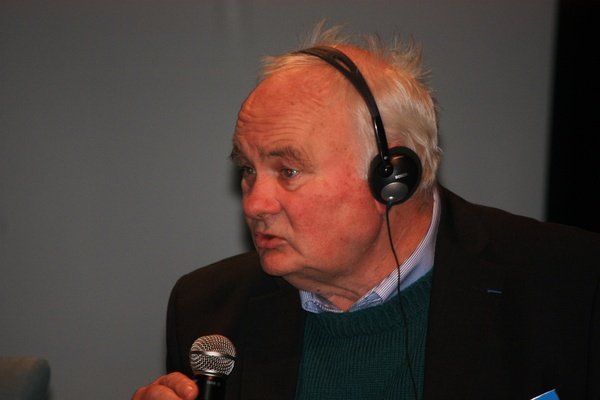
Jean Wencker lors du colloque international Salmon Summit à Huningue en 2015 – CR .ERN

Another hydroelectric power station authorized on an ecologically sensitive river

On May 14, 2025, the Lyon administrative court of appeal validated the construction of a hydroelectric power plant on the Sallanche river, a tributary of the Arve (in Haute Savoie). FNE had challenged the prefectoral environmental authorization order in 2019, as the project threatened this river, classified as a biological reservoir, and diverted more than half the water flowing into the Sallanche. This ruling follows an initial decision by the Grenoble Administrative Court on December 6, 2022, which had initially annulled the project’s authorization precisely because of the risks it posed to the ecosystem.

FNE AURA (France Nature Environnement AUvergne-Rhône-Alpes), notes that this decision leads to a further artificialization of waterways, a phenomenon that is at the root of the difficulties in achieving good ecological status for rivers. Indeed, more than half the rivers in the Rhône-Méditerranée basin are in unsatisfactory condition, and many rivers already modified by artificial developments are struggling to maintain balanced biodiversity.

In legal terms, the administrative court of appeal adopted a different interpretation of current legislation, in particular article R214-109 of the French Environment Code. Unlike the Grenoble administrative court, it did not consider that the planned diversion would significantly affect the hydrology of the river, even though the latter is classified as a biological reservoir.

The court therefore overturned the Grenoble administrative court’s ruling and validated the prefectoral decree of December 26, 2019 authorizing the project.

This ruling reflects continuing legal uncertainty, particularly after a legislative attempt in 2019 to simplify the interpretation of rules on the protection of biological reservoirs. However, the Conseil d’État overturned this amendment and favors a case-by-case approach, leading to the risk of contradictory decisions and increasing legal uncertainty for the protection of biodiversity.Yet another hydroelectric plant authorized on a River with high ecological stakes.

More info :

Cour administrative d’appel de Lyon :
https://www.actu-environnement.com/media/pdf/jurisprudence/57.pdf

FNE :
https://www.fne-aura.org/communiques/region/centrale-hydroelectrique-de-sallanches-un-pas-de-plus-vers-la-degradation-de-nos-cours-deau/

La loire à Champtoceau

Disparition de Philippe Auclerc et Laurent Roy : hommage

En ce début mars 2025, nous avons appris avec tristesse la disparition brutale de deux hommes passionnés et engagés pour les rivières : Philippe Auclerc, Rédacteur en chef pendant 25 ans de « La Loire et ses Terroirs » et de la lettre « Les Nouvelles du bassin de la Loire » et Laurent Roy, ancien Directeur de l’Eau et de la Biodiversité au Ministère de 2013 à 2015 et ancien Directeur de l’Agence de l’Eau Rhône Méditerranée Corse jusqu’en 2023. Notre association a eu la chance de travailler avec eux, ils ont souvent partagé les visions de notre association et leurs compétences ont fait avancer la cause des rivières.

Philippe Auclerc était un fin connaisseur du territoire ligérien et de ses acteurs. Son engagement pour la préservation de la Loire et de ses affluents était profond et sa plume était sincère et souvent aiguisés sur la description du jeu d’acteur et le sens de la gestion de l’Eau du bassin. Son travail a plusieurs fois croisé les actions de l’association SOS Loire Vivante, il est venu nous voir dès les débuts de notre combat dans les années 1990 et a encore récemment été le modérateur de notre dernier colloque « Des Saumons et des Hommes » à Brioude en 2023, un sujet qui l’animait fortement. À travers ses écrits, il a su sensibiliser un large public aux enjeux environnementaux et patrimoniaux de ce fleuve. La disparition de Philippe marque la fin d’une époque pour les passionnés de la Loire, c’était le seul encore aujourd’hui à informer de la vie du fleuve, avec un sens critique, de la source à l’estuaire. Nous espérons que son projet de relier les ligériens perdurent. Nos pensées vont à sa famille et ses proches.

Laurent Roy a également joué un rôle important en faveur des politiques de gestion de l’eau et de préservation de la biodiversité en France tout au long de sa carrière. Avec European Rivers Network nous avons pu le rencontrer plusieurs fois lorsqu’il était au Ministère et à l’Agence de l’Eau, notamment au sujet du rétablissement de la continuité écologique sur le Rhin ou en lien avec le projet du label « Sites Rivières Sauvages ». Homme de conviction, sa capacité à dialoguer et échanger de manière constructive en faisait une personnalité respectée dans le milieu. Nous présentons nos sincères condoléances à sa famille.

 IUCN Report Recommends: Stop Water Abstraction at Shushica River in Albania and Use Alternatives

Joint press release by EcoAlbania, Riverwatch and EuroNatur


Tirana, January 29, 2025  –  This Monday, the International Union for Conservation of Nature (IUCN) released an assessment report about the controversial water abstraction project from the Shushica River, a vital tributary of the Vjosa River within Albania’s Vjosa Wild River National Park (VWRNP). With the project, the Albanian government aims to divert water to the Mediterranean coast to support large-scale tourism. The report, developed by leading international and Albanian experts, concluded that the proposed project would have a severe impact on the national park’s biodiversity and fail to comply with IUCN national park standards. It recommends avoiding the project altogether and using alternative water resources instead. “Avoidance is mandatory to achieve No Net-Loss of biodiversity and avoid significant adverse impacts on the integrity of the VWRNP and its objectives.” so the report states (IUCN, 2025, p. 59).

EcoAlbania, Riverwatch and EuroNatur welcome the results of the report and urge the Albanian government to act decisively on the report’s findings and protect the VWRNP by prioritizing the Avoidance Scenario. This scenario prohibits water abstraction from the Shushica River and recommends alternative water sources outside the park, ensuring that the national park’s objectives are upheld. WATCH OUR VIDEO

Key Findings of the Assessment

  • Violation of National Park criteria & Severe Ecological Risks: The assessment highlights the project’s potentially devastating impacts, including:
    • Loss of critical habitats for endangered species, such as fish, amphibians, and aquatic vegetation.
    • Irreversible damage to sediment transport, water quality, and biodiversity.

As a result of the above, the project is in violation of IUCN guidelines for Category II National Parks, to which the Albanian government has committed itself. It “is expected to have implications for the objectives of the VWRNP. As planned, the project water abstraction will not comply with IUCN guidelines for Category II National Parks, potentially affecting the park’s integrity and conservation objectives as well as ecosystem services.” (IUCN, 2025 Executive Summary)

  • Lepusha Springs Are Crucial: Contrary to the claims of the project proponents – including the Albanian Ministry of the Environment – the Lepusha Springs are of crucial importance for the Shushica. They form the primary source of the river and are integral to the river’s ecosystem. The IUCN report describes the springs as a “key inherent part of the Shushica River, given the functional meaning for the whole river ecosystem.” (IUCN, 2025, p. 22) The project as planned would extract the entire flow of the springs during dry months, leaving no water for the river’s biodiversity.
  • Viable Alternatives Exist: The assessment identifies several alternative water sources, such as the Borshi, Tatzati and Fera Springs, which are capable of meeting water demand without damaging the Vjosa Wild River National Park.
  • Climate Change Compounds the Risk: With climate change projected to reduce water availability in the Vjosa and Shushica River by 30% by 2050, the ecological impact of water abstraction would be even more severe in the future.

The Austrian company STRABAG has been laying these pipes to divert the spring water of the Shushica to the Mediterranean coast © Adrian Guri


NGOs and Local Communities Call for Immediate Action
The NGOs of the Blue Heart campaign and local residents of the Shushica Valley are united in their opposition to the planned project.

“This report reinforces the stance we’ve held since the start of this fight: the project would cause significant damage to vast areas of the Wild River National Park, and with alternative water sources available, it is completely unnecessary,” said Olsi Nika from EcoAlbania. “The Avoidance Scenario is the only path forward to protect one of Europe’s last wild river ecosystems and preserve the integrity of the VWRNP.”

“For generations, the Shushica River has been the lifeline of our valley—providing water for our fields, supporting our livelihoods, and offering a place of natural beauty,” said ,” said Astrit Balilaj, mayor of the village Kuç in the Shushica Valley .“We will not stand by and let this project destroy our river and our way of life. The government must listen to science and choose the Avoidance Scenario to protect our future.”

NGOs echo the call to abandon plans that threaten the national park, urging project developers, including the Albanian Development Fund, to embrace sustainable alternatives that respect the park’s integrity and long-term ecological health.


Background information

  • Other Scenarios Evaluated: In addition to Avoidance, the report assessed two other scenarios of lower priority, following the standardized framework of an IUCN Mitigation Hierarchy Assessment:
    • Minimization/Mitigation Scenario: : This would necessitate significantly less water abstraction from the Lepusha Springs, a complete redesign of the water intake and the use of alternative sources in parallel. A year-long hydrological and biodiversity study is required to determine an environmental flow regime and so is “an Environmental Impact Assessment (EIA) according to the amended EIA Directive” (IUCN, 2025, p. 65) in order to minimize environmental impacts during construction phase. This means that construction could not proceed as currently planned.
    • Offsets Scenario: Under this scenario, the project would proceed as planned but compensation measures—such as expanding the VWRNP boundaries to include additional areas, such as the Vjosa Delta—would be required to offset the damage. However, the report stresses that offsetting cannot fully mitigate the ecological harm caused by the project.
  • Download the Full Report and the Executive Summary. The report was independently financed by IUCN, and through aligned grant funds from Patagonia, and the Gordon and Betty Moore foundation, and was prepared by leading international and Albanian experts.
  • The Shushica, a key tributary of the Vjosa and part of Europe’s first Wild River National Park, faces threats from a water abstraction project. The government plans to divert its spring water to the Mediterranean coast to support large-scale tourism. While a 17 km pipeline from Kuç to Himara is nearly complete, the critical diversion infrastructure remains unbuilt. Financed by KfW and the EU (Western Balkans Investment Framework) and constructed by Austrian STRABAG, the project is both destructive and unnecessary, as alternative water sources exist outside the park. Local communities are determined to stop the diversion dam.
  • The Vjosa is one of the last big wild river in Europe outside Russia. Along her course of almost 270 kilometers, the river flows entirely unobstructed from the Pindus Mountains to the Adriatic Sea. In March 2023, after ten years of our campaign, the Albanian government proclaimed Europe’s first Wild River National Park.
  • Photos attached: The attached photo material can be used once in connection with this press release and indicating photo credits. Photos in print quality on request.

Contact
Besjana Guri – EcoAlbania b.guri@ecoalbania.org   0035/692954214
Ulrich Eichelmann – Riverwatch ulrich.eichelmann@riverwatch.eu 0043/6766621512
Christian Stielow – EuroNatur christian.stielow@euronatur.org 0049/7732 9272 15
 

logo Living Rivers Europe

Living Rivers Europe publishes its position : Making Europe climate and water resilient

from wwf epo , 24 january

Europe stands at a critical juncture. As the fastest-warming continent, we are witnessing the devastating impacts of climate change – from deadly floods to severe droughts and wildfires – all driven by extreme water events. At the same time, Europe’s freshwater is widely polluted, with less than 30% of surface waters meeting pollution standards set by the Water Framework Directive. Time is running out, but decisive EU leadership can pave the way for a resilient future.

As the EU prepares its Water Resilience Strategy, the Living Rives Europe coalition is launching its joint position on the path forward for a water and climate resilient Europe.

Read the position here.