Visit of the “Nouveau Poutès” dam organized by SOS Loire Vivante on May 21

On the occasion of the World Migratory Fish Day on May 21, SOS Loire vivante and EDF invite you to explore this exemplary site.
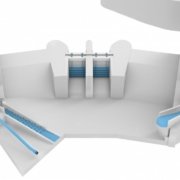
After many years of partial leveling and reconfiguration work, the result of our struggle, the site is now finished. By opening two huge gates, it allows migratory fish to pass through for 3 months a year, the rest of the year the water is turbined while respecting a minimum flow of 5m3/s for the Allier between Poutès and Monistrol d’Allier.
Reserve your place as soon as possible

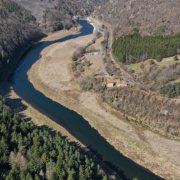
France : “Nouveau Poutès dam” : observation of the lenght of the reservoir

> Watch the ERN Video “Overflight of the Allier River upstream of the Poutès dam” 

Only since the second week of March it has been possible to turbine. Indeed, since the closing of the gates, the Allier had never exceeded the reserved flow (5m3/sec). According to EDF, the operating tests were positive.

On March 15, with a total flow of 15m3/sec, we were able to observe the creation of a reservoir over a few hundred meters. Further upstream, the Allier, deeper than in the ‘transparency’ mode of the dam over a few hundred meters, remained in its former minor bed with a good current favorable to migration.

On Thursday March 24th, this time with a total flow of the Allier of 10M3/sec, SOS Loire Vivante – ERN  flew over the site at high altitude with a drone to better observe the evolution of the bed and the water retention area. In addition, with the authorization of EDF, we flew at low altitude as close as possible to the dam and the water intake. The observations of March 15 were confirmed.

> Watch the ERN Video “Overflight of the Allier River upstream of the Poutès dam” 

Join the International Day of Action for Rivers! March 14, 2022

The International Day of Action for Rivers cofounded by IR, ERN and others is a day dedicated to solidarity – when diverse communities around the world come together with one voice to say that rivers matter. That communities having access to clean and flowing water matters. That everyone should have a say in decisions that affect their water and their lives. That it’s our time to stand up for these rights, now more than ever.

We’re celebrating the 25th Anniversary of this Day for Rivers by also highlighting the importance of Rivers to Biodiversity.

> More information

May 21, 2022 is World Migratory Fish Day !

May 21, 2022 is World Migratory Fish Day !

Organized every two years by the World Fish Migration Foundation, this day honors free-flowing rivers and migratory fish, which are often threatened. This day, many organizations around the world organize events on the theme “Reconnecting fish, rivers and people”. Already 95 events open to the public are registered, and it is not over.

> Check out the events

> Any association or individual can get involved and register an event.
Organize an event

> Take part in the actions organized by SOS Loire Vivante / ERN:
Virtual visit of the “New Poutès” dam completely reconfigured for salmon migration.

The location of the dam on the upper Allier river is of crucial importance: it determines the access of the salmon to the best spawning areas for the Loire-Allier strain of salmon, a unique strain able to migrate over long distances!

SOS Loire Vivante / ERN will organize a visit to the “new Poutès” dam and will record the visit and conduct interviews on site.

Other actions are being organized by SOS Loire Vivante.


> Website of the world fish migration day

poster

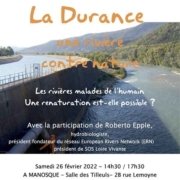
Conference debate: The Durance – rivers sick of humans? Is a renaturation possible?

The Durance : a “unnatural” river

We are more than 3 million people who depend on it for our greatest comfort (extraction of aggregates, irrigation, drilling for drinking water, cooling of the nuclear reactors of Cadarache, etc.), for this reason, humans have made it the most developed river in France with kilometers of infrastructures (weirs, dams, reservoirs, bridges, roads and highways, dwellings, warehouses, factories, etc.) per one kilometer of river

Humans put considerable pressure on rivers by exploiting them. It is 90% of the water of the Durance which is diverted to produce electricity for the most part.

Can we keep on in that way taken more than 5 centuries ago and accentuated these last 70 years? Another way of looking at things, another way of behaving with regard to our rivers and in particular the Durance, is conceivable. We are going to debate this, for this we will propose to you beforehand, some lines of thought, notably from the presentations of our guest Roberto Epple (hydrobiologist, founding president of the European Rivers Network (ERN), president of SOS Loire Vivante) but also from the members of our association (SOS Durance Vivante).

For those who wish to know more, you can already visit our website (French only)

Otherwise, we will meet on Saturday, February 26th in Manosque, salle des tilleuls 14h30. We will comply with the sanitary obligations of the moment.
France : Public policies to safeguard the Loire Salmon : a total incoherence !

France: PUBLIC POLICIES TO SAFEGUARD THE LOIRE SALMON: A TOTAL INCOHERENCE!

On the Allier, while EDF is completing work on the “new Poutès”, which will improve the situation of the salmon in the Allier, its own subsidiary, SHEMA, is building a hydroelectric power station that will perpetuate the negative impacts of the Vichy dam, which will reduce to nothing the efforts made upstream. Absurd and revolting!

>>read the complet Press release (in french only) edited by ERN-SOS Loire vivante and other NGO


Most European rivers will not achieve good ecological status by 2027 (Living rivers Europe Coalition)

Living River Europe coalition including WWF and EEB and ERN present a preliminary assessment of river basin management plans
Under the title “THE FINAL SPRINT FOR EUROPE’S RIVERS” and “NGO ANALYSIS OF 2022- 2027 DRAFT RIVER BASIN MANAGEMENT PLANS”, WWF, EEB and other partners of the Living Rivers Coalition have presented a first analysis of the draft river basin management plans shortly before the end of the official public participation under the Water Framework Directive.
According to this analysis, 11 of the 13 river basins considered will not meet the WFD objectives by 2027. In almost half of the cases, the indicators examined on pollution, continuity, high and low water management, agriculture, hydropower, coal mining and renaturation measures were found to be largely insufficient. In addition to insufficient funding, the report cites the persistent lack of policy integration in areas such as agriculture, energy and infrastructure, as well as the frequent use of exemptions as the main reasons.
The report is available on the EEB website:
https://eeb.org/library/the-final-sprint-for-europes-river-report/
The WWF / Living Rivers Coalition press release can be found here:
https://www.wwf.eu/?uNewsID=3697866


Report cover page

Hydropower in Europe : Transformation – not development (WWF Report)

European rivers are the most fragmented in the world, contributing to the rapid decline in freshwater biodiversity.
As a result, a drastic transformation of the hydropower sector is urgently needed to reduce its environmental
impact. This can be achieved through several steps: the first one is to stop building new hydropower plants which worsen the fragmentation of rivers and lead to the loss of precious habitats and species.

The second step is to lessen the environmental impact of existing plants through plant environmental refurbishment. From ecological flows to acquiring knowledge on fish migration patterns, hydropower plants can be adapted and managed in a more nature- sensitive manner, as illustrated by a case study on the Allier River in the Loire Valley, France.

The third step is the restoration of the rivers’ natural functions,
in particular continuity and habitats. The case study on the construction of a reproduction channel next to the Imatra hydropower plant in Finland, illustrates active restoration measures that should be taken to complement mitigation measures at the plant itself.

download the WWF Report :  https://www.wwf.eu/what_we_do/water/?uNewsID=2329866 


Great Big Jumps in many places despite Covid .

Good news. Despite the official cancellation of the Big Jumps 2020 on July 12th due to the Covid 19 epidemic, some very original events took place. We already have knowledge of Big Jumps in Belgium, Bosnia Herzegovina, France, Italy, Poland, Portugal, Spain. In a few days we will be able to publish photos and videos

DAM BUSTERS : Dam Removal Europe presents the trailer of its new film

DAM BUSTERS is the new film by Dam Removal Europe and the World Fish Migration Fundation about dam removal. Worldwide distribution, premiere expected in 2021.

Following the journey around the world of Pao Fernández Garrido, a Spanish engineer, the film sets out to meet the “river heroes”, women and men, in all continents in their passionate quest to restore rivers and ecosystems. Laura Wildman from the United States, Roberto Epple – Founding President of ERN-France, are among the film’s personalities.

France, the first country, along with the United States, to have carried out major dam removals since 1996, will be in the spotlight with the removal of the major dams on the Sélune and the partial removal of the Poutès dam on the Haut Allier.


A film from Francisco Campos Lopez, in collaboration with Magen Entertainment, LLC.

#DamRemovalEurope #DamRemovalGlobal #WorldFishMigrationDay #dam removal #RiverResotrationHeroes