Freshwater ecosystems are one of the most degraded in Europe, with freshwater molluscs and fish the two most threatened animal groups and 60% of surface waters failing to reach good ecological status. The fitness check of the Water Framework Directive concluded that the main reasons for failure are for a large part connected to insufficient measures to tackle diffuse pollution coming from agriculture, and the hydromorphological changes affecting water bodies. Restoring freshwater ecosystems is therefore a necessity to sustain the natural functions of rivers, lakes and wetlands. Only with healthy, biodiverse water bodies can we allow nature to thrive, ensure clean and sufficient water supply, and resilience to climate change impacts.
read the complet document : > FINAL LRE briefing – freshwater – NRL
In the next few days, rivers will once again be in the international spotlight.
On 25 September, a large number of river events will be organised in over 100 countries and the European River Summit will take place frim Sept 29 – Oct 1 in Brussels. ERN will also be part of the programme.
> more info World Rivers Day
> more info European Rivers Summit
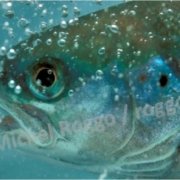
France / Sélune River : Only 4 weeks after the demolition of the Roche qui boit dam and 2 years after Vezin’s demolition, a first salmon was already electronically located upstream of the construction sites !
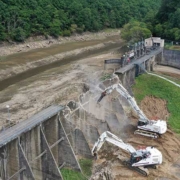
– The “La Roche qui boit” dam has been removed!
After many postponements, the second 17-metre high dam “La Roche qui boit” on the Sélune has been demolished. A 45-metre wide breach has already been opened to allow the flow of any floods. The remaining sides of the 120 m wide structure and the renaturation work should be completed by the end of 2022. After the demolition of the 37 m high Vezins dam two years ago, the ecological continuity of the historic salmon river Sélune is now restored after about 100 years. In the main river alone, more than 60 km are free and allow access to former spawning sites. Salmons could swim up the Sélune from the Baie Saint Michel during the next salmon migration, at the latest in spring 2023. Two castillons (salmon that have only spent one year at sea) have already been observed by specialists just downstream of the “Roche qui boit”. The campaign for a free Sélune led by associations including ERN, the French Fishing Federation, FNE and others will have lasted 20 years. A great success!
Copyright : ERN – Roberto Epple
The record of ERN’s Q&R session in french is now available
The European Open Rivers Programme is inviting Expressions of Interest (EoI) for project submissions for dam removal preparatory and demolition projects that fall under grant categories A and B. The EoI must be submitted online via the programme’s Grant Management System by 17:00 CET on 8th July 2022.
For more information about the application eligibility criteria, grant types, application process and guidelines, and how applications will be assessed, please visit our Application Resources webpage.
ERN (European Rivers Network) is coordinating and supporting all applys from France and french speaking regions. Contact us : contact@erninfo.net
ANP|WWF Portugal, World Fish Migration Foundation, Wetlands International and The Nature Conservancy invite you to the 7th Dam Removal Europe seminar, an event that will be held, for the first time, in Lisbon, Portugal, where the dam removal process is starting.
This time, the objective is to increase the general commitment and know-how on dam removal, to make it as effective as possible and to initiate new funding mechanisms and policy changes. Speakers from Europe and beyond will share their best practices.
The event will consist of a two-day conference and a third day devoted to a field trip to a river restoration site. The seminar is part of the global celebrations of World Fish Migration Day and one of the highlights will be the Portuguese premiere of the documentary DAMBUSTERS.
ERN, official partner, will participate in the event with a live broadcast on the Romanche river where Roberto Epple, president of the association, will present the destruction of 4 dams on this river.
You will meet river basin authorities, ministries, mayors, political decision makers, European project managers, water agencies, companies, engineers, researchers, students, social experts and the public interested in free flowing rivers.
To register and access the program, click here!
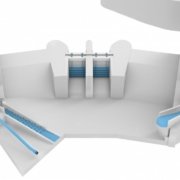
On the occasion of the World Migratory Fish Day on May 21, SOS Loire vivante and EDF invite you to explore this exemplary site.
After many years of partial leveling and reconfiguration work, the result of our struggle, the site is now finished. By opening two huge gates, it allows migratory fish to pass through for 3 months a year, the rest of the year the water is turbined while respecting a minimum flow of 5m3/s for the Allier between Poutès and Monistrol d’Allier.
Reserve your place as soon as possible
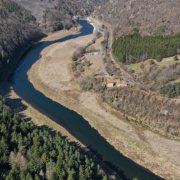
> Watch the ERN Video “Overflight of the Allier River upstream of the Poutès dam”
Only since the second week of March it has been possible to turbine. Indeed, since the closing of the gates, the Allier had never exceeded the reserved flow (5m3/sec). According to EDF, the operating tests were positive.
On March 15, with a total flow of 15m3/sec, we were able to observe the creation of a reservoir over a few hundred meters. Further upstream, the Allier, deeper than in the ‘transparency’ mode of the dam over a few hundred meters, remained in its former minor bed with a good current favorable to migration.
On Thursday March 24th, this time with a total flow of the Allier of 10M3/sec, SOS Loire Vivante – ERN flew over the site at high altitude with a drone to better observe the evolution of the bed and the water retention area. In addition, with the authorization of EDF, we flew at low altitude as close as possible to the dam and the water intake. The observations of March 15 were confirmed.
> Watch the ERN Video “Overflight of the Allier River upstream of the Poutès dam”
 ERN France
 ERN is the official WWF Freshwater Partner in France and cooperates with WWF Switzerland, Austria, Netherlands and others