Logo ERN, petit format

European Commission to take Spain to court over destruction of Doñana Wetlands

The European Commission announced last week that it would be referring Spain to the European Court of Justice (ECJ) over the serious deterioration of the Doñana wetlands, and for its failure to implement the Water Framework Directive/WFD and the Birds and Habitats Directives

Logo ERN, petit format

#ProtectWater : More than 200 000 signatures thanks to you !

The #ProtectWater campaign has helped to reach 200,000 signatures in Europe (read more).

THANKS to all of you who signed!

Let’s continue …. Spread the information around you to reach 300,000 signatures !

#ProtectWater : 200,000 signatures !! MERCI ! from European Rivers Network on Vimeo.

WFD “Fitness check” : The paper jeopardizing the WFD was NOT endorsed at the Water Directors’ meeting!

Good News : The paper drafted by a group of government officials was NOT endorsed at the Water Directors’ meeting November the 29!!

This document included a series of proposed changes to the WFD which, if ever put into effect, would constitute a significant weakening of the legislation.

The letter sent to Water Directors on behalf of the Living Rivers Europe coalition, as well as all the separate letters sent and communications were explicitly recognised in the discussion and in the final report of the meeting ! Congratulation !!

This really is a major success for Living Rivers Europe.

WFD “Fitness check” : Living Rivers Europe writes to Water Directors

Living Rivers Europe coaltion (European Anglers Alliance, EEB, ERN, Wetlands International et WWF) sent to the Water Directors, before the meeting in Vienna 29 and 30 November, a letter to express there grave concerns over the process and the  content of the work of the Consultation Group on the future of the Water Framework Directive (WFD). LRE strongly urge Water Directors not to endorse the document on ‘the future of the WFD’ .

Read the letter

Logo ERN, petit format

Vehicle tyres and synthetic clothes are two of the leading causes of household microplastic pollution (FoE)

Vehicle tyres and synthetic clothes are two of the leading causes of household microplastic pollution, a report from Friends of the Earth UK has found. 

The UK study estimated that just four main sources delivered between 9,000 and 32,000 tonnes of microplastics into waterways every year.

The two worst causes were tyre abrasion and the washing of synthetic clothes, such as fleeces.

When people wash clothes made from synthetic material it passes through the sewage system because there are no systems to recover these tiny plastic fibres. They eventually end up in rivers or the marine environment. In parts of Europe it is estimated that two-thirds of clothing are made from synthetic materials.

Recent studies have shown that plastic ends up in the human body. 

This study, which was carried out by Eunomia for Friends of the Earth UK, reveals that household plastic waste is roughly on par with large plastic waste, such as bottles, as around 26,000 tonnes of that also enters UK waterways each year.

The four main sources of microplastic waste, according to the report which was reported on today in the Guardian, were as follows:

  • Vehicle tyres: plastic microfibers are created when abrasion on the road surface creates tiny fragments which wash into streams and rivers;
  • Clothing: the washing of synthetic clothing separates tiny specs of plastic which make their way through the water treatment system;
  • Plastic pellets used to manufacture plastic items: These tiny cast off from manifactured items make their way to waterways;
  • Paints on buildings and road markings: Weather and flake-off results in tonnes of these tiny fragments ending up in surface water every year.

Earlier this year Eunomia also produced a report for the European Commission on microplastics, particularly those created by wear and tear.

They concluded that the largest reductions could be made at source. They called for new measures to limit the release of manufacturing pellets, to remove the worst performing tyres from the market and to analyse the synthetic clothing that emits the most microfibers when washed and take measures to limit their access to the market.

Water Framework Directive fitness check : the threat of weakening the law becomes real

The #ProtectWater campaign call exceeded 100,000 signatures in less than a month. Congratulation !! But that’s not enough for the European Commission!

The announced threat of a weakening of the Framework Directive is coming to fruition. Member States have been preparing a paper on the future of the WFD which is explicit on the need to change the WFD. 29 November in Vienna, the Water Directors are aiming to adopt by a consensus this document announcing a weakening of the law.

Remain mobilized and of course if you have not done yet sign the public consultation

#ProtectWater : 100 000 signatures and new visuals

The #ProtectWater campaign call exceeded 100,000 signatures in less than a month. Congratulation !! But it is not enough !

For the second phase of the campaign, we launched new visuals to engage the public.

The threat of seeing our emblematic species disappear if the WFD is changed or weakened is the theme for the month of November.

Follow us on Facebook and sign the public consultation

Launch of the « ProtectWater » campaign

European rivers and lakes are under attack ! Act now to protect them ! Participate in the European Commission’s public consultation !

This is the appeal of the online campaign #ProtectWater, lunched today by WWF, the European Environmental Bureau, European Anglers Alliance, European Rivers Network and Wetlands International, who together form the Living Rivers Europe coalition.

During the first step, the campaign uses provocative scenarios and imagery around the future of beer to encourage citizens in Europe and beyond to participate in the European Commission’s public consultation on the EU Water Framework Directive (WFD), which is running until 4 March 2019.

This consultation is the only opportunity for the general public to have its say during the evaluation of the law, and the campaign provides an easy tool for citizens to express their support to keep this law strong and effective.

Read presse release

Campaign page and link to participate to the public consultation

#ProtectWater #ProtectBeer

New report : Bringing life back to Europe’s waters, the EU water law in action (LRE/ERN)

The WFD is one of the most ambitious, holistic pieces of EU environmental legislation ever to pass.
The new report by WWF, EEB, the European Anglers Alliance and European Rivers Network shows, where political will exists, the WFD provides an effective framework for addressing the main pressures facing rivers, lakes, wetlands, streams and groundwater.

This report published for the EU Water Conference on 20 and 21 September in Vienna where it will set the course for the future of European water protection as decision-makers come together to take stock of Member States’ progress in sustainable water management and implementing the EU’s water legislation, and discuss whether the existing EU legislation is still “fit for purpose”. It is a critical time in the current “fitness check” process for the Commission to gather views from Member States, their agencies and a variety of stakeholders.

Download the report

Brussels – 20 September 2018 , Media Release from WWF

“Bring life back to Europe’s rivers and lakes”, WWF urges Member States ahead of critical water conference in Vienna

 As EU Member States, the European Commission and other stakeholders gather in Vienna today, WWF calls for their clear commitment to saving Europe’s rivers, lakes and wetlands, and for a full implementation of the EU Water Framework Directive (WFD), the most important legal instrument for protecting Europe’s freshwater bodies.

The EU Water Conference on 20 and 21 September will set the course for the future of European water protection as decision-makers come together to take stock of Member States’ progress in sustainable water management and implementing the EU’s water legislation, and discuss whether the existing EU legislation is still “fit for purpose”. It is a critical time in the current “fitness check” process for the Commission to gather views from Member States, their agencies and a variety of stakeholders.

For WWF, it is clear that the current EU water law is ambitious and effective, and are disheartened by Member States’ lack of political will to make it work on the ground. An amendment to the law as a result of the fitness check process would simply allow Member States to side-step their legal obligation to bring all European waters into good condition by 2027 at the latest and to protect them from deterioration.

“A weakening of the legislation would be a declaration of bankruptcy of European environmental policy,” said Martina Mlinaric, Senior Water Policy Officer at WWF’s European Policy Office said. “Having missed the original objective of bringing all European waters to good health by 2015, Member States are now feeling the pressure, but, instead of doubling their efforts, many governments are now desperately searching for an easy way out of their commitments and are using the fitness check process to achieve that.”

As part of its fitness check, the European Commission will soon launch a public consultation, asking both European citizens and experts to provide their own opinions and assessment of the EU water law. The results of this consultation will contribute directly to the European Commission’s assessment of the legislation.

“An objective and transparent evaluation involving the public is critical. We therefore urge all stakeholders and European citizens to stand up for our rivers and lakes and make their voices heard” said Andreas Baumüller, Head of Natural Resources at WWF’s European Policy Office. “As WWF, our message to Member States and the European Commission is simple:  Bring life back to Europe’s rivers, lakes and wetlands – defend the EU water law!”

The WFD is one of the most ambitious, holistic pieces of EU environmental legislation ever to pass and, as a new report by WWF, EEB, the European Anglers Alliance and European Rivers Network shows [1], where political will exists, the WFD provides an effective framework for addressing the main pressures facing rivers, lakes, wetlands, streams and groundwater. Nevertheless, with only a measly 40% of EU waters currently healthy [2], it is clear that Member States need to seriously step up their game if they are ever to reach the final 2027 good status objective. So far, Member States’ ambition and efforts have been minimal at best, evident through their largely ineffective river basin management plans, programmes of measures, insufficient funding allocation, and excessive use (and misuse!) of the various types of exemptions provided within the law.

There have been meetings between Member States to discuss the future of the EU water law, all of which have taken place outside of the official process [3]. Some of these took place before the Commission’s official fitness check had even started, let alone concluded. This is despite the fact that, since the legislation came into effect, there has been an official, transparent process to support Member States with implementing this law, including NGOs and other stakeholders.

________________________

[1] Bringing life back to Europe’s waters: The EU water law in action, 2018, WWF, EEB, European Anglers Alliance and European Rivers Network (available to download here as of 20 September: http://www.wwf.eu/media_centre/publications/)

[2] European waters – assessment of status and pressures, 2018, EEA

[3] Whilst Member States are free to discuss what they want, these meetings deviate significantly from the established Common Implementation Strategy process, which was designed to involve all Member States, the Commission and relevant stakeholders (such as industry and environmental NGOs), and ultimately support Member States with implementing the Directive. As part of this process, all topics related to EU water legislation must be tackled by the Strategic Coordination Group, which is comprised of relevant stakeholders (including WWF), Member States and the Commission. However, Member States have been taking topics out of this group and discussing them in their own meetings. These meetings also undermine the official fitness check process that the Commission has only recently started, and will clearly establish whether the Directive has delivered or not (and, if not, why not).
European waters getting cleaner, but big challenges remain (PR/ EEA)

Press release from European Environement Agency, 3 July 2018

“Despite progress in improving the quality of Europe’s lakes, rivers, coastal waters and groundwater sources, pollution, structures like dams, and over-abstraction remain top threats to their long-term health. A vast majority of Europe’s water bodies still fail to meet the European Union’s minimum target for ‘good status’, according to a European Environment Agency ‘state of water’ report published today.

 Image © EEA/Peter Kristensen

We must increase efforts to ensure our waters are as clean and resilient as they should be — our own well-being and the health of our vital water and marine ecosystems depend on it. This is critical to the long-term sustainability of our waters and in meeting our long-term goals of living well within the limits of our planet.

Hans Bruyninckx, EEA Executive Director

EU Member States have made marked efforts to improve water quality, by improving wastewater treatment and lowering the runoff of pollutants from farmland, according to the EEA report ‘European waters — assessment of status and pressures 2018’. Measures have also been taken to make barriers passable to migrating fish and restore degraded aquatic ecosystems.

While Europe’s ground water bodies, like aquifers, are in good health in most cases, only 40% of monitored lakes, rivers, estuaries and coastal waters achieved the  the EU Water Framework Directive’s minimum ‘good’ or ‘high’ ecological status during the 2010-2015 monitoring period, according to the report. The last EEA assessment in 2012 found a similar level of water bodies meeting ‘good’ or ‘high’ ecological status. The EEA assessment also looked at the quantitative state and over-abstraction of Europe’s groundwater and the overall chemical status of water bodies.

The EEA report gives an updated health check on over 130,000 surface and groundwater bodies monitored by EU Member States, based on the data collected and reported from more than 160 so-called River Basin Management Plans covering the period 2010 to 2015.

‘Thanks to the implementation of European water legislation in the Member States, the quality of Europe’s freshwater is gradually improving, but much more needs to be done before all lakes, rivers, coastal waters and groundwater bodies are in good status. Tackling pollution from agriculture, industry and households requires joint efforts from all water users throughout Europe,’ said Karmenu Vella, EU Commissioner for Environment, Maritime Affairs and Fisheries.

‘We must increase efforts to ensure our waters are as clean and resilient as they should be — our own well-being and the health of our vital water and marine ecosystems depend on it. This is critical to the long-term sustainability of our waters and in meeting our long-term goals of living well within the limits of our planet,’ said Hans Bruyninckx, EEA Executive Director.

The EEA water assessment is the second since 2012. Knowledge of Europe’s waters has grown significantly since then, providing a better understanding of the status, the problems that lead to failure in achieving ‘good status’ and the measures implemented to generate improvement. The EEA report complements a forthcoming European Commission report, which will assess to what extent the Member States comply with the Water Framework Directive. This Directive sets out a framework on how to assess, manage, protect and improve water quality across the EU. It requires Member States to produce River Basin Management Plans (RBMPs) as well as a Programme of Measures to improve water quality.

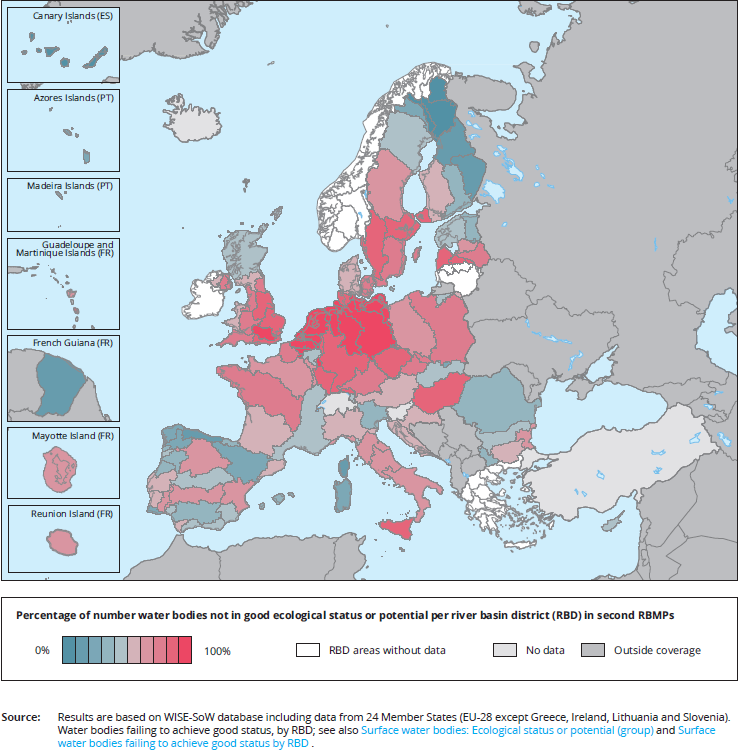
Percentage of surface water bodies in less than good ecological status by River Basin Districts 

Note: Percentage based on known ecological status or potential (without unknown status).  Caution is needed when comparing results between Member States, as the results can be significantly affected by the methodology applied by individual Member States.

Other key findings

  • Compared to surface waters, groundwater sources generally have the best status. Good chemical status has been achieved for 74% of the groundwater area, while 89 % of the area achieved good quantitative status. The reasons for not meeting the minimum targets were mostly due to contamination of water sites by nitrates from agricultural run-off, salt intrusion, and the seeping of hazardous chemicals from contaminated sites (e.g. industrial sites, mining areas or waste storage).
  • Northern Scandinavia, northern United Kingdom (Scotland) and Estonia, as well as Slovakia, Romania, and several river basin districts in the Mediterranean region show a high proportion of surface water bodies in high or good ecological status. In contrast, many of the central European river basin districts, with higher population density and more intensive agriculture, show the highest proportion of water bodies failing to achieve good ecological status.
  • Only 38% of monitored lakes, rivers and other surface water bodies are in good chemical status — with concentrations of pollutants not exceeding environmental quality EU-wide standards.
  • In most Member States, a few substances account for poor chemical status, the most common being mercury. Once widely used in thermometers, batteries, and paints, mercury continues to be found in water samples, followed by cadmium, which is used in phosphate fertilisers and in metal production.
  • The Water Framework Directive and RBMPs have significantly improved water management across the EU. Many Member States have invested in better ecological and chemical monitoring programmes, with more monitoring sites, more quality elements assessed and more chemicals analysed. This has led to increased availability of information and provides a much better understanding of status and pressures. The Water Framework Directive has also generated a substantial effort across EU Member States to reduce sources of pollution from agriculture, industry and households, as well as in a more natural flow of rivers and the removal of obstacles to fish migration, generating benefits for nature and protection against floods.

EU water quality target

Achieving good status involves meeting certain standards for the ecology, chemistry and quantity of waters. Ecological status is the best overall indicator of how healthy a body of water is. It takes into account how pollution, habitat degradation, climate change, and other pressures like the number of man-made dams impact the quality of the water.

The top pressures responsible hindering progress  in meeting the EU targets include barriers like dams, land reclamation, and channelization, which change the flow of rivers or streams; diffuse source pollution like farm run-off; and point source pollution such as waste water discharge from sewers. The main impacts on surface water bodies are nutrient enrichment, chemical pollution and altered habitats due to morphological changes.

Monitoring and reporting are the main tools used to classify the health of EU waters. EU Member States define the status based on a scale from high, good, and moderate to poor and bad status for surface waters and two classes, good or poor, for groundwater. Monitoring is meant to track the effectiveness of measures to clean up water bodies and achieve the EU’s ‘good status’ target.

EU Member States are currently in their second monitoring and reporting cycle (2015-2021) under the EU Water Framework Directive. This round includes 89,000 rivers, 18,000 lakes, 13,000 groundwater sites, and 3,600 coastal and estuary waters. Reporting from Greece, Ireland, Lithuania and from parts of Spain could not be included in the report.”


download PR in pdf

see related content

download report