Dam removal report 2024 is available

A a glance :

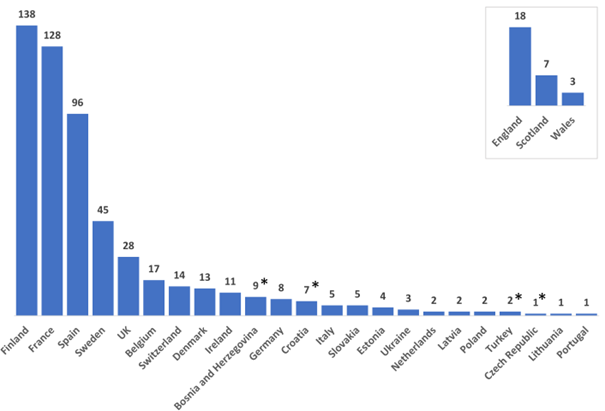
542 obstacles removed in 2024 in 23 countries – an increase of 11% on last year.
2900 km of rivers reconnected across the continent
4 countries have removed their first barriers

Those highlight the growing support for barrier removals across Europe as well as increasing understanding among communities and governments of the benefits of reconnecting and restoring our rivers for people and nature. These actions are helping to strengthen climate resilience, enhance water and food security, and reverse nature loss.


read the report

read press release


Figure 1. Number of removed barriers per country in 2024. Notes: the inset shows the removals per country in the UK. The countries that officially removed their first barriers in 2024 are marked with an asterisk (*)


Loire/Ardèche : Montpezat – Quo Vadis !

For several years now, SOS Loire Vivante-ERN has been successfully campaigning on the subject of the Montpezat hydroelectric complex and the potential renewal of the concession at the end of 2028.

This is a thorny issue, because behind the question of energy production (135 MW), we are actually talking about one of the largest transfers of water in Europe between the Loire and Ardèche basins, amounting to 80 – 300 Mio M3 /year.

In order to lay the foundations for the future concession and to share the various issues surrounding the management of the structure, a restricted inter-sage Loire amont / Ardèche working group, led by the Prefect of the Haute Loire, has been set up. The WG, in which SOS Loire Vivante -ERN is represented, will deliver its recommendations to the InterSAGE by the end of 2025.

In order to bring everyone up to the same level of knowledge, the first two meetings were devoted to hydroelectricity and the natural environment, and at the end of May the focus will be on uses. A mediator has been appointed for the following meetings. That is wise…

In the summer, SOS Loire Vivante – ERN will be inviting interested NGOs from the Loire and Ardèche basins to a visual seminar in order to take stock of the situation and crystallise the initial positions.

> more information about the Montpezat hydroelectric complex

Rhinau fish pass: work completed on schedule

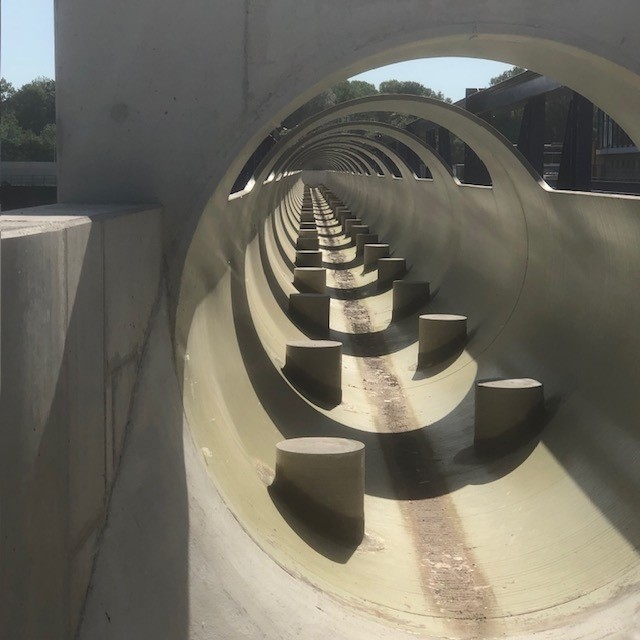
The impressive Rhinau fish pass on the Rhine will be put in the water next week for testing.
The deadline for completion of the work has been met.

A large-scale monitoring system will keep track of how the fish pass is used.

©Daniel Reininger – Alsace Nature

More info


Goldman Prize 2025 : Eco Albania rewarded for his work for the Vjosa

Since 1989, the Goldman Environmental Prize has been awarded to environmental “heroes” around the world. In Europe, and in the “fresh water” category, two Albanian activists from Eco Albania were rewarded for their defense of the Vjosa, one of the continent’s last wild rivers. Through their campaign, they succeeded in preventing the construction of multiple dams and in designating the Vjosa and several of its tributaries a national park.

In 1992, France and Loire Vivante also won an award for Christine Jean, who coordinated the national campaign to prevent the construction of dams on the Loire at Serre de la Fare, Le Veurdre and Chambonchard.

Plus d’infos

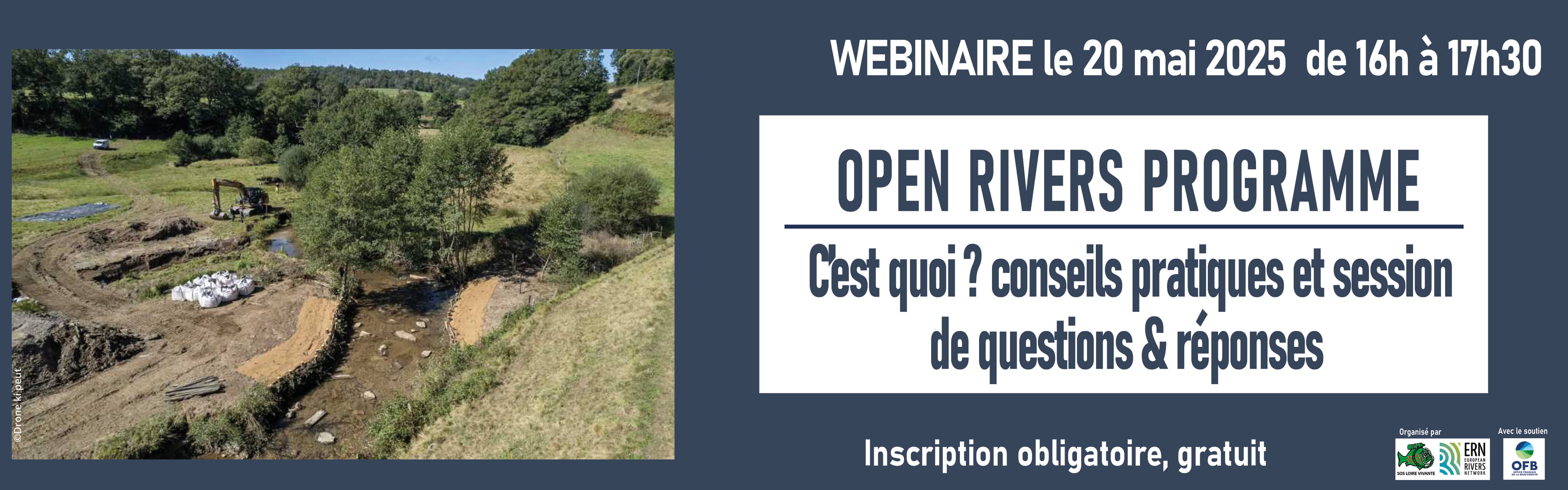
Tuesday, May 20 from 4 to 5:30 p.m.: ERN webinar “Learn more about the Open Rivers Programme” (in French).

The Open Rivers Programme continues to found barriers removal projects, preparatory studies and works. ERN – SOS Loire Vivante, can help and advise you if you wish to apply. To prepare the next call for projects, a webinar to present the program, eligibility criteria and ask your questions is organized on May 20 from 4 to 5:30 pm (in french). registration required.


Open Rivers Programme : Open Rivers Programme: Two new projects selected in partnership with ERN and SMDMCA

The Open Rivers Programme continues to support the restoration of river continuity in Europe.

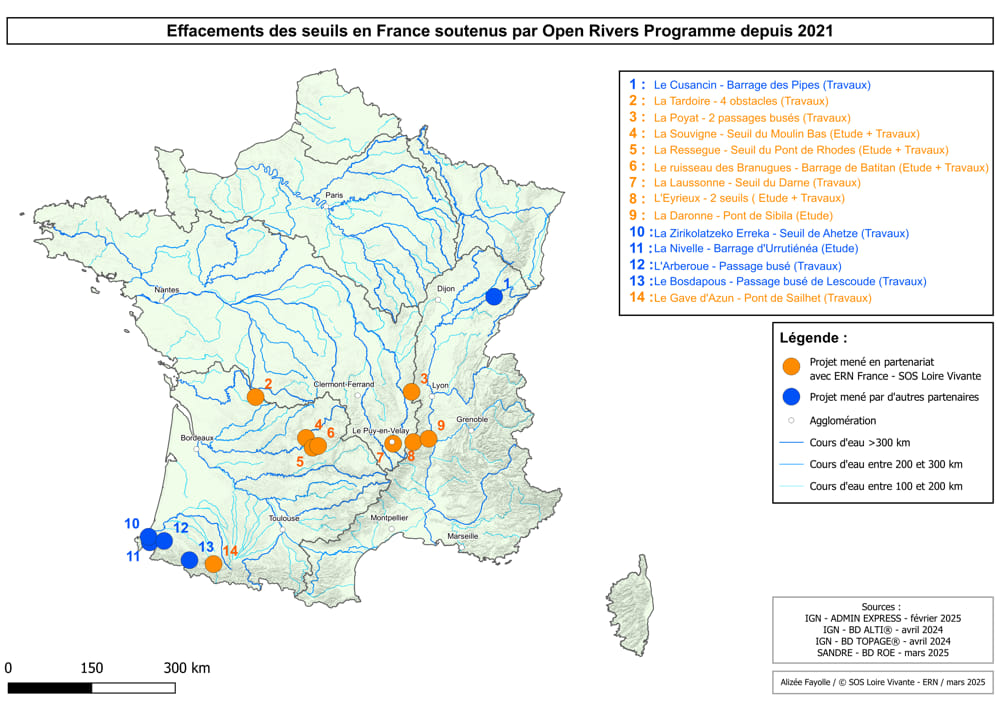
Two new projects, supported by ERN in partnership with SMDMCA, have just been selected in the Cantal region of France: the Batitan and Moulin Bas weirs.

This brings to 13 the number of projects (studies or works) in partnership with ERN and the Open Rivers Programme in France.


Seuil de Moulin Bas ©SMDMCA

The Moulin Bas project

The Moulin Bas weir is located on the Souvigne stream, a tributary of the Dordogne. This watercourse, classified in lists 1 and 2 (L.214-17 du CE) is of great ecological importance. In 2018, the Souvigne was home to 8.4% of the spawning grounds for large salmonids in the Dordogne basin, according to a study carried out by ECOGEA for MIGADO. The Moulin Bas weir is an obstacle to migratory fish. It will therefore be removed during the works scheduled for autumn 2025, opening up 15 km of river, or 83% of the Souvigne’s length. Read more

Seuil de Batitan ©SMDMCA

The Batitan project

The Batitan dam is located on the Branugues stream, a tributary of the Cère, in the Cantal department. The Branugues stream is home to numerous species, including fario trout and river lamprey. As with the Moulin Bas project, work will start in autumn 2025, opening up more than 8 km of stream, or 87% of the creek. By eliminating this obstacle, it will be possible to restore upstream spawning habitats and bolster the trout population already present in the stream. Read more 


Upcoming webinar

Ahead of the next Open Rivers Programme call for projects, ERN will be organizing a webinar to present the program and eligibility criteria. (to be confirmed – May 20, 2025 in frenche).


Dates of the next Open Rivers Programme calls for projects

Summer session 2025: from June 9 to July 4, 2025 (decision and start of projects from November 2025)
Autumn session 2025: from October 6 to October 31, 2025 (decision and start of projects from March 2026).

Find out more about these projects and the Open Rivers program:


Disparition de Philippe Auclerc et Laurent Roy : hommage

En ce début mars 2025, nous avons appris avec tristesse la disparition brutale de deux hommes passionnés et engagés pour les rivières : Philippe Auclerc, Rédacteur en chef pendant 25 ans de « La Loire et ses Terroirs » et de la lettre « Les Nouvelles du bassin de la Loire » et Laurent Roy, ancien Directeur de l’Eau et de la Biodiversité au Ministère de 2013 à 2015 et ancien Directeur de l’Agence de l’Eau Rhône Méditerranée Corse jusqu’en 2023. Notre association a eu la chance de travailler avec eux, ils ont souvent partagé les visions de notre association et leurs compétences ont fait avancer la cause des rivières.

Philippe Auclerc était un fin connaisseur du territoire ligérien et de ses acteurs. Son engagement pour la préservation de la Loire et de ses affluents était profond et sa plume était sincère et souvent aiguisés sur la description du jeu d’acteur et le sens de la gestion de l’Eau du bassin. Son travail a plusieurs fois croisé les actions de l’association SOS Loire Vivante, il est venu nous voir dès les débuts de notre combat dans les années 1990 et a encore récemment été le modérateur de notre dernier colloque « Des Saumons et des Hommes » à Brioude en 2023, un sujet qui l’animait fortement. À travers ses écrits, il a su sensibiliser un large public aux enjeux environnementaux et patrimoniaux de ce fleuve. La disparition de Philippe marque la fin d’une époque pour les passionnés de la Loire, c’était le seul encore aujourd’hui à informer de la vie du fleuve, avec un sens critique, de la source à l’estuaire. Nous espérons que son projet de relier les ligériens perdurent. Nos pensées vont à sa famille et ses proches.

Laurent Roy a également joué un rôle important en faveur des politiques de gestion de l’eau et de préservation de la biodiversité en France tout au long de sa carrière. Avec European Rivers Network nous avons pu le rencontrer plusieurs fois lorsqu’il était au Ministère et à l’Agence de l’Eau, notamment au sujet du rétablissement de la continuité écologique sur le Rhin ou en lien avec le projet du label « Sites Rivières Sauvages ». Homme de conviction, sa capacité à dialoguer et échanger de manière constructive en faisait une personnalité respectée dans le milieu. Nous présentons nos sincères condoléances à sa famille.

Living Rivers Europe publishes its position : Making Europe climate and water resilient

from wwf epo , 24 january

Europe stands at a critical juncture. As the fastest-warming continent, we are witnessing the devastating impacts of climate change – from deadly floods to severe droughts and wildfires – all driven by extreme water events. At the same time, Europe’s freshwater is widely polluted, with less than 30% of surface waters meeting pollution standards set by the Water Framework Directive. Time is running out, but decisive EU leadership can pave the way for a resilient future.

As the EU prepares its Water Resilience Strategy, the Living Rives Europe coalition is launching its joint position on the path forward for a water and climate resilient Europe.

Read the position here.

Fontgombault (in operation), Bénavent, Saint-Gaultier, Ruffec – the number of micro-power projects on the Creuse River continues to grow

At the end of October, the investigating commissioner issued a favorable opinion on the project to authorize the Moulin de Bénavent hydroelectric power station, brushing aside the five opinions of environmental protection associations, experts in the field of water and rivers. They had demonstrated that the project did not meet the challenges of restoring ecological continuity and migratory fish on a river classified as a priority axis and biological reservoir by the SDAGE and the national biodiversity strategy. Despite all the existing literature on the impact of weirs and received ideas, we can still read in the conclusions of the report that the structure “will protect the homes of towns and villages located downstream from the mill”!

Read the report of Bénavent public enquiry (french)

Read our views on the projects Bénavent, Saint- Gaultier (french)

New cycle of Tuesday Webinars: REGISTRATION OPEN

Public debate – also via videoconferencing and webinars

Register and take part in our next webinars. Already 3 new dates.

Programme details and registration here (in french only)

  • 26 novembre 2024 de 16h à 18h : « Saumon Loire Allier : où en est-on ?

  • 3 décembre 2024 : Les aménagements urbains de protection contre les inondations de Brives-Charensac à l’épreuve!

  • 21 janvier 2025 : La pollution microplastique sur le bassin de la Loire.