France: Biggest dam removal in European history started

Photo : Copyright Vincent M.


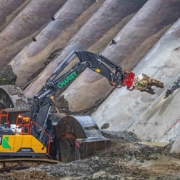
Sélune River, Normandy, France – In a historic moment for Europe’s rivers, the first, irreparable breach was made today in the 36 metre high Vezins Dam – kick-starting the biggest dam removal in Europe so far.

This landmark event is part of a long-term project to free the Sélune River, and bring salmon, eels and other wildlife back to the river and the famous bay of Mont-Saint-Michel – a UNESCO world heritage site and one of Europe’s prime tourist attractions.

Along the Sélune River in Normandy, the removal of two old, obsolete dams over the next two years – the Vezins and La Roche Qui Boit— will open up 90 km of river, improving water quality, allowing migratory salmon to return to their ancient spawning grounds and benefiting people and nature all along the river.

“The removal of the Vezins Dam signals a revolution in Europe’s attitude to its rivers: instead of building new dams, countries are rebuilding healthy rivers and bringing back biodiversity,” says Roberto Epple, president of European Rivers Network and 2018 Euronatur Award recipient. “Nature can recover remarkably quickly when dams are removed and I look forward to watching salmon swimming past Mont St Michel and spawning in the headwaters of the Sélune for the first time since my grandparents were young.”

Historically, the Sélune River was home to salmon that travelled from the river mouth, near Mont Saint Michel, upstream to mate and lay eggs. However, construction of these two dams stopped the salmon from migrating and this effectively stopped the recreational and commercial harvest of them as populations collapsed. The removal of these dams will help to bring more wildlife and biodiversity back to the river along with other recreational and touristic opportunities.

Artificial barriers (dams) are one of the biggest threats to river ecosystems, resulting in river fragmentation and loss of habitat connectivity. They stop the natural flow of sediments downstream and affect migratory fishes from travelling up- or downstream to complete their lifecycles. These impediments often lead to the decrease or decimation of native fish populations and can harbour other, non-native species in their adjacent impoundments. A new study in Naturerevealed just one-third of the world’s longest rivers remain free-flowing with river “fragmentation and flow regulation are the leading contributors to the loss of river connectivity.”

Globally, freshwater species populations have declined by 83% on average since 1970. The recently approved Intergovernmental Science-Policy Platform on Biodiversity and Ecosystem Services (IPBES) reportspecifically recommends conserving and restoring river connectivity to boost freshwater biodiversity. As prescribed by the Water Framework Directive (WFD), each of Europe’s rivers must attain a ‘good’ ecological status and yet 40% of rivers fall short. Removal of old, obsolete dams is a viable option to help reach WFD goals, reconnect and restore rivers and allow fish populations and other wildlife to return and flourish. In fact, many countries in Europe are now removing dams as the economic, environmental and social benefits of doing so far outweigh the alternative of restoring the dam.

It is estimated that over 3,500 barriers have been removed across Europe including the biggest dam removal in Spain last year and an ongoing historical river restoration project in Estonia that will remove 8-10 dam and open up 3,300km of river basin. Moreover, European citizens are also donating funds to see these barriers go as a part of a larger dam removal crowdfunding campaign.

“There are tens of thousands of old, obsolete dams in Europe that can and should be removed,” says Arjan Berkhuysen, managing director of the World Fish Migration Foundation.  “We are hopeful that by removing not only big dams like this but also by removing small barriers through local efforts we can restore these important life sources.”

The unique project will measure the effects of dam removal with ten-years worth of environmental data.

More information :  https://www.ern.org/en/selune-libre/

Dowload Press Release here

##

Notes for Editors:

Photographs of the dam and start of its removal are available here, please respect the copyrights.

Contact:
Roxanne Diaz, WFMF Communications Officer, Mob +31 (0) 6 18918786 Email: roxanne@fishmigration.org
Roberto Epple, Chairman ERN European Rivers Network / Friends of the Sélune, Mob. +33 6  08 62 12 67 , Email : roberto.epple@ern.org

Dam Removal Europe The Dam Removal Europe initiative aims to connect local dam removal projects, stakeholders and organizations to better highlight and disseminate the positive impacts dam removal provides for rivers. It is an initiative that allows relevant specialists share knowledge and inspire new visions for a free-flowing Europe. Dam Removal Europe better enables support and guidance for future dam removal projects under the umbrella of the European Dam Removal movement.

ERN European Rivers Network > www.ern.org  ERN is an NGO engaged in the preservation and sustainable management of water and rivers. ERN is based in France and is Freshwater-Partner of WWF France.
Success of last Dam Removal Europe seminar – 22- 23 May, Pärnu, Estonia

May 22nd and 23rd, in Pärnu, Estonia, was the “Let it Flow” seminar on dam removal in Europe. Organized by the Dam Removal Europe platform, the World Fish Migration Fundation and the Environment Agency of Estonia The opportunity was given to visit the restoration works on the Pärnu River, the country’s first salmonid river. Including […]

“Love Flows” : a beautiful film to involved people into the next World Fish Migration Day

Ce documentaire réalisé par Francisco Campos-Lopez (réalisateur primé) retrace les événements de la Journée mondiale des poissons migrateurs en 2018 et met en lumière l’impact des barrages et les personnes qui s’emploient à restaurer nos rivières. Ce film donne une voix à ces poissons migrateurs en montrant les actions : célébrations, connaissances, restauration que nous pouvons mettre en place pour les préserver.

En mars 2019, le film a été sélectionné pour le Festival du film environnemental de Washington DC.

Participez à la prochaine Journée Mondiale des Poissons Migrateurs le 16 mai 2020! L’objectif est d’organiser plus de 1000 événements locaux à travers le monde pour une résonance globale. Organisez un évènement, créons l’impact !!

Plus d’infos sur la Journée Mondiale des Poissons Migrateurs

Regarder, diffuser la video !

The prefect of Lot-et-Garonne orders the Caussade dam removal

No less than 5 court decisions, favorable to FNE and SEPANSO Aquitaine, as to the illegality of the project, had not prevented the Chamber of Agriculture of Lot-et-Garonne to build a dike 300 meters long by 12 meters high on the Caussade stream in order to create an artificial lake of 920 000 m3 for about 20 farmers.

But on May 2, the state took a decree obliging the Chamber of Agriculture to destroy the dam within 3 months and to restore the site under 18 months: restore the riverbed, wetlands, destroyed habitats many protected species; put in place compensation measures proportionate to the impacts of illegal work …. The decree also specifies that the Chamber of Agriculture must record 1 million euros corresponding to the dam removal works, with a penalty of 500 € per day within 3 months if the reservoir has not disappeared.

In a territory where the lack of water is regular, FNE denounced a racket of water and a project that did not respond to the challenges of climate change and sharing the resource. In its court decision, the court also pointed out that this project is incompatible with the Water Framework Directive and the SDAGE (Master Plan for Water Development and Management) of the Adour-Garonne basin and acknowledged the lack of contribution of the project to the adaptation of agricultural productions to climate change “.

This is a victory for the NGOs, who will monitor the application of the decree and rely on the authorities to enforce the rules.

Read FNR press release (in french)

Large scale dam removal: “Selune Valley Revival”- International conference – FIRST CALL

European Rivers Network, the French Agency for Biodiversity, the national french Federation for Fishing, Dam Removal Europe  and the INRA announce the international conference on dam removal and renaturation of the Sélune river, from 24th to 26 September, 2019 in Brittany and Normandy (Mont Saint Michel).

The Sélune, coastal river, considered as the 3rd river of France in “Salmon potential”, now renaturing, will be at the heart of the conference and presented with different points of view (ecological, territory project, research program). This summer, the Vezins dam (36m high) will be removed making this project the biggest dam removal project in Europe. These huge works – which will be followed by the removal in 2021 of the La Roche-qui-boit dam (16m high), will improve the quality of the water into the bay of Mont St Michel and restore ecological continuity for more than 70 km of Selune river. It is an opportunity for the territory to create value with this river renaturated. The project has an important scientific monitoring program since more than 6 years (sociological, geomorphological and biological) allowing knowledge of the valley, helping the implementation and evaluation of the project.

3 days of conference will present a global vision of the policy of restoration of continuity in France and in Europe by highlighting the successes and the failures, the means implemented, the challenges and stakes to integrate and the research programs. Cases studies from Europe and US on dam removal and territorial projects compatible with a free flowing river will be shown.

Registration and practical info  : www.ern.org/en/colloque-international-selune/

This event is part of the internationals seminars regularly organized by the Dam Removal Europe platform co-founded by ERN – the next event will take place on 22 and 23 May in Estonia – and give the chance in Europe, France and the Sélune Basin to share knowledge and experiences on dam removal and projects enable the re-appropriation of the river space.


“Artifishal” : Patagonia new documentary on rivers and future of wild fish

Patagonia’s new documentary “Artifishal” denounces intensive salmon farming in northern European aquaculture farms. It shows the consequences of these farms for our wild fish and our rivers.

Patagonia invite you to sign their online petition supported by North Atlantic Salmon Fund Iceland
Redd Villaksen – Norwegian Wild Salmon Alliance, Salmon and Trout Conservation Scotland, Salmon Watch Ireland to call on decision-makers to ban fish farms in Europe and restore habitats.

More info : www.patagonia.com/artifishal.html

A preview screening of the film is scheduled April 24 at 7:30 pm at the Maison des Métallos in Paris.

Watch trailer :


save the date : Next Dam Removal Workshops in Estonia and France

Save the date. Two news Dam Removal Workshops ;

– 22-23 May 2019 : Seminar in Estonia on the River Parnu
– Fall 2019 : Seminar in France on the Selune river


Eco-Masterplan shows value of Balkan Rivers (PR EuroNatur)

Post extract from the web site of Riverwatch

++ 80,000 kilometers of rivers in the Balkans scientifically assessed ++ 76 percent thereof identified as no-go zones for hydropower development ++ Switch in energy policy is necessary and possible ++

Vienna, Radolfzell, November 27, 2018 – Three quarters of the rivers in the Balkans are ecologically so valuable, that they should be completely off limits for hydropower development. This is the conclusion of the Eco-Masterplan, which was published today by the NGOs Riverwatch and EuroNatur within the context of the “Save the Blue Heart of Europe” campaign. The Eco-Master Plan is a kind of spatial plan for the watercourses between Slovenia and Greece, indicating No-go zones for new hydropower plants. For this purpose, a river network of over 80,000 kilometers in length was scientifically assessed. The result: about 61,000 kilometers of river (76 percent) are of high ecological quality and therefore designated as No-go zones for hydropower expansion (click here for visual story-map). “We call upon investors and decision-makers in the Balkans and in the EU to refrain from approving hydropower plants in these No-go areas in the future. The protection of Balkan Rivers is a pan-European task and the Eco-Masterplan is a tool for all those in charge in order to preserve this treasure,”… read the complet Pressrelease and download the report  

Rivernews France from November 2018 is published

Read the Rivernews France November 2018 (french only)

Contents :

Notre Directive-Cadre sur l’Eau est menacée !

Continuité écologique : Pays-Bas 1 / France 0

Le Prix EuroNatur 2018 attribué à …

La Métropole du Grand Paris adopte le Big Jump !

Effacement sur la Sélune, Abaissement sur l’Allier

L’Eau vous consulte : Donnez votre avis !

En bref…


Netherlands : Gateway to the Rhine open for salmon

Photo Guy Warzée

November the 15 the Netherlands were celebrating the opening of the storm surge barrier on the Haringvliet, exactly 47 years after the Haringvliet sluices were rendered operative. That is where one of the three branches of the Rhine flows out into the North Sea. Until now, the storm surge barrier was a major obstacle to the passage of salmon and sea trout into the Rhine delta. Its partial opening greatly increases the chance that salmon and other “long distance migratory fish” will gain access to the Rhine catchment area. In addition, letting in saline water will improve the biodiversity of Haringvliet water.

Because of the drought that has affected the Netherlands over the past few months and the low river discharge, the sluices still remain closed on 15 November, only the decree has been officially adopted. They will from now operate in a fish friendly way in a “learning by doing” approach. As soon as sufficient fresh river water is entering into the Haringvliet Lake they partially open the sluices (maybe this week). If too much saline water is entering, the sluices will be closed. 

The partial opening of the Haringvliet barriers has figured on the long list of measures advocated by environmental associations and the International Commission for the Protection of the Rhine (ICPR) for decades. Tenacity and commitment to conservation of nature and the environment has been effective.

Now the Rhine goes open until France and Rhinau hydropower plant. But France and EDF are still making no real progress with the construction of fish ladders at their 3 hydropower plants to enabling migratory fish to make their way up the Upper Rhine at long last. More than ever, effort has to be continued and it is up to France to respond to the great challenges on the Upper Rhine.   

The lack of action on the part of EDF might lead to a situation in which the statutory requirements of the EU Water Framework Directive (WFD) are missed by a wide margin.  

The environmental associations in the Rhine catchment area have therefore registered an appeal seeking to oblige the EU Commission to open proceedings against the French Republic for breach of treaty obligations because of failure to comply with the WFD. We hope that France will at last put this topic on the top of his priority list !! 

 More info :

Read more : www.salmoncomeback.org and last press release from salmon comeback