Improve the hydropower complex of Montpezat
Concession end in December 2028
The Montpezat hydroelectric complex: an ingenious infrastructure
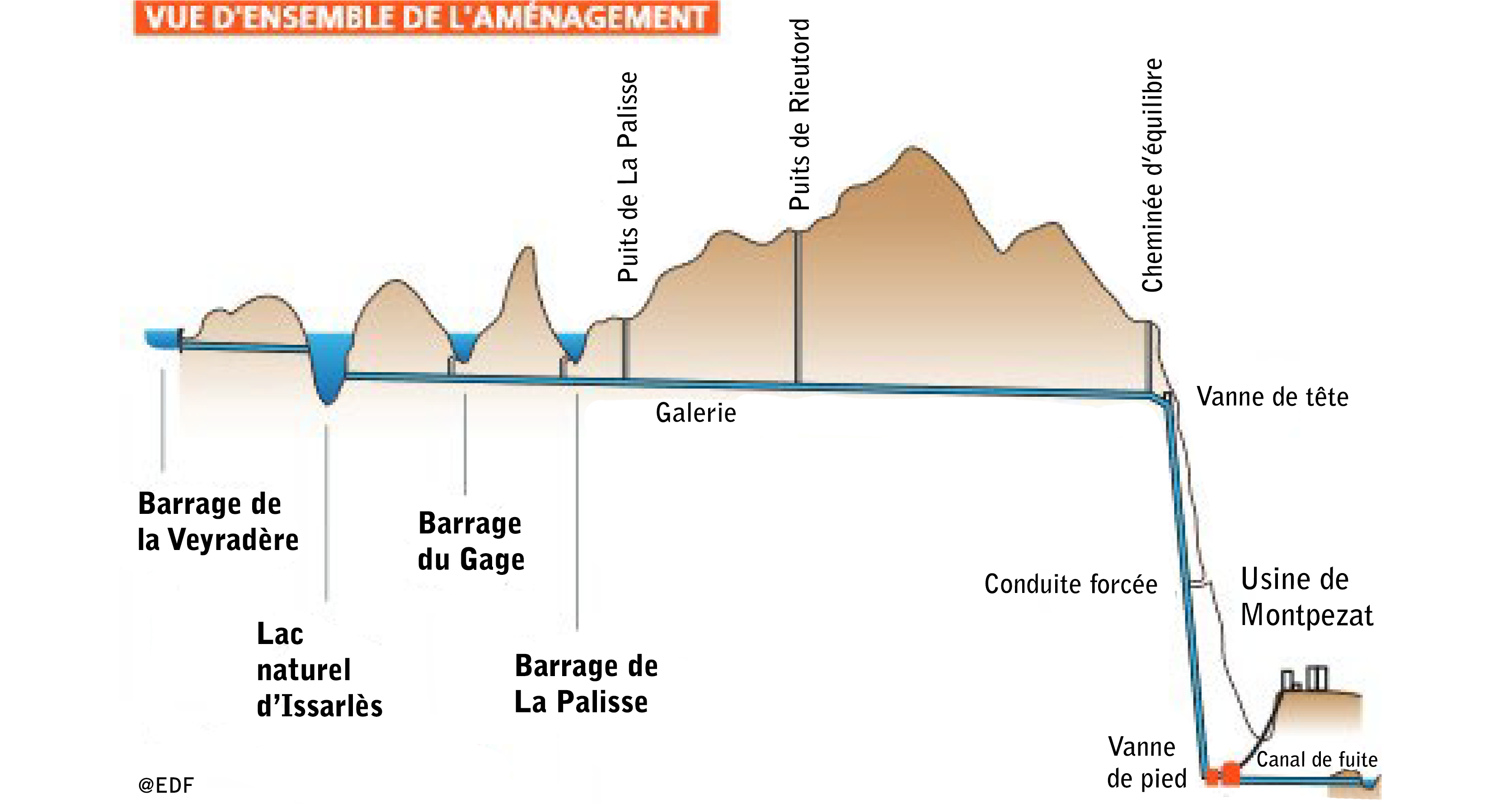
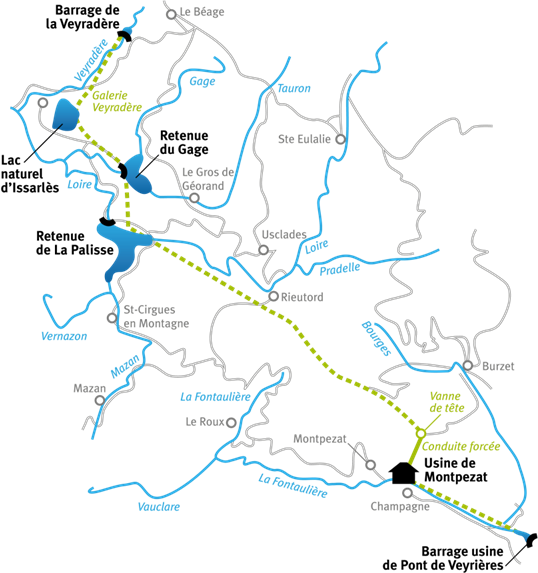
After the war, numerous hydroelectric power plants were built in France, including Montpezat in the Ardèche region from 1947 to 1954. Classified as strategic, Montpezat generates high-quality energy, providing peak power to meet immediate needs (150 MW) and ensuring the security of the Cruas nuclear power plant on the Rhône River. Each year, an average of 220 million (Mio) cubic meters of water (with annual variations ranging from 80 Mio cubic meters to as much as 345 Mio cubic meters) from the Loire River and its major tributaries is collected and stored in three reservoirs as well as in the natural crater lake at Issarlès, and then sent through a 25-kilometer tunnel to the Ardèche watershed. The long 636-meter drop through penstocks allows the water to be turbined at the Montpezat underground power plant. The water is then channeled through a canal to a regulating dam, before joining the Fontaulière River, which flows into the Ardèche. This is a large-scale interbasin water transfer, unique in Europe. more information on the functioning and the structures that make up the Montpezat complex
A “New Montpezat” for a better water sharing !
Following the “Nouveau Poutès” project, SOS Loire Vivante – ERN France is now working in the Haute-Loire on the Montpezat hydroelectric complex, a true postwar feat of engineering designed to address the energy crisis of that era.
The guiding principle behind this project was to divert the high flows of the Loire and its tributaries toward the Ardèche River, located downstream, in order to generate a large head of water and produce electricity on demand. Thus, originally, the complex was managed to optimize energy production. Then, in the 1990s, low-flow support for the Ardèche and the Loire was taken into consideration.
Three-step management :
– March 7 through June 14: This is the filling period : water is collected and stored, and normally no electricity is produced during this period.
– From June 15 to September 15: This is the period during which the reservoirs are used for low-flow support (mandatory): As a general rule, on the Ardèche side, this begins almost immediately in mid-June (8.4 Mio m³ on average), and on the Loire side, it begins in late July/early August (with successive increases from 0.5 Mio m³ between 1988 and 2014 to 2 Mio m³ since 2022). The total volume available for low-flow support is fixed at around 12 Mio m³. However,this does not take into account the usable volume of Lake Issarlès, which must maintain its “natural” level until September 15 (for tourism purposes).
– From September 16 to March 6: this is the run-of-river period during which peak electricity is generated for a few hours each day. Reservoir volumes are utilized, as is all the fall and winter precipitation flowing into the structures, with a required minimum flow of 0.4 m³/s for the Loire River.
The problem: Water is transferred from the Loire River watershed (Atlantic Ocean) to the Fontaulière, a tributary of the Ardèche (Mediterranean Sea), and even though a small amount is returned to the Loire during the summer, the river clearly lacks water.
The impacts are well-documented and numerous (disruption of ecological continuity due to dams, reduced sediment transport, fewer morphogenic floods, and decreased flow in the Loire).
Over the past thirty years, the annual flow at Pont de la Borie (in the municipality of Lac d’Issarlès) is -80%, and -33% near the town of Chadrac (at the confluence with the Borne River, 2 km from Le
Puy-en-Velay). On the one hand, this transferred water is beneficial for the Ardèche as the river suffers from low water levels during the summer. However, the increased levels have encouraged significant new uses, particularly for agriculture and tourism.
Envisioning the New Montpezat: The end of the concession in 2028 will be an opportunity to rethink everything. There is little time left to consider what kind of future we want for this facility. The CLE of the Haute-Loire SAGE has announced its intention to launch a study on optimizing the complex. Optimization alone is not enough; we must go further and seek alternatives to the current management model for the complex. Thus, a reconfiguration of the facility (pumping station, wastewater treatment plant, or other) should not be ruled out. It must address the new challenges posed by climate change and reduce its ecological impact on ecosystems—particularly on the Loire River—while ensuring a fair and balanced distribution of water between the Ardèche and Haute-Loire departments. This requires a democratic debate both at the local level (notably through the SAGEs and the InterSage Loire Amont/Ardèche) with strong civil society involvement, and at the national level in relation to energy needs (as a strategic facility).
Thus, the “new Montpezat” could be a flagship project that better benefits the headwaters region and fits into a broad and coherent framework for the UNESCO biosphere across the Loire-Ardèche-Allier “water tower.” In this context, SOS Loire Vivante has been organizing tours and webinars, and also citizen mobilisation to protect the upper part of th Loire River Basin.
Questions and Topics for Discussion
The expiration of the Montpezat concession provides an opportunity to raise awareness about the issues surrounding the Montpezat complex, reestablish dialogue among stakeholders, share visions and needs, prioritize them in light of regional challenges, the needs of natural ecosystems, and trends and changes in the climate and energy landscape, and answer a key question: What will be the primary purpose of the Montpezat facility in the future: low-flow support, water sharing, or electricity generation?
The Equitable Distribution of Water Resources
At a time when water resources are becoming increasingly scarce, the question of how to allocate them among different uses is becoming ever more pressing. Solidarity between river basins can be exercised in a fair and sustainable manner if the issues at stake are in the public interest: is it fair that the various users of the Loire River basin should make efforts to conserve water when half the flow is diverted for electricity generation and for tourism in the Ardèche Gorges? This question must be addressed during negotiations between the Upper Loire and Ardèche Local Water Commissions.
Hydropower: Renewable but Not Green!
People often equate green energy with renewable energy. However, renewable energy is not necessarily environmentally friendly. Large hydropower facilities have serious repercussions on the river’s ecosystem, as well as on its flora and fauna:
Disappearance of small and medium-sized floods: Small and medium-sized floods play a fundamental role in the life of the river by creating highly rich ecosystems, supplying water to adjacent wetlands, and moving riverbed stones. The diversion of water causes these natural floods to disappear from the Loire and alters the habitats necessary for biodiversity.
A diminished Loire: A large portion of the Loire’s water is diverted. At Le Puy-en-Velay, 60 kilometers from its source, the Loire is missing about half of its flow each year. The consequences are numerous: warming waters, the decline of certain species—particularly fish—and habitats drying up… In the summer, the flow is reduced to the minimum necessary for the river’s survival!


At a glance
– Commissioning: 1954
– Average annual production: 310 GWh (Montpezat and Pont-de-Veyrières combined)
– Installed capacity : 150 MW
– On average, 220 million (Mio) cubic meters of water are transferred each year, with annual variations ranging from 80 Mio cubic meters to as much as 345 Mio cubic meters
Presentation of the complex, EDF 2016 video (french)
Download
Cette page est mise à jour par SOS Loire Vivante – ERN France.
>> retourner sur le site web exclusivement consacré à nos actions sur la Loire (SOS Loire Vivante)
>> rester sur le site web des actions nationales et internationales de l’association (ERN)