Tag Archive for: montpezat

Montpezat – Drought: SOS LV alert


Photo de la Loire à Brives Charensac

The River Loire at Brives Charensac, with an estimated flow rate of 2.0–2.5 m³/s at midday on 19 September 2026, a few days after the start of the gradual reduction in low-water support.
It will fall further…


Face à des débits inférieurs au minimum réglementaire sur la Loire à Chadrac (43), près du Puy-en-Velay, SOS Loire Vivante interpelle officiellement le Préfet de la Haute‑Loire.

Le 15 septembre, EDF a repris le turbinage à Montpezat et dérive encore plus d’eau du haut bassin de la Loire vers l’Ardèche. A cette date, et jusqu’au 15 juin 2027, s’arrête l’obligation du maintien du débit minimal de la Loire au Pont de La Borie à 1m3/s. A savoir que durant une partie de  l’été la Loire a profité  d’un soutien d’étiage de environ  0,4 –  0,5m3/s en provenance des barrages de la Palisse et du Gage.

Le niveau de la  jeune Loire, affaibli et en stress hydrique, va donc encore baisser et des précipitations ne sont pas en vue. Pour exemple, à Brives Charensac le débit de la Loire se réduira de 30 – 35 %.

Nos demandes urgentes :

–   Appliquer au plus vite le décalage/prolongation de la période d’étiage jusqu’au 15 octobre au moins (option validée par les SAGE Loire Amont et Ardèche) afin de garantir au moins le débit minimal biologique de 0,8m3/s  au Pont de La Borie ce qui correspond à environ 1 Million m3 pour 30 jours. Au regard des réserves stockées cela  est possible sans mettre en question le soutien d’étiage coté Ardèche. La perte de production d’électricité ne dépassera pas 0,5 % de la production annuelle.

– Relance formelle des échanges inter‑SAGE (Groupe de travail) pour repenser le futur fonctionnement du ‘Nouveau Montpezat’ en intégrant les nouveaux enjeux dans le contexte du changement climatique. L’actuelle concession expire fin 2028.

La gestion durable de la ressource en eau impose d’anticiper les évolutions à venir plutôt que de les subir. » La qualité des milieux aquatiques ne peut pas être la variable d’ajustement.

> Lire la Lettre adressée au Préfet
> les articles des journaux et un reportage FR3 Auvergne suite à notre conférence de presse du 17 septembre seront en ligne sur notre site dès publication.

> Mieux connaitre Montpezat

Webinar on July 16 at 5:30 p.m.: France: Is There Still Water Governance?

Interview and Q&A with Thierry Burlot, President of the Loire-Bretagne River Basin Committee

In a rapidly changing context, is our water governance system still effective? What role and influence do the PTGE, SAGE, InterSAGE, and River Basin Committees play in policy-making? Do these bodies facilitate calm and informed decision-making? How should public debate be organized in light of changing water uses? , or citizens’ conventions? …

Are additional forums for debate needed in the case of major water transfers between river basins, such as the Montpezat water transfer between the Loire and the Ardèche?

Organized with the support of the OFB. This webinar contributes to the initiatives of the Waterways Resource Center

REGISTRATION (frenche only)


Loire/Ardèche : Montpezat – Quo Vadis !

For several years now, SOS Loire Vivante-ERN has been successfully campaigning on the subject of the Montpezat hydroelectric complex and the potential renewal of the concession at the end of 2028.

This is a thorny issue, because behind the question of energy production (135 MW), we are actually talking about one of the largest transfers of water in Europe between the Loire and Ardèche basins, amounting to 80 – 300 Mio M3 /year.

In order to lay the foundations for the future concession and to share the various issues surrounding the management of the structure, a restricted inter-sage Loire amont / Ardèche working group, led by the Prefect of the Haute Loire, has been set up. The WG, in which SOS Loire Vivante -ERN is represented, will deliver its recommendations to the InterSAGE by the end of 2025.

In order to bring everyone up to the same level of knowledge, the first two meetings were devoted to hydroelectricity and the natural environment, and at the end of May the focus will be on uses. A mediator has been appointed for the following meetings. That is wise…

In the summer, SOS Loire Vivante – ERN will be inviting interested NGOs from the Loire and Ardèche basins to a visual seminar in order to take stock of the situation and crystallise the initial positions.

> more information about the Montpezat hydroelectric complex

A special Montpezat rivernews has just been published!

Our latest Rivernews december / january 2024  is devoted entirely to the Montpezat hydroelectric complex and provides an update on the volumes stored and transferred in 2023. Allg figures are to be confirmed during January 2024 and will be updated if necessary on our dedicated webpages.

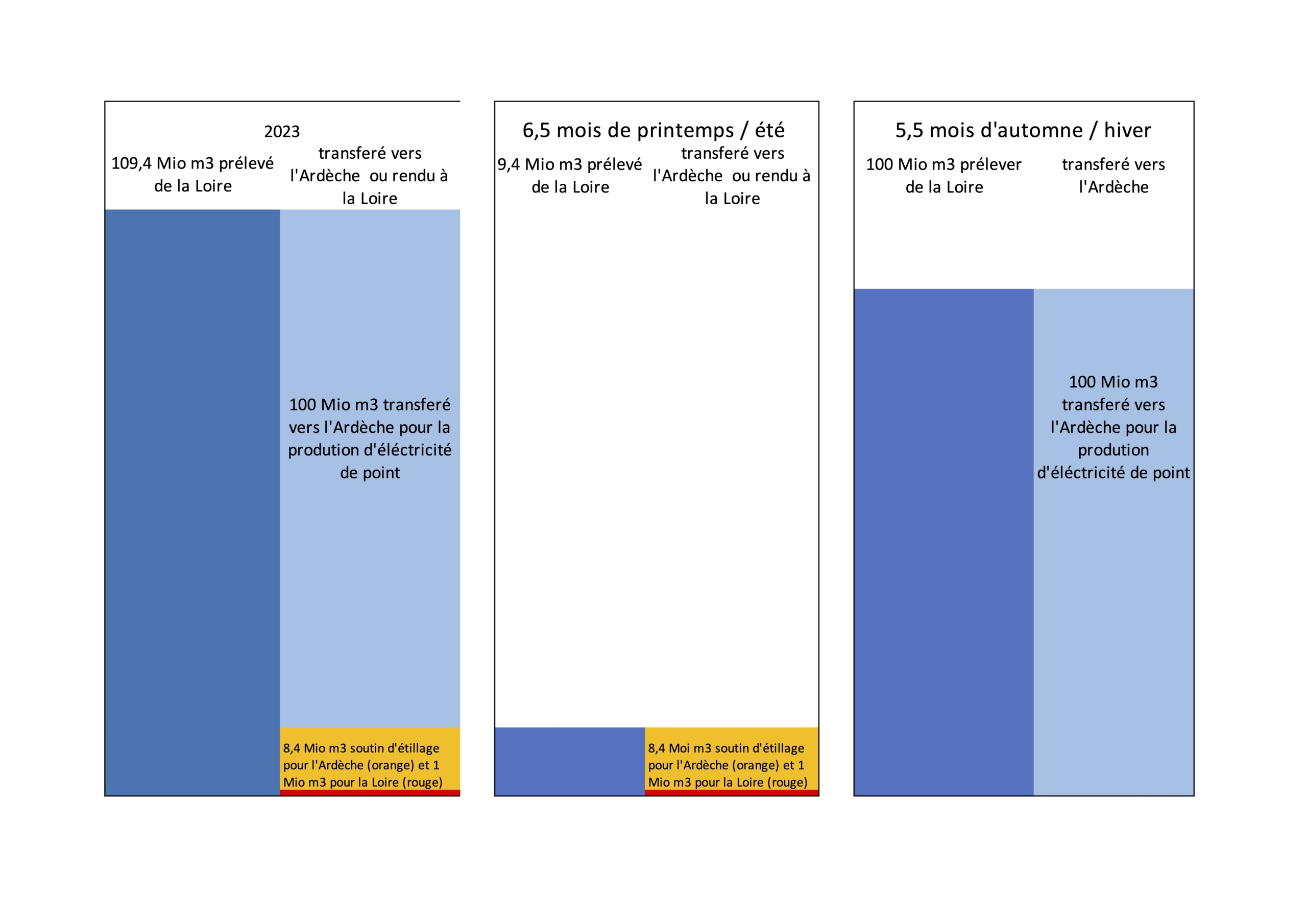
In 2023, 108.4 million m3 were transferred to the Ardèche (compared with 220 million m3 in the “best” years). Most of this, 100 Mio m3, was taken from the Loire in autumn and transferred in winter for peak electricity production. The significant drop in rainfall in autumn/winter resulted in a 50% reduction in winter turbines compared with the past. In spring, 9.4 Moi m3 were stored in the reservoirs on the Loire side and used to support the low-water levels of the Ardèche (8.4 Moi m3) and the Loire (1 Moi m3), in line with the low-water support objectives. The year 2023 had got off to a bad start, however, and it seemed impossible to fill the reservoirs at the La Palisse, Gage and Issarlès dams, but the weather came to the complex’s rescue in the last few weeks, just before the summer period, which means that the Issarlès lake must remain open to tourists.

See also our other articles:

  • Raising the La Palisse dam: good idea or bad idea?
  • Immersion at the Citizens’ March for equitable water sharing between the Loire and Ardèche rivers
  • Children send us a message: Some of the winners of the 2022-2023 edition of Rivière d’Images et Fleuves de Mots, environmental education project

Read our newsletter (in french only)


Figures for 2023
Volumes stored and transferred to the Ardèche or returned to the Loire